The Universe Unfurled: Measuring Distances Without Leaving the Couch

The Universe Unfurled: Measuring Distances Without Leaving the Couch
Gazing at the night sky, it’s hard to grasp the unimaginable vastness. Stars twinkle billions of light-years away, galaxies swirl in the cosmic dance, and yet, we know their distances with surprising precision. How? Unlike interstellar travellers hurtling through space, we rely on ingenious methods for unraveling the universe’s cosmic map.

Imagine holding a fingernail at arm’s length, that’s roughly the scale of Earth compared to our nearest star, Proxima Centauri. For such close neighbors, we employ a trick called parallax. By observing Proxima from opposite sides of Earth’s orbit, we witness a tiny shift in its position. This shift, like the difference in two photos taken from slightly different angles, reveals its distance.

But what about objects beyond our galactic doorstep? Enter the cosmic distance ladder, a series of rungs, each calibrated against the previous one. Pulsating stars called Cepheids act as our first rung. Their predictable brightness variations betray their intrinsic luminosity, allowing us to calculate their distance even in distant galaxies.
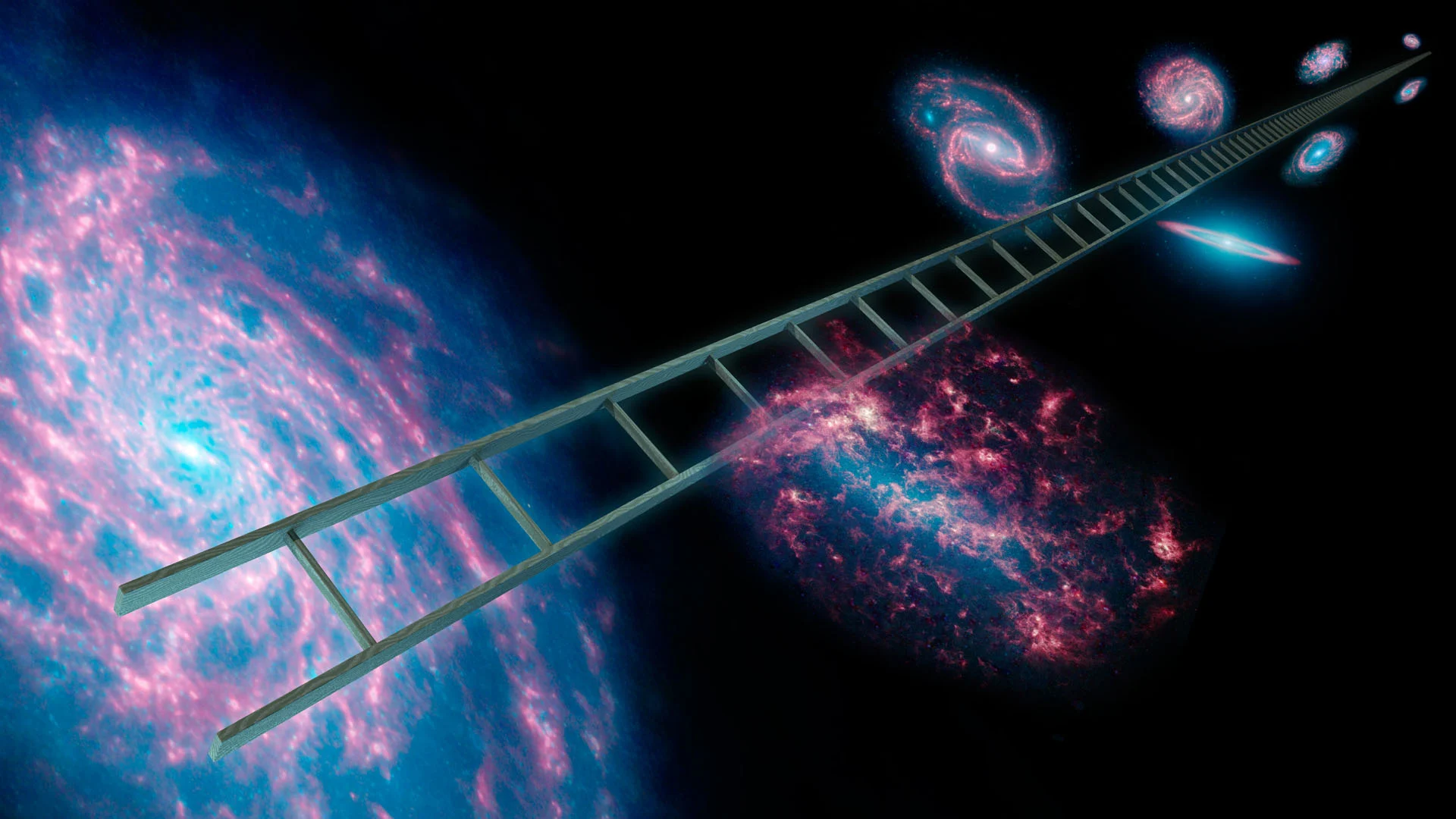
Think of these pulsating stars as cosmic lighthouses, their flashes signaling distance. But as with lighthouses, their visibility fades with distance. For far-flung galaxies, we turn to cosmic explosions called supernovae. These brilliant flares, though rare, provide a temporary cosmic yardstick, their peak brightness revealing their cosmic address.

The ladder reaches its final rungs with a concept called redshift. Galaxies moving away from us stretch the light they emit, making it appear “redder.” This stretching, like the Doppler effect for sound, tells us how fast they’re receding, and thanks to Hubble’s Law, we know their speed is directly proportional to their distance.

Each rung of the ladder builds upon the last, allowing us to climb ever deeper into the cosmos. It’s a bit like measuring the height of a skyscraper by first measuring the height of a door, then comparing it to the number of doors stacked on top.

So, while human probes may not yet roam the Milky Way’s outskirts, our minds, armed with scientific ingenuity, can travel billions of light-years. We map the universe’s expanse, not with footprints, but with the subtle whispers of light and the grand explosions of distant stars. Next time you gaze at the night sky, remember, you’re holding a cosmic map in your mind’s eye, a testament to the boundless human thirst for knowledge, even when confined to our earthly couch.


Tagged : / / /

The 7 Hardest Degree Courses In The World! Want To Pursue?

The 7 Hardest Degree Courses In The World! Want To Pursue?
Higher education can open up a world of opportunities, but some degrees are more challenging than others. If you’re looking for a degree that will push you to your limits and reward you with a deep understanding of your chosen field, consider one of the hardest degrees in the world.

Here is a list of the 7 hardest degrees in the world :

1. Theoretical physics
Theoretical physics is the study of the fundamental laws of the universe. It is a highly complex and challenging field that requires a strong foundation in mathematics and physics. Theoretical physicists use mathematics and physics to develop new theories about the universe and to solve complex problems in physics. Theoretical physicists often deal with concepts that are difficult to visualize or understand. They must be able to think abstractly and reason logically to solve problems.

2. Neurosurgery
Neurosurgery is a branch of medicine that specializes in the diagnosis and treatment of disorders of the nervous system, including the brain and spine. Neurosurgeons must have a deep understanding of the anatomy and physiology of the nervous system, as well as the skills to perform delicate surgery on the brain and spine. The nervous system is made up of billions of nerve cells and their connections, and it is responsible for controlling all of our bodily functions, including thought, movement, and sensation. Neurosurgeons must have a deep understanding of this complex system in order to safely and effectively diagnose and treat disorders of the nervous system. Neurosurgeons must be able to perform delicate surgery on the brain and spine, which are two of the most sensitive organs in the body. A small mistake during neurosurgery can have serious and even life-threatening consequences.

3. Linguistics
Linguistics is the scientific study of language. It is a broad field that encompasses many different areas, including phonetics, phonology, morphology, syntax, semantics, and pragmatics. Linguists must have a strong foundation in mathematics and logic, as well as a deep understanding of human language. One of the things that makes linguistics so difficult is the complexity of human language. There are over 7,000 different languages spoken in the world, and each language has its own unique grammar and vocabulary. Linguists must be able to understand and analyze the different features of different languages.

4. Quantum computing
Quantum computing is a new and emerging field of computer science that uses the principles of quantum mechanics to perform calculations. Quantum computing has the potential to revolutionize many different fields, including medicine, materials science, and finance. One of the things that makes quantum computing so difficult is the complexity of the subject matter. Quantum mechanics is a complex and challenging field of physics. Quantum computer scientists must have a strong foundation in quantum mechanics and computer science. Another challenge that quantum computer scientists face is the lack of hardware and software. Quantum computers are still in their early stages of development, and there is a shortage of both hardware and software for quantum computing. Quantum computer scientists must be able to develop new and innovative hardware and software solutions to overcome these challenges.

5. Theoretical Mathematics
Theoretical mathematics is the study of abstract mathematical concepts and theories. It is a highly challenging field that requires a strong foundation in mathematics and logic. Theoretical mathematicians must be able to think critically and solve complex problems. One of the things that makes theoretical mathematics so difficult is the abstract nature of the subject matter. Theoretical mathematicians often deal with concepts that are difficult to visualize or understand. They must be able to think abstractly and reason logically to solve problems.

6. Astronautical engineering
Astronautical engineering is the study of the design, construction, and operation of spacecraft and other spacecraft-related systems. It is a highly demanding field that requires a strong foundation in mathematics, physics, and engineering. Astronautical engineers must also have a broad understanding of space science and astronomy. One of the things that makes astronautical engineering so difficult is the complexity of the spacecraft that astronautical engineers design. Spacecraft are complex systems that must be able to withstand the harsh conditions of space. Astronautical engineers must take into account a wide range of factors when designing a spacecraft, including the mission objectives, the environment, and the budget. Another challenge that astronautical engineers face is the need to be innovative. The field of astronautical engineering is constantly evolving, and astronautical engineers must be able to develop new technologies and solutions to meet the demands of the space industry.


7. Architecture
Architecture is the art and science of designing and building buildings and other structures. It is a highly demanding field that requires a strong foundation in mathematics, physics, and engineering. Architects must also have a creative vision and be able to think outside the box. One of the things that makes architecture so difficult is the complexity of the projects that architects work on. Buildings are complex systems that must be both functional and aesthetically pleasing. Architects must take into account a wide range of factors when designing a building, including the climate, the site, and the needs of the users. Another challenge that architects face is the need to stay up-to-date on the latest technologies and materials. The field of architecture is constantly evolving, and architects must be able to adapt to new trends and developments.

So which one of these do you want to pursue??

Tagged : / / / /

The Big Bang Theory Of The Universe And The Mysteries Associated With It!

The Big Bang Theory Of The Universe And The Mysteries Associated With It!
The Big Bang Theory is the prevailing cosmological model for the observable universe from the earliest known periods through its subsequent large-scale evolution. The model accounts for the fact that the universe expanded from a very high density and high temperature state, and offers a comprehensive explanation for a broad range of phenomena, including the abundance of light elements, the cosmic microwave background (CMB) radiation, large-scale structure, and Hubble’s law.

While the Big Bang Theory is widely accepted, there are still some mysteries that remain unsolved. Here are a few of the biggest mysteries of the Big Bang:

1. What happened before the Big Bang?

The Big Bang Theory describes the evolution of the universe from a very hot and dense state to the present day. However, it does not explain what caused the Big Bang to happen in the first place. Some scientists believe that the universe has always existed in some form, and that the Big Bang was simply a transition from one state to another. Others believe that the universe was created out of nothing in a single event.

2. What is dark matter?

Dark matter is a mysterious substance that makes up about 85% of the matter in the universe. It is invisible to telescopes, but its presence can be inferred from its gravitational effects on visible matter. Scientists still do not know what dark matter is made of, or how it formed.

3. What is dark energy?

Dark energy is an even more mysterious substance than dark matter. It is thought to be responsible for the accelerating expansion of the universe. Scientists know even less about dark energy than they do about dark matter.

4. What happened to the antimatter?

When matter and antimatter come into contact, they annihilate each other. However, the universe is made up mostly of matter, with very little antimatter. Scientists do not know why there is so much more matter than antimatter in the universe.

5. Are there other universes?

Some scientists believe that our universe is just one of many in a multiverse. A multiverse is a collection of universes, each with its own physical laws and constants. There is no direct evidence for a multiverse, but some scientists believe that it is the best way to explain some of the mysteries of our own universe.

These are just a few of the many mysteries of the Big Bang Theory. As scientists continue to study the universe, they hope to solve these mysteries and gain a better understanding of our cosmic origins.

Conclusion
The Big Bang Theory is a remarkable scientific achievement that has helped us to understand the universe in a whole new way. However, there are still many mysteries that remain unsolved. Scientists are working hard to solve these mysteries, and we can expect to learn even more about the Big Bang in the years to come.

Tagged : / / / /

NASA’s Dragonfly Mission : Why is NASA Sending Dragonfly To Saturn’s Moon Titan?

NASA’s Dragonfly Mission : Why is NASA Sending Dragonfly To Saturn’s Moon Titan?
NASA’s Dragonfly mission is a planned robotic exploration of Saturn’s moon Titan. Scheduled to launch in 2027 and arrive in 2034, Dragonfly will be the first rotorcraft to fly on another world. It will use its eight propellers to fly over Titan’s icy surface, exploring multiple sites and collecting data on the moon’s geology, atmosphere, and habitability.

Titan is one of the most intriguing moons in the Solar System. It has a dense atmosphere, lakes of methane and ethane, and a subsurface ocean of liquid water. Scientists believe that Titan may be a good place to look for evidence of prebiotic chemistry, the chemical processes that lead to the formation of life.

Dragonfly’s primary goals are to:

1. Study Titan’s habitability and potential for life. Dragonfly will search for organic molecules and other signs of life in Titan’s atmosphere and surface materials. It will also study the moon’s methane cycle, which may be similar to the water cycle on Earth.

2. Investigate Titan’s prebiotic chemistry. Dragonfly will study the chemical reactions that occur in Titan’s atmosphere and surface materials. This information will help scientists to understand how organic molecules form and evolve on Titan, and to compare Titan’s chemistry to that of early Earth.

3. Explore Titan’s diverse geological landscape. Dragonfly will visit multiple sites on Titan, including lakes, rivers, dunes, and impact craters. This will help scientists to understand the moon’s geological history and to identify potential landing sites for future missions.

Dragonfly will be equipped with a variety of scientific instruments, including a mass spectrometer, a camera, and an infrared spectrometer. These instruments will allow Dragonfly to collect detailed data on Titan’s atmosphere, surface, and subsurface.

NASA is sending Dragonfly to Titan because it is one of the most promising places in the Solar System to look for evidence of life beyond Earth. Titan’s dense atmosphere, lakes of liquid hydrocarbons, and subsurface ocean make it a unique and fascinating world. Dragonfly’s mission will help scientists to better understand Titan’s habitability and potential for life.

Why is Dragonfly a rotorcraft?

Dragonfly is a rotorcraft because it is the most efficient way to explore Titan’s surface. Titan’s atmosphere is thick and heavy, making it difficult for traditional aircraft to fly. However, Dragonfly’s propellers will allow it to lift off and land vertically, and to navigate through Titan’s terrain.

Dragonfly will also be able to fly over Titan’s lakes and rivers, which would be impossible for a traditional aircraft. This will allow Dragonfly to explore a wider range of sites and to collect data on Titan’s methane cycle.

What are the challenges of the Dragonfly mission?

The Dragonfly mission is a challenging one, due to the distance to Titan and the harsh environment of the moon. Dragonfly will have to travel over 800 million miles (1.3 billion kilometers) to reach Titan, and it will have to operate in temperatures as low as -292 degrees Fahrenheit (-180 degrees Celsius).

Dragonfly will also have to power itself using nuclear energy, since solar energy is not practical on Titan. This is the first time that a nuclear-powered spacecraft will be sent to another world.

Despite the challenges, the Dragonfly mission is a promising one. If successful, it will provide scientists with new insights into Titan’s habitability and potential for life.

Tagged : / / /

Project Primrose: Adobe’s High-Tech Interactive Fashion Project Dress That Changes Shapes And Designs

Project Primrose: Adobe’s High-Tech Interactive Fashion Project Dress That Changes Shapes And Designs
Adobe’s Project Primrose is a high-tech fashion project that has the potential to revolutionize the way we think about clothing. The project is a collaboration between Adobe’s Creative Technologies Lab and fashion designer Christine Dierk. The result is a dress that can change its shapes and designs in seconds.

The dress is made from a flexible textile display that is covered in tiny scale-like modules. Each module can change color and pattern independently, allowing the dress to create an infinite variety of designs. The dress is also equipped with sensors that allow it to respond to movement and touch. This means that the dress can change its design as the wearer moves and interacts with the world around them.

Project Primrose is still in the early stages of development, but it has the potential to change the way we think about fashion. The dress could be used to create clothing that is both stylish and functional. For example, the dress could be used to create clothing that can change color to match the wearer’s surroundings or clothing that can provide feedback on the wearer’s fitness level.

Here are some of the potential applications of Adobe’s Project Primrose:

1. Fashion: The dress could be used to create high-fashion clothing that is both stylish and unique. The dress could also be used to create clothing that can change its design to match the wearer’s mood or the occasion.

2. Entertainment: The dress could be used to create costumes for performers and entertainers. The dress could also be used to create interactive experiences for audiences.

3. Sports and fitness: The dress could be used to create sportswear that can provide feedback on the wearer’s performance or clothing that can help to improve the wearer’s performance.

4. Medicine: The dress could be used to create medical garments that can monitor the wearer’s health or clothing that can deliver medication.

Adobe’s Project Primrose is an exciting new development in the world of fashion technology. The dress has the potential to revolutionize the way we think about clothing and to create new and innovative ways to express ourselves.

Here are some additional thoughts on the potential impact of Adobe’s Project Primrose:

Personalization: The dress could be used to create clothing that is truly personalized to the wearer. For example, the wearer could choose their own designs and patterns for the dress. The dress could also be used to create clothing that can adapt to the wearer’s individual needs.

Sustainability: The dress could be used to create clothing that is more sustainable. For example, the dress could be made from recycled materials or materials that are biodegradable. The dress could also be used to create clothing that can be worn for longer periods of time.

Accessibility: The dress could be used to create clothing that is more accessible to people with disabilities. For example, the dress could be designed to be easy to put on and take off for people with limited mobility. The dress could also be designed to provide feedback to people who are blind or visually impaired.

Adobe’s Project Primrose is a still in the early stages of development, but it has the potential to have a major impact on the world of fashion and beyond. The dress could be used to create clothing that is more stylish, functional, sustainable, and accessible.

Tagged : / / /

Psyche Mission : NASA To Launch Mission To An Asteroid Worth All The Gold On The Earth!

Psyche Mission : NASA To Launch Mission To An Asteroid Worth All The Gold On The Earth!
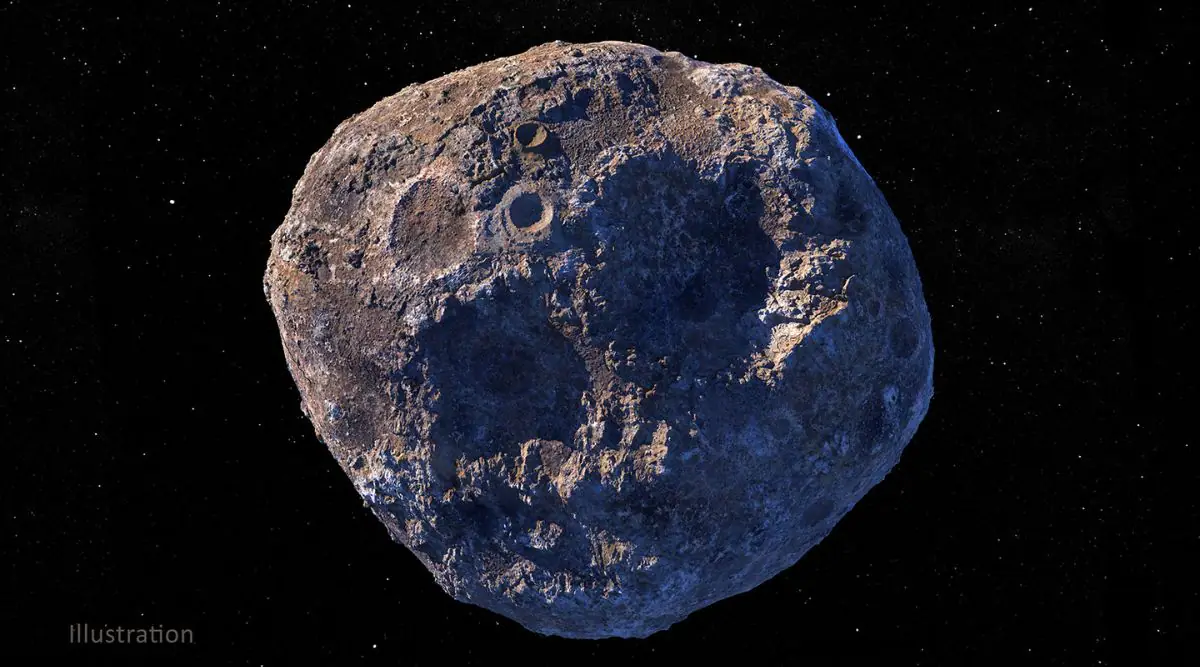
NASA is preparing to launch a mission to an asteroid worth more than all the gold on Earth. The asteroid, called Psyche, is located in the asteroid belt between Mars and Jupiter. It is thought to be made up of mostly iron and nickel, with a smaller amount of gold and other precious metals.

The Psyche mission is scheduled to launch on October 12, 2023. The spacecraft will travel to the asteroid and orbit it for two years. During that time, it will use a variety of instruments to study the asteroid’s composition, shape, and magnetic field.

Scientists are excited to study Psyche because it is thought to be the exposed core of a protoplanet, or a planet that never fully formed. By studying Psyche, scientists hope to learn more about how planets form and evolve.

The Psyche mission is also of interest to the mining industry. The asteroid is estimated to be worth $10 quintillion, which is more than the total value of all the gold that has ever been mined on Earth. However, it is still unclear whether it will be possible to mine Psyche in a cost-effective way.

The Psyche mission is a complex and ambitious undertaking. However, it has the potential to revolutionize our understanding of the solar system and to open up new possibilities for space mining.

What will the Psyche mission do?

The Psyche mission will use a variety of instruments to study the asteroid, including:

  • A magnetometer to measure the asteroid’s magnetic field
  • A gamma ray and neutron spectrometer to measure the asteroid’s composition
  • An infrared imaging spectrometer to map the asteroid’s surface temperature and mineralogy
  • A multispectral imager to take high-resolution images of the asteroid’s surface
  • The Psyche mission will also use solar electric propulsion, a type of propulsion that uses solar energy to power the spacecraft. This type of propulsion is very efficient, but it is also very slow. As a result, the Psyche mission will take four years to reach the asteroid.

What do scientists hope to learn from the Psyche mission?

Scientists are hoping to learn a lot about Psyche and about the formation of planets from the Psyche mission. Some of the questions that scientists hope to answer include:

What is Psyche’s composition?
How did Psyche form?
Does Psyche have a magnetic field?
Is Psyche the exposed core of a protoplanet?
What can Psyche teach us about the formation and evolution of planets?
The Psyche mission is a very exciting mission with the potential to revolutionize our understanding of the solar system.

What are the implications of the Psyche mission for space mining?

The Psyche mission is also of interest to the mining industry. The asteroid is estimated to be worth $10 quintillion, which is more than the total value of all the gold that has ever been mined on Earth. However, it is still unclear whether it will be possible to mine Psyche in a cost-effective way.

There are a number of challenges that would need to be overcome in order to mine Psyche. One challenge is the distance to the asteroid. Psyche is located in the asteroid belt, which is between Mars and Jupiter. This means that it is very far from Earth, which would make mining it very expensive.

Another challenge is the asteroid’s composition. Psyche is thought to be made up of mostly iron and nickel, with a smaller amount of gold and other precious metals. This means that the asteroid would need to be processed in order to extract the valuable metals. This processing would also be very expensive.

Despite the challenges, the Psyche mission is a sign that space mining is becoming a reality. As technology continues to improve, it is possible that we will be able to mine Psyche and other asteroids in the future.

Tagged : / / / / / /

Aditya L1 Updates : India’s Aditya L1 spacecraft crosses key milestone on journey to solar center

Aditya L1 Updates : India’s Aditya L1 spacecraft crosses key milestone on journey to solar center
India’s Aditya L1 spacecraft has crossed a key milestone on its journey to the center of the solar system, escaping the sphere of Earth’s influence, the Indian Space Research Organisation (ISRO) said Saturday.

The Aditya L1 mission, which started its four-month journey towards the center of the solar system on September 2, carries instruments to observe the sun’s outermost layers.

“The spacecraft has escaped the sphere of Earth’s influence,” ISRO said in a statement late Saturday.

Aditya, named after the Hindu sun deity, has traveled 920,000 kilometers (570,000 miles), just over half the journey’s total distance.

Once it reaches its final destination, a halo orbit around the first Lagrangian point (L1) between the Earth and the Sun, Aditya L1 will begin a year-long mission to study the Sun.

The Aditya L1 mission is a significant milestone for India’s space program. It is the first Indian mission to study the Sun, and it is one of the most ambitious solar missions ever undertaken.

The data collected by Aditya L1 will help scientists to better understand the Sun’s structure and dynamics, and it will also help to develop new technologies to protect satellites and astronauts from harmful radiation from the Sun.

The Aditya L1 mission is expected to reach its final destination in January 2024.

Significance of the Aditya L1 mission

The Aditya L1 mission is a significant milestone for India’s space program and for solar science as a whole. The mission will provide new insights into the Sun’s structure and dynamics, and it will help to improve our understanding of space weather.

The data collected by Aditya L1 will also help to develop new technologies to protect satellites and astronauts from harmful radiation from the Sun.

Tagged : / / / / / /

James Webb Space Telescope Spots Thousands of Milky Way-Like Galaxies in the Early Universe

James Webb Space Telescope Spots Thousands of Milky Way-Like Galaxies in the Early Universe
The James Webb Space Telescope (JWST) has made another incredible discovery, this time spotting thousands of Milky Way-like galaxies in the early universe. This discovery challenges our current understanding of how galaxies form and evolve.

The galaxies were found in a new image of the distant universe taken by JWST’s Near-Infrared Camera (NIRCam). The image shows a patch of sky that is only about one-twelfth the size of the full moon, but it is packed with thousands of galaxies.

Many of the galaxies in the image are spiral galaxies, similar to our own Milky Way galaxy. However, some of the galaxies are also elliptical galaxies, which are much rarer in the early universe.

The discovery of these galaxies is significant because it suggests that galaxies formed much earlier than previously thought. The galaxies in the image are so distant that their light has taken billions of years to reach us. This means that they were formed when the universe was just a few billion years old.

The discovery of these galaxies also challenges our current understanding of how galaxies form. According to the current theory, galaxies form slowly over time as smaller galaxies merge together. However, the discovery of so many Milky Way-like galaxies in the early universe suggests that galaxies can form much more quickly.

Astronomers are still trying to understand what this discovery means for our understanding of galaxy formation. However, it is clear that the JWST is revolutionizing our understanding of the early universe.

Here are some of the implications of this discovery:

  • It suggests that galaxies formed much earlier than previously thought.
  • It challenges our current understanding of how galaxies form.
  • It suggests that the early universe was much more crowded with galaxies than we thought.
  • It raises the possibility that there are many more galaxies in the universe than we previously thought.
  • This discovery is just the beginning. The JWST is expected to make many more groundbreaking discoveries in the years to come.
Tagged : / / / / /

Dark Photons: Could They Explain One of the Universe’s Greatest Mysteries?

Dark Photons: Could They Explain One of the Universe’s Greatest Mysteries?
Dark matter is one of the greatest mysteries of the universe. It makes up about 85% of the matter in the universe, but we don’t know what it is. Dark matter doesn’t interact with light, so we can’t see it directly. But we know it’s there because of its gravitational effects on visible matter.

One possible explanation for dark matter is that it’s made up of dark photons. Dark photons are hypothetical particles that are similar to photons, the particles of light, but they interact with ordinary matter much more weakly.

Dark photons could have been created in the early universe, when the universe was much hotter and denser. As the universe expanded and cooled, the dark photons would have become trapped in dark matter halos, which are large clouds of dark matter that surround galaxies.

Dark photons could explain a number of the observed properties of dark matter. For example, they could explain why dark matter doesn’t interact with light and why it’s so evenly distributed throughout the universe.

Scientists are searching for dark photons in a number of ways. One way is to look for them in particle accelerators. Another way is to look for them in the cosmic microwave background radiation, which is the leftover light from the Big Bang.

If dark photons are discovered, it would be a major breakthrough in our understanding of dark matter and the universe as a whole.

Here are some of the potential benefits of discovering dark photons:

1. A better understanding of dark matter: Dark photons could provide a new way to study dark matter and learn more about its properties.

2. A new window into the early universe: Dark photons could help us to understand how the universe formed and evolved in the early stages of its existence.

3. A new way to search for other dark matter candidates: If dark photons are discovered, they could help us to search for other dark matter candidates, such as weakly interacting massive particles (WIMPs).

The discovery of dark photons would be a major milestone in physics and cosmology. It would help us to better understand the universe and our place in it.

Here are some of the challenges of searching for dark photons:

  • Dark photons are very weakly interacting particles: This makes them very difficult to detect.
  • There are many different types of dark matter candidates: This makes it difficult to know which type of dark matter to search for.
  • Particle accelerators and other detectors are not very sensitive to dark photons: This makes it difficult to find dark photons, even if they exist.

    Despite the challenges, scientists are optimistic that dark photons will be discovered one day. The discovery of dark photons would be a major breakthrough in our understanding of the universe.

Tagged : / / / / /

Google develops new AI tool capable of predicting harmful genetic mutations

Google develops new AI tool capable of predicting harmful genetic mutations
Google has developed a new artificial intelligence (AI) tool that can predict whether genetic mutations are likely to be harmful. The tool, called AlphaMissense, could revolutionize the diagnosis and treatment of genetic diseases.

AlphaMissense works by analyzing the sequence of a gene and comparing it to a database of known mutations. The tool can then predict whether a new mutation is likely to cause a disease, and how severe the disease is likely to be.

In a recent study, AlphaMissense was able to predict the harmful effects of genetic mutations with 90% accuracy. This is a significant improvement over current methods, which are only able to predict the harmfulness of mutations with about 70% accuracy.

The development of AlphaMissense is a major breakthrough in the field of genetic medicine. The tool could help scientists to better understand the causes of genetic diseases, and to develop more effective treatments.

Potential benefits of AlphaMissense

AlphaMissense has the potential to revolutionize the diagnosis and treatment of genetic diseases. Here are some of the potential benefits of the tool:

1. More accurate diagnosis: AlphaMissense can help doctors to more accurately diagnose genetic diseases. This is because the tool can predict the harmful effects of mutations with 90% accuracy.

2. Earlier diagnosis: AlphaMissense can help doctors to diagnose genetic diseases earlier. This is because the tool can be used to screen for mutations in newborns, even before the child shows any symptoms of a disease.

3. More personalized treatment: AlphaMissense can help doctors to develop more personalized treatments for genetic diseases. This is because the tool can predict the severity of a disease based on the specific mutation that is present.

4. New drug development: AlphaMissense can help scientists to develop new drugs for genetic diseases. This is because the tool can be used to identify genes that are involved in causing diseases.

Challenges and limitations

While AlphaMissense is a powerful new tool, there are still some challenges and limitations that need to be addressed. One challenge is that the tool is still under development. This means that it is not yet perfect, and it may not be able to accurately predict the harmful effects of all mutations.

Another challenge is that AlphaMissense is a complex tool that requires a lot of data and computing power to run. This means that it may not be accessible to all doctors and hospitals.

Finally, AlphaMissense is only able to predict the harmful effects of mutations. It cannot be used to diagnose or treat diseases. This means that doctors will still need to use other methods to diagnose and treat diseases, even if they have access to AlphaMissense.

The development of AlphaMissense is a major breakthrough in the field of genetic medicine. The tool has the potential to revolutionize the diagnosis and treatment of genetic diseases. However, there are still some challenges and limitations that need to be addressed before the tool can be widely used.

Overall, AlphaMissense is a promising new tool that has the potential to make a significant impact on the lives of people with genetic diseases.

Tagged : / / /

Earth-like Planet Discovered Within Our Solar System

Earth-like Planet Discovered Within Our Solar System
Japanese researchers may have discovered evidence that points to the existence of another planet in our solar system that is analogous to Earth.

Patryk Sofia Lykawka of Kindai University in Osaka and Takashi Ito of the National Astronomical Observatory of Japan in Tokyo said in their study that was published in the Astronomical Journal, “It’s possible that a body of a primordial planet can survive in the far Kuiper Belt as a KBP, as so many bodies existed early in the solar system.” Their findings were based on the fact that so many bodies existed in the early stages of the solar system.

Interstellar objects such as dwarf planets, asteroids, carbon masses, and ice volatile substances like methane and ammonia call the Kuiper Belt, which is located just beyond the orbit of Neptune and surrounds the Sun like everything else in our solar system, home. The Kuiper Belt may be found just beyond Neptune’s orbit.

The research group noted in their report, “We predict the existence of an Earth-like planet and several trans-Neptunian objects on peculiar orbits in the outer solar system which can serve as observationally testable signatures of the putative planet’s perturbations,” The researchers believe that the new planet might be anywhere from 200 to 500 astronomical units away from the Sun, and that it could be anywhere from 1.5 to 3 times the size of Earth.

They also mentioned the ways in which their proposed planet varies from the planet referred to in earlier forecasts as “Planet Nine.” According to the earlier forecasts, “Planet Nine” was going to be considerably more large and located in an orbit that was far further away.

According to what was stated by the researchers, “in conclusion, the results of the Kuiper Belt planet scenario provide support for the existence of a yet-to-be-discovered planet in the far outer reaches of the Solar System.” Finding planets that are analogous to Earth is a crucial element of the field of astronomy, and the idea that these planets might contain conditions that are suitable for the existence of life is a significant contribution to our understanding of the possibilities of livable habitats beyond the confines of our own planet.

Tagged : / / / /

India’s Chandrayaan 3 Mission: A Countdown to History

India’s Chandrayaan 3 Mission: A Countdown to History
The countdown is on for India’s Chandrayaan 3 mission, which is scheduled to launch at 2.35 pm today ( Friday, July 14th 2023). The mission will attempt to soft-land a lander and rover on the lunar surface, and will also conduct a number of scientific experiments. Chandrayaan 3 is the third lunar mission by the Indian Space Research Organisation (ISRO), and is a follow-on to the Chandrayaan-1 and Chandrayaan-2 missions. The lander and rover on Chandrayaan 3 are similar to those used on Chandrayaan-2, but the mission will not have an orbiter.

The main objectives of Chandrayaan 3 are to:

1 Demonstrate safe and soft landing on the lunar surface.
2 Demonstrate rover roving on the moon.
3 Conduct in-situ scientific experiments.

The lander on Chandrayaan 3 is called Vikram, and the rover is called Pragyan. Vikram is equipped with a number of scientific instruments, including a camera, a magnetometer, and a seismometer. Pragyan is a robotic rover that will be able to travel up to 500 meters on the lunar surface.

The scientific experiments that will be conducted on Chandrayaan 3 will focus on the study of the moon’s surface, its composition, and its history. The mission will also look for signs of water on the moon. The launch of Chandrayaan 3 is a major milestone for India’s space program, and it is expected to make a significant contribution to our understanding of the moon. The mission is also a testament to the growing technological capabilities of India, and it is sure to inspire future generations of scientists and engineers.

The Launch

The Chandrayaan 3 mission is scheduled to launch on Friday, July 14, at 2:35 p.m. IST from the Satish Dhawan Space Centre in Sriharikota, India. The launch will be broadcast live on ISRO’s website and YouTube channel.

The mission will use a GSLV Mark 3 (LVM 3) heavy lift launch vehicle to place the lander and rover into orbit around the moon. The lander and rover will then separate from the launch vehicle and descend to the lunar surface.

The landing is scheduled to take place on August 23 or 24. If the landing is successful, Chandrayaan 3 will be the first Indian mission to soft-land on the moon since Chandrayaan-2 in 2019. In the Chndrayaan -2 mission Chandrayaan-2 spacecraft inserted into lunar orbit and then on September 2, 2019; Vikram Lander was separated while orbiting the moon in a 100kms lunar polar orbit, however, communication from the lander to the ground stations was lost at an altitude of 2.1 km from the surface of the moon.

The Significance of the Mission

The Chandrayaan 3 mission is a significant milestone for India’s space program. It is the third lunar mission by ISRO, and it is the first mission to attempt a soft-landing on the moon since Chandrayaan-2. The success of Chandrayaan 3 would be a major achievement for India, and it would boost the country’s reputation as a spacefaring nation. The mission would also help to advance our understanding of the moon, and it could lead to future missions to explore the lunar surface.

The Future of Space Exploration

The Chandrayaan 3 mission is a stepping stone to future space exploration missions. If the mission is successful, it could pave the way for future Indian missions to the moon, such as a human mission.The mission could also help to inspire future generations of scientists and engineers to pursue careers in space exploration. The success of Chandrayaan 3 would show that India is a leading nation in space exploration, and it would encourage other countries to pursue their own space exploration programs.

Conclusion

The Chandrayaan 3 mission is a major milestone for India’s space program, and it is sure to have a significant impact on the future of space exploration. The success of the mission would be a major achievement for India, and it would boost the country’s reputation as a spacefaring nation. The mission would also help to advance our understanding of the moon, and it could lead to future missions to explore the lunar surface.

Tagged : / / / / / /
Verified by ExactMetrics