This magic pot converts salt water to fresh drinkable water at a very low cost

Resources of fresh water are limited on earth. Most of the dry and arid areas do not have any access to fresh water resources. Fresh water is available only in the form of surface water from rivers or lakes. Even the underground water resources are so limited that extraction of water from the ground water table is giving brackish water. The need for additional fresh water supplies is a constant endeavor. Almost 98 percent of water available on earth is the oceanic salty water and 1.5 % is locked up in glaciers and ice caps. Almost less than 0.5 % is available for drinking purpose.

eliodomestico-solar-still-gabriele-diamanti-ariannuova-infographic

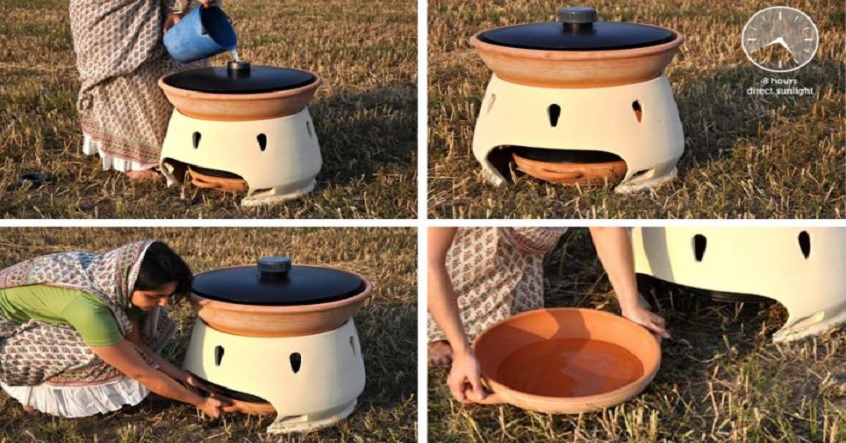
Water scarcity is a reality and in many areas of the world, people are dying of thirst. To combat the growing water scarcity and to make drinking water available to the rural population, an amazingly simple device was designed by Gabriele Diamanti to convert the salt water to normal water. This device, the Eliodomestico is extremely simple to use and easy to operate. This machine uses solar energy and heat to convert salt water to potable water. Moreover it does not need any electrical or solar power or any other external source to function

This device is easy to carry and can be taken to any place and set up. It does not require much space and can be placed on open barren areas in front of the house or nearby in any open space. The unit as such is made of three parts. The top part in which the salt water is poured. The central part where conversion of the salty water takes place. And finally the bottom part which comprises of a basin where fresh water can be collected. As throughout the year, water from seas and lakes evaporate and form clouds and cooling of the same gives rain, similar concept is used for this device.

The salt water or the dirty and brackish water is poured into the top black portion of the Eliodomestico. Leave the machine in the open and exposed to sunlight. The water evaporates and using a pressure pie, the steam or vapor generated is transferred to another compartment. In this compartment, vapor cools down and forms fresh water which is then collected in the basin part of the device. This fresh water can be used for drinking and other purpose.
Next Page For More

Tagged : /

E-sailing cuts space travel time by two third and makes return journey from Mars possible!

Deep space travel is an engineering feat. Not only does it require a lot of precision but patience too. Those who are mislead by the movie represented ideas of space travel should know the fact that unlike the movies, deep space travel is extremely slow because the outer regions of the Solar System take decades to reach.

NASA-Begins-Testing-of-Revolutionary-E-Sail-Technology2

Did you know that Voyager 1 took over 30 years to reach the interstellar space? 30 years? Isn’t this a very long time? And a lot can be done if a way could be found to cut short the time spent on travel time because then this time could be utilised for further research and study on the same project. Considering all these things, scientists at NASA’s Marshall Flight Centre in Huntsville, Alabama are testing a new technology that could cut that time by two thirds.

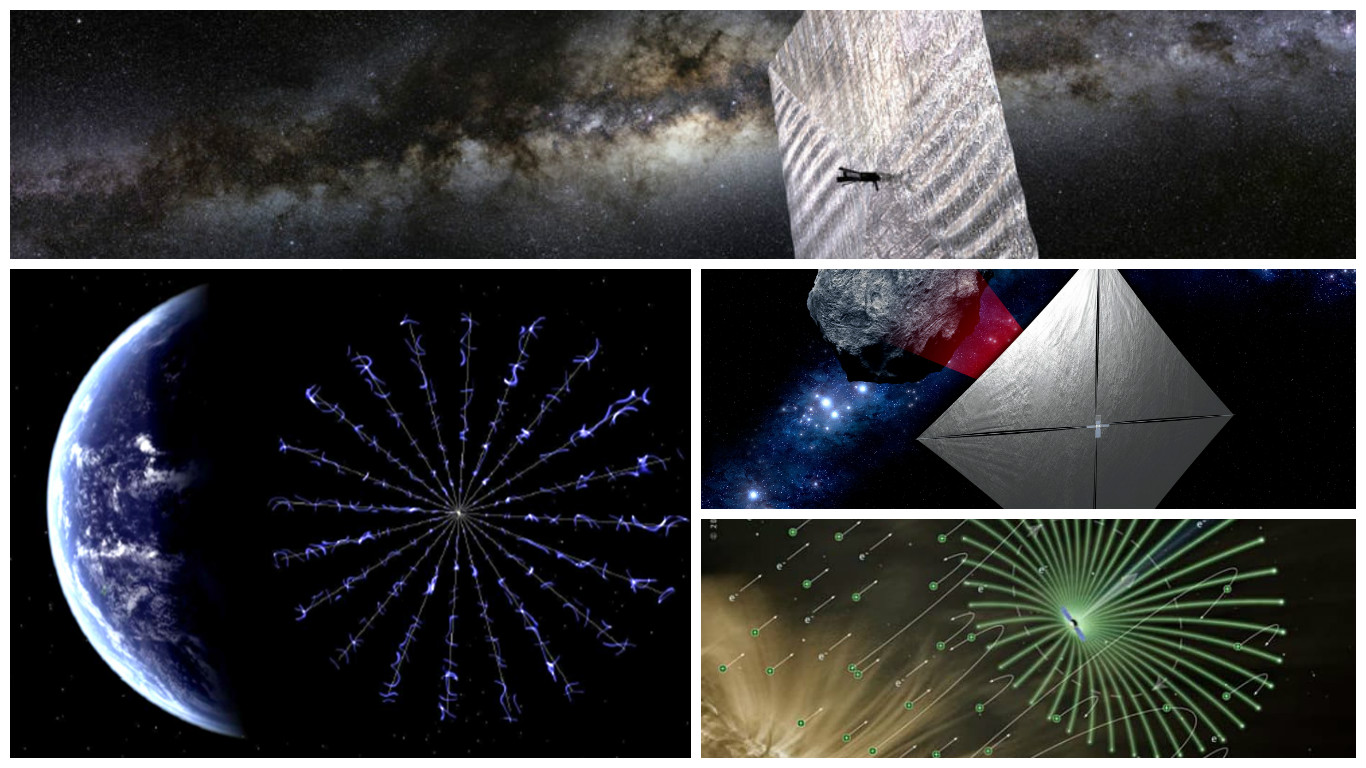
The new technology is based on a novel concept called the Heliopause Electrostatic Rapid Transit System (HERTS) or E-sail. It is a new form of propellant-less propulsion that relies on a series of wires to catch the solar winds. The scientists claim that the new technology can reduce the travel time from Earth to the heliopause about 123 AU (18 billion km, 11 billion mi) from the Sun- to less than 10 years.  The E-sail concept consists of a small unmanned payload that contains instruments and a power source.

Next Page For More

Tagged : /

Waiting impatiently! Where are all those aliens?

Who can forget the lovable, affable character of ET from Steven Spielberg’s classic movie E.T- The Extra-terrestrial and the bond it shares with the kids? That movie moved one and all and made everyone feel for the otherworldly creatures if they exist. “Do you believe in aliens?” is as ancient a question as “do you believe in ghosts?” There are billions of planets in our Milky Way and our Earth is just the size of the tip of a needle in the whole Universe. So it is natural that we can’t be alone in this whole universe; there have to be other beings like us somewhere in a far far world! But where and how far? The answer to this question according to a new paper is: the galactic centre! And the study also assumes that those alien friends are far more ancient than us humans.

200170-predator-006

There was a time when we didn’t even know about the planet we lived on. But now as time progressed and technology with it, we became capable enough to peep around in the space around our planet and make assumptions about the life beyond us. Now we know that our planet is not the only one, our sun is not the only one and there are thousand such worlds as ours. Mike Gowanlock, a post-doctoral researcher at MIT’s Haystack Observatory, said: “It’s only been recently with Kepler that we’ve learned there are small, Earth-sized planets around a range of stars.” But since earth is the only planet we know that has life as of now, we will have to start alien hunting with certain assumptions. If we consider our planet as a good prototype for planets with life then the basic requirements list will include a star of a certain brightness and metallicity, a healthy dose of evolutionary time and a relatively disaster-free cosmic environment. We can call these areas as “Galactic Habitable Zones” but where is the probability of finding such zones?

2921588-Hot_Toys_Scar_Predator

To answer this question, Gowanlock and his colleagues used computer simulations to construct the first ever “habitability heat map” of the Milky Way. This map was to help them identify the most promising regions for complex land-based life to emerge.  Their models took into account the mass and density of stars, star formation history, galactic chemical evolution, and time. They also included a cosmic disaster: Exploding stars. It is to be noted that supernova explosions are a major powerful cosmic event. When it happens, the neighbouring stellar members get showered with high-energy x-ray and gamma radiation so much so that any earth-like biosphere within a few parsecs will be fried and toasted resetting the evolutionary clock. Using the map and modelling millions of stars with a galactocentric radius of anywhere from 14 to 2.5 kiloparsecs (1 kpc = ~3,300 light years), Gowanlock found that overall habitability increases towards the galactic centre because in the inner reaches of the galaxy, stars are packed much more tightly and apocalyptic supernovae are much more common but the ‘reset’ events are outweighed by the sheer density of the stars which in turn provides more opportunities for life to flourish.

Next Page For More

Tagged : /

Futuristic tiny drones to see the world just like an insect does!

According to a study published recently in The Royal Society Interface researchers from the Swiss Federal Institute of Technology have created an artificial eye and navigation system for tiny insect drones that can contribute in the field of disaster-area surveillance or delivering supplies to people in inaccessible areas. This artificial eye designed by the Swiss researchers weighs only two milligrams and made of three photodetectors arranged in a triangular configuration with a lens at the top.

article-0-0CF8A9B500000578-634_634x409

Based on a combination of data received from the photodetectors, the device can determine the speed and direction in its view, with equal ease in poorly lit indoors and bright outdoors and that too three times faster than real-life insects.

The algorithm and design of the photosensor is ready so the researchers now plan to move ahead in the direction of configuring several artificial eyes on one drone to create a more sophisticated visual system. This system is expected to allow the tiny drone to take off, land and stabilize its flying position while in the air.

Drone-Tiny-Handheld-1

A plan to develop a strip of artificial eyes called ‘vision tape’ (a flexible patch that can be attached to any type of surface, such as other types of robots or even furniture or clothing) is also in the pipeline.

As a technology lover you may like our daily important technology news series. It’s a playlist and you can retrieve the total day-wise videos. Please consider subscribing our YouTube channel:

Author: Technology and Beyond

Tagged : /

This bike mounted device is attractive and effective!

Before dealing with this attractive and effective device, we need to know exactly why this device is so important. Cycling safety is always a concern. Cyclists are vulnerable and the points mentioned below explains the cause of their vulnerability:

  • Per kilometer accident rates for bikes are 26 to 48 times higher than for all types of automobiles.
  • A staggering 44,000 cyclists have died so far in traffic accidents in the United States alone, since 1932.
  • S. cyclists are three times more prone to accidents than German cyclists. This figure goes upto six times when compared with Dutch cyclists.
  • Cyclists fear motor traffic the most as per the British Medical Journal data.
  • More often than not, motorists accuse cyclists for the accidents. A Toronto analysis of 2572 police collision reports was an eye opener. It demonstrates that in 90% of the cases motorists are responsible for the accidents. The most common causes include motorist violating red light, not stopping in proper place or starting early, unsafe overtaking or opening of car door onto incoming cyclists etc.

3

7

4

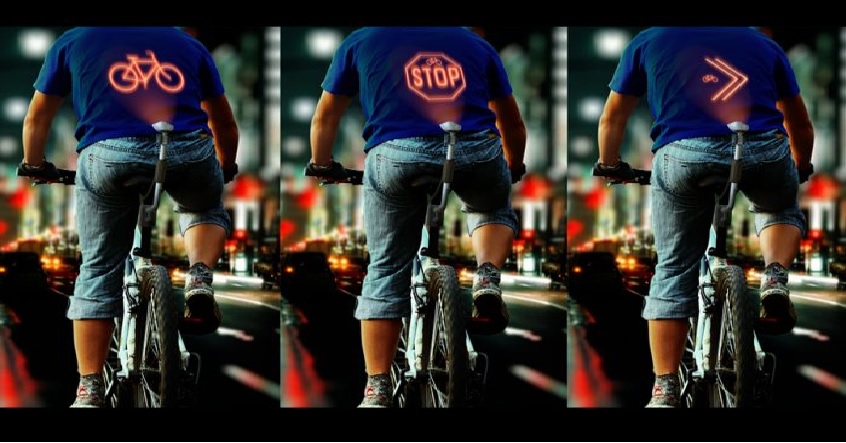
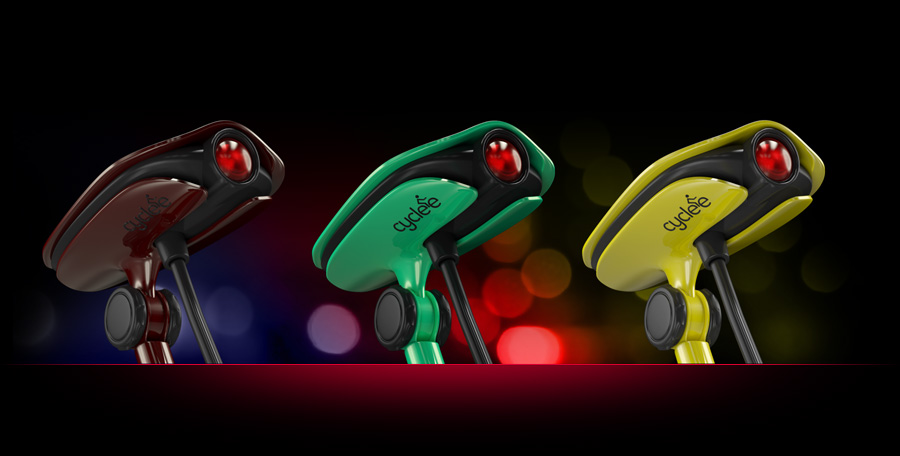
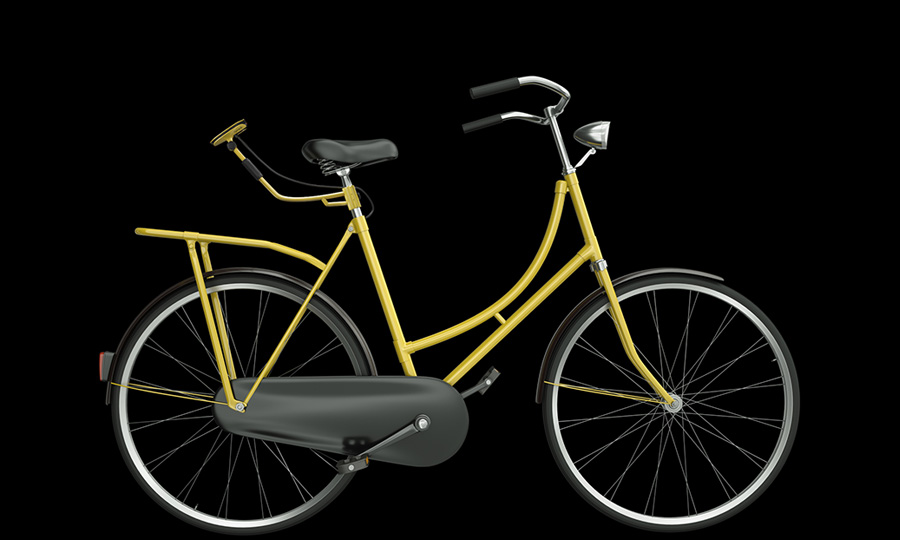
“Cyclee” product has been developed keeping in mind the safety of the cyclists. It is basically a sign projector concept which is to be used at night. It projects the relevant warning signs on the back of the cyclist so that motorists at the back are fully aware about the intentions and actions of cyclist. The chipset present in the projection device is highly programmable and configurable which can be modified wirelessly through a mobile App. This device is compatible with all bicycle models. The mounting part is bicycle model dependent.

This great device, if it is used properly, can make life easy for both motorists and the cyclists and save the lives of a lot of people avoiding unnecessary road accidents.

[adinserter block=”7″]

Author: Technology and Beyond

Tagged : /

Throw them around! THESE coffee cups will grow into real green tress and save the environment!

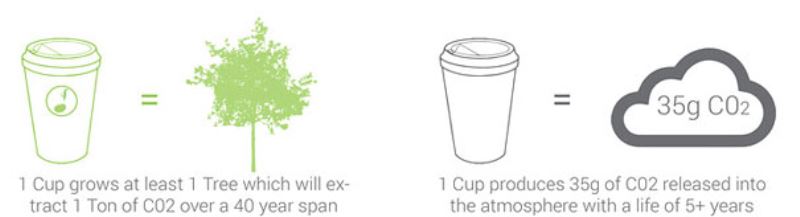
In America alone, 400 million cups of coffee are consumed each day! You are right when you think about the volume of waste paper cups and get frightened about the amount of pollution they create! But, fear not, a Californian company has a creative idea for you regarding upcycling the waste coffee cups.

Resized-SJNPV

The company Reduce, Reuse, Grow is an environment friendly company who is coming out with biodegradable cups which is supposed to degrade within six months.

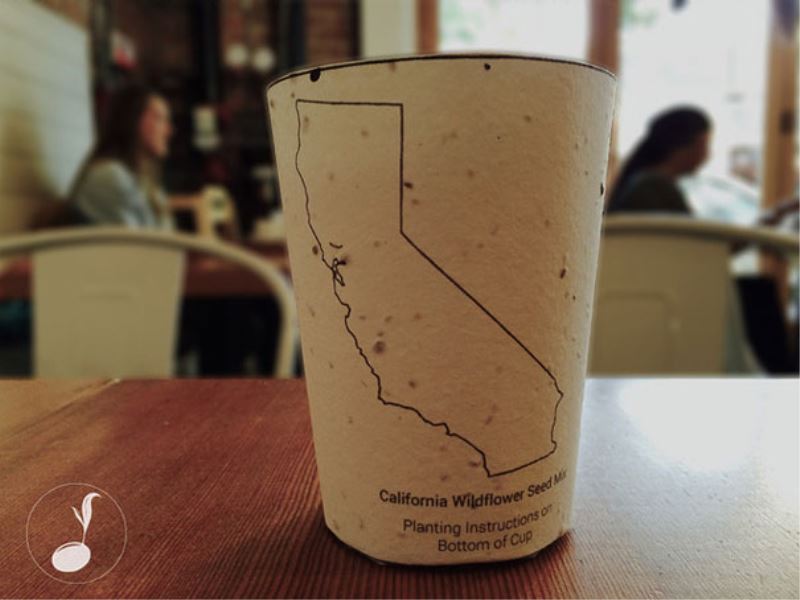
Hold on! We know that there is nothing new in this idea but this company has taken the upcycling to a whole new level. The disposable paper cups, which you throw away, eventually grow into trees or native flowers.

Not only that, you have two options in this regard. You may plant the cup yourself or put it inside a special bin outside the associated coffee shops. This organization will get those collected and distribute them to different communities who need seeds for reforestation.

Resized-H6P1P

Being environment friendly, this organization also takes initiative to place seeds native to the region where coffee cups are being used. Like, in California, you get coffee cups with seeds of poppy flowers and redwood trees.

For more information, please visit www.plantTrash.com

[adinserter block=”7″]

Author: Technology and Beyond

Tagged : /

THIS is how the new-born babies perceive the emotions of their parents

If you are going out in a hurry and leaning over your new-born just to say a few quick sweet words, make sure that lean sufficiently so that your baby can see your face and perceive your emotion. And when we say “sufficiently”, we are asking you to maintain a maximum distance of 12 inches. Otherwise, your baby will not be able to understand you or your emotions.

This has been confirmed by latest scientific research.

Researchers at the University of Oslo took the help of technology, probability and previous studies to conclude that newborns can be visually aware and can distinguish emotions. Even a baby of two / three days old can distinguish faces and emotional facial expression from a distance of 12 inches. This distance is the ideal distance between a mother and her nursing baby.

Beyond 12 inches, the visual image gets blurred for the baby to comprehend facial expressions.

This is how babies perceive our faces, depending on the distance.

baby-vision-2

To arrive at the conclusion, scientists blended modern simulation techniques and probabilistic analysis with previous knowledge-base.  Video has been captured to record various facial expressions and exceptions have been recorded where infants couldn’t process the expressions. It is only at this point adults were allowed to view the footage.

By this process, they wanted to ensure that adults themselves can identify the emotions. Otherwise, it was obvious that infants will not be able to do that.

Interestingly, adult participants could identify the facial expressions in three fourth of the cases while seeing the footage from a distance of 12 inches.

This is actually why babies meet you with blank stares when you try to capture their attention from a distance beyond 12 inches.

[adinserter block=”7″]

Author: Technology and Beyond

Tagged : /

The humane face of the technology: This mobile system can prevent flood anywhere!

We, the living being, get devastated while facing natural calamities such as flooding. Let alone facing such situations, the thought itself induces traumatic experience for us. However, it seems, brilliant engineering effort can stop at least one natural calamity; flooding.

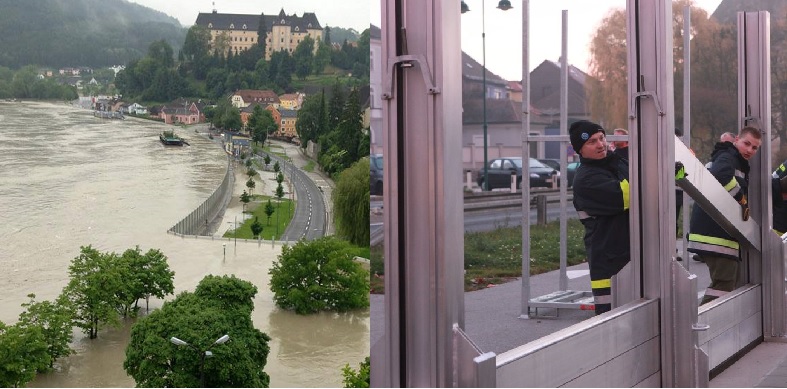
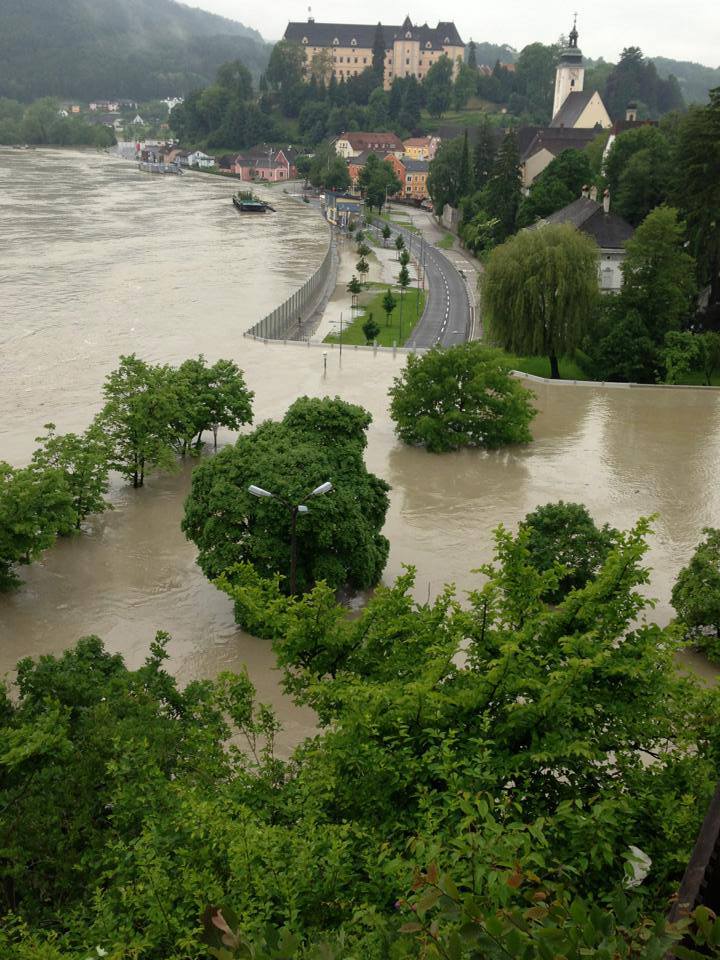
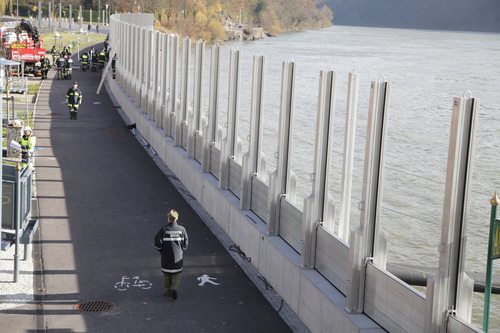
Take the case of city of Grein, Austria which used to suffer from devastating flood from Danube River until a few years back. Authorities quickly reacted by installing demountable or mobile flood walls to ensure the safety of the citizens.

Fantastic feature: Look how water is being prevented to enter the city

Machlanddamm-flood-wall-austria (1)

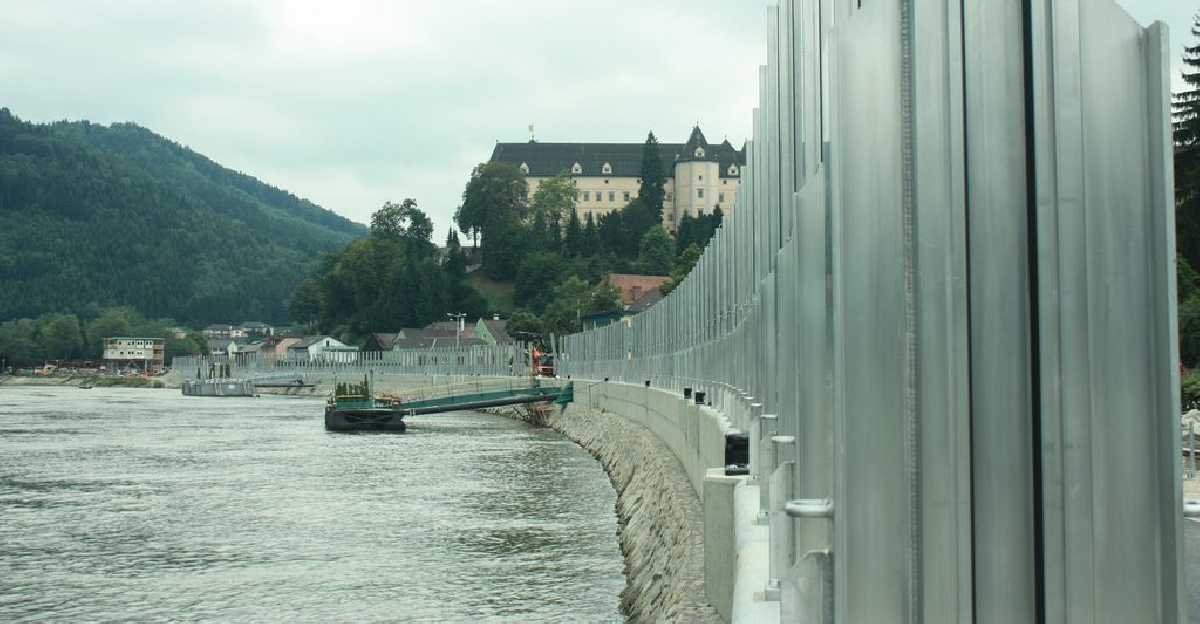
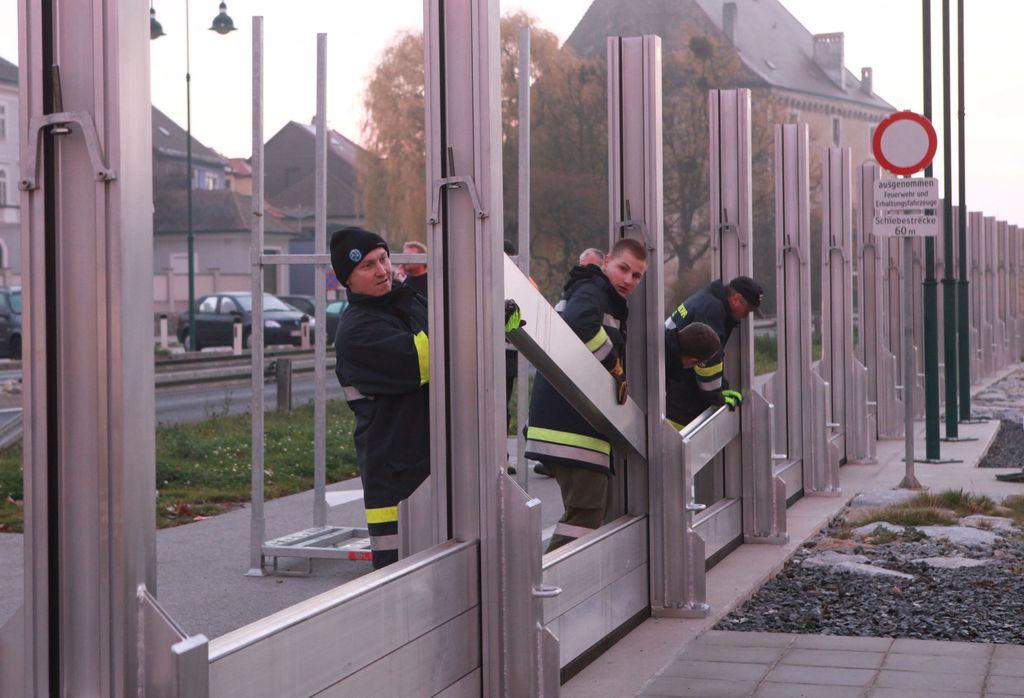
The system has been designed by a UK-based company called Flood Resolution Co. Ltd. The so-called mobile wall consists of two sub-systems: permanently built solid foundations with associated infrastructure and detachable mobile barriers.

The company elaborated, “The system is based on an underground wall, protecting an area against groundwater that rises simultaneously with the level of flood waters. The depth of the underground wall is based on a bedrock and subsequently determines the height of the barrier.”

This is the example of cutting edge technology

Austria-2

The underground wall is built with reinforced concrete and on the top, it is designed with elaborate mechanized wall fittings to keep the water out.

The wall looks mundane without floods

Machlanddamm-flood-wall-without-flood (1)

IBS Tehcnics who studies the system in detail, published a paper on the mobile wall and they pointed out that “the highest and most spectacular mobile flood wall was completed in December 2010 in Grein, with a total barrier height of 3.6 meters on a base wall that’s one meter high.”

This is how stop planks are placed between the columns to quickly install the wall

Mobile Dämme sind oft die einzige Möglichkeit, um zu schützen.  

The paper further elaborated, “The system protects the land behind it to a flood level of 4.6 meters at the upstream end of the site — a height which is equal to the upper storeys of the adjacent properties.”

This is how the river is held back

Austria-4 (1)

Grein flood protection project was part of a greater project called Machland Dam project wherein six such sections of mobile walls were installed. The total project was completed on 25th August,2012. The real test of the mobile wall happened during monsoon, during June 2013. Because of its effectiveness it soon became famous.

You may be interested in the video below which shows how flooding is effectively being prevented.

width="560" height="314" allowfullscreen="allowfullscreen">

Every Country should embrace this technology. People always talk about technology making us unsocial and mechanized but this application really brings out the humane face of the technology which is literally a lifesaver.

[adinserter block=”7″]

Author: Technology and Beyond

Tagged : /

From Russia with love! THIS crazy new vehicle drives on all surfaces, even on water!


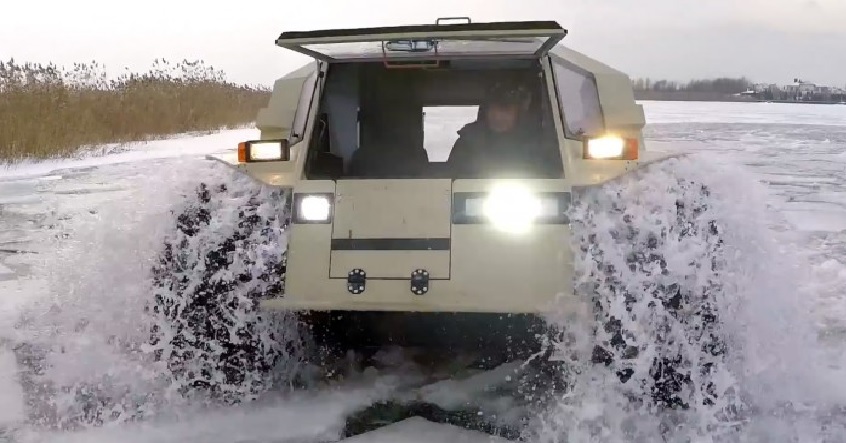
If you have a fixed mind-set about choosing suitable vehicles according to the surfaces/ terrains, this truck is bound to alter that notion in a big way. SHARP ATVs are supposed to be used on all surfaces.

sherp-atv-russia-2

Not only riding on various surfaces, this wonder vehicle climbs over obstacles, takes 360- degree turns and comfortably crosses water bodies. This vehicle, developed by Alexei Garagashyan, costs $49,000.

SHERP ATV is equipped with self-inflated tires, a rugged polymer exterior, and a 15.3-gallon capacity fuel tank. It can easily climb over obstacles upto a height of 2.4 feet and It automatically floats while in water. The vehicle has a top speed of 28 mph. When you are driving it on water, it manages an impressive 3.7 mph. Huge tires have been equipped with threads which doubles as paddles while the truck is in water.

Generally, the military vehicles are not sold to public but this truck, though it looks like a military vehicle, is available for purchase and anyone can buy it.

The SHERP ATV is 11 feet in length and accommodates two. This beast, weighing 2866 pounds, is equipped with a 44 horse power Kubota diesel engine.

Are you concern about zombie apocalypse? Well, in that case, it will be an ideal fit. Otherwise also, it can act as a perfect survival vehicle.

You may be interested in the video below:

width="560" height="314" allowfullscreen="allowfullscreen">

[adinserter block=”7″]

Author: Technology and Beyond

Tagged : /

CO2 to Concrete: CO2ncrete may build buildings in future!

Carbon emission worries have been around from quite a while. All around the world people talk and discuss and study this and try to find out ways to reduce the total carbon emissions so that the continuous rise in the temperatures and the ever warming earth’s atmosphere can be changed for better.

323F817E00000578-0-image-a-17_1458148448699

One solution that is being talked about is catching the carbon at the source of its emission, but this solution comes with its own problem: where to store all this carbon? If ever there was a way of capturing these huge stores of carbon and putting it to some good use, it will be a great victory in the fight against emissions. Thinking on the same line, the researchers at the University of California (UCLA) are trying to convert this CO2 into concrete. The researchers have named this complex process ‘upcycling’.

The ‘upcycling’ process will be an achievement in itself because concrete production itself is a very emission based process accounting for five percent of all carbon emissions. The scientist’s main target though is flue gas, the combustion exhaust gas from power plants – an even larger source of carbon emissions.

The scientists say that the carbon captured from such sources will become the raw material for the new concrete which they prefer to call CO2ncrete! For their experiments, the researchers used carbon dioxide with a purity of more than 99 percet. The carbon was extracted from a pressurized reservoir maintained at 20 MPa (megapascal) using a siphon, which was employed in all of the carbonation experiments. At this stage, the material has been produced at lab scale and 3D printed into tiny cones.

J.R. DeShazo and Gaurav Sant are working on this project and according to DeShazo: “This technology could change the economic incentives associated with these power plants in their operations and turn the smokestack flue gas into a resource countries can use, to build up their cities, extend their road systems.”

You may be interested about the video below:

width="639" height="639" allowfullscreen="allowfullscreen">

[adinserter block=”7″]

Author: Technology and Beyond

Tagged : /

THIS is what actually happened on Easter Island?

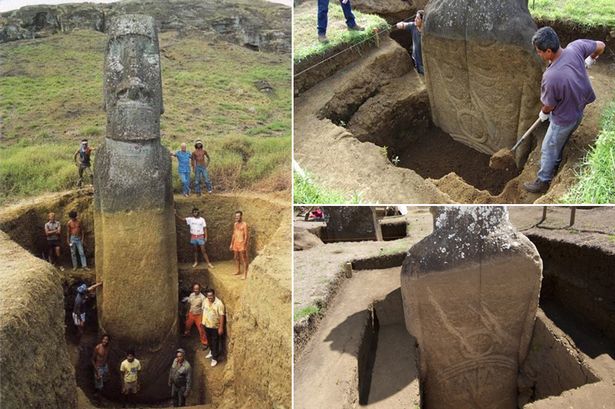
Hundreds of attractive and mysterious moai statues remind us of a vibrant civilization which used to exist at Ester Island. Till today, scientists are not clear about how this great civilization vanished in the thin air. So, far, they listed out many probable causes.

Main-Easter-Island-heads

It may be so that they could not manage the available resources and exhausted the resources of the island and were forced to leave from there. It is a strong probability that they fell victim of European illness and slave trade. Or, it may so that some external factor played havoc in their ecosystem.

A recent study, however, indicated the truth, which seems to be much complicated than a single and simple cause.

“These different interpretations may be complementary, rather than incompatible,” mentioned Dr. Valentí Rull. “In the last decade, there’s been a burst in new studies, including additional research sites and novel techniques, which demand that we reconsider the climatic, ecological and cultural developments that occurred.” Rull is a senior researcher of the Spanish National Research Council in Barcelona, Spain. He is also the lead author of this study which is carrying out holistic reassessment of Easter Island history.

Scientists were trying hard to collect the evidences in this regard for a long time. There exists a lot of historical pointers but all are incomplete, inconsistent and full of gaps. On top of that, many data collected in the past were heavily biased towards some preferred factors. Attempts were not made to incorporate bigger issues like environmental changes. Until recently, the fundamental question of civilization vanishing in the thin air were unresolved. The existing theories were also silent about the formation of civilization in the first place.

Next Page For More

Tagged : /

Revealed: This is how we can hide ourselves from Alien predators!

In case extra-terrestrials are trying to find a habitable planet and looking towards the earth, what we are supposed to do? Hide ourselves from predator eyes with the help of a cloaking device or announce our presence with the burst of light?

lasercloakin

Scientists at Columbia University have just discovered how to do it in either way. Once you have the tool, you have the choice of deciding and doing it according to the need of the day.

Recently, hiding ourselves has become a major concern after Professor Stephen Hawking, opined that any contact with technologically advanced civilisations would be as catastrophic and devastating for humanity now as the arrival of Europeans was for native societies around the world about half a millennium ago.

The recent discovery by Columbia University might be an encouraging development for entities Seti, the Search for Extra-Terrestrial Intelligence, which is .actively looking for the signs of aliens.

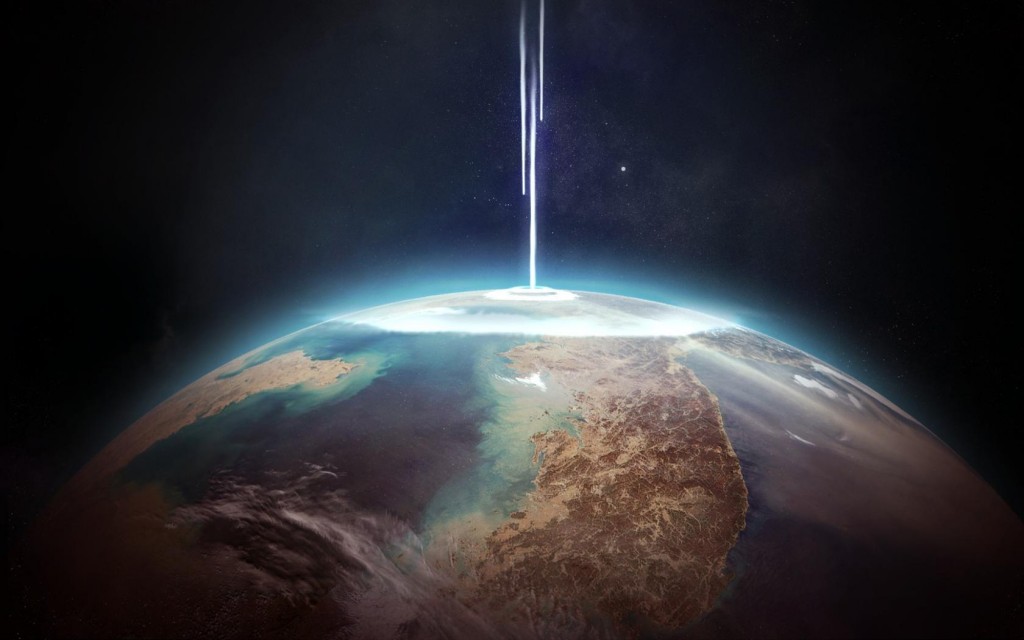
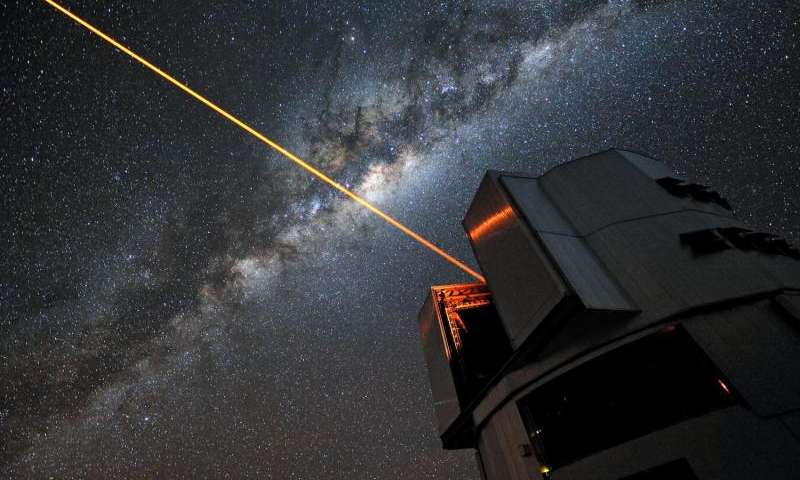
The Columbia astronomers presented a paper for the Royal Astronomical Society describing how a 30MW laser would be able to mask the visual signal from a planet. Incidentally, the same device can transmit a huge amounts of data between the cosmic bodies. That’s not all, a 250MW tuneable laser will be able to generate a “chromatic cloak” capable of hiding human civilization at every wavelength.

This brings back the interesting questions posed by Fermi Paradox, which was proposed by Italian physicist Enrico Fermi. He, during a conversation with colleagues, posed a vital question: “Where is everyone?”

This new finding gives an immediate answer to that question. They are hiding somewhere nearby right beneath our noses, cloaking themselves effectively and efficiently  from us!

Prof David Kipping and his graduate student Alex Teachey tried to find out the difficulty level of hiding from everyone and to everybody’s surprise, the process turned out to be very simple and easy.

[adinserter block=”7″]

Next Page For More

Tagged : /

Here comes the shape-shifting sofa for all your needs

With the ever increasing population and the ever decreasing space availability, flexible furniture has become the demand of the day. You can’t afford to put all kinds of furniture for different needs like, a bed for sleeping, a dining table for eating, a study table or a laptop table for working, a lounger or couch for the living room, a stool for single person seating, a sofa for guests and so on.

lift-bit-exhibition-carlo-ratti-for-vitra-milan-design-week-2016_dezeen_thumbnail

What people today look for is multipurpose furniture-one that can transform according to your needs and you don’t have to sacrifice a lot of space for that. “Lift-bit” surely scores high on all these parameters. And if you are wondering what exactly is a ‘Lift-bit’ then let us tell you that it is basically a shape-shifting sofa.

This supercool sofa can reconfigure itself into a seat, a couch, a bed or even an end table and you can do all these things using just your iPad. It is one of its kind and the first ever ‘digitally transformable sofa.”

The Lift-bit has been designed by Carlo Ratti for furniture company Vitra and it is basically a single, upholstered, hexagonal stool mounted on motorized actuators that can be raised or lowered in a few seconds using an app. You just have to bring some of these together and adjust their heights in relation to each other to arrive at your desired piece of furniture.

The accompanying app comes pre-loaded with some optimal suggested set-ups but also allows the users to use their creativity for creating the furniture of their choice. The interface allows the user to design different configurations. Apart from homes, Lift-bit can certainly find use in a restaurant or hotel lobby, which need flexibility when it comes to seating depending on the time of the day.

Don’t you think it could be a great addition to your furniture collection?

You may be interested in the video below:

width="559" height="559" allowfullscreen="allowfullscreen">

[adinserter block=”7″]

Author: Technology and Beyond

Tagged : /

Look, WHAT this augmented reality display can do for you!

Do you know about HUD? Well if you don’t then HUD stands for heads-up display and the current HUDs show vehicle speed and turn-by- turn directions projected onto the lower portion of the windshield.

slidernav3

But now, Christian Reinhard wants to take HUD a step further by using augmented reality in the next-gen HUDS to ‘paint’ information on the road. Reinhard leads the development of human-machine interaction for Continental subsidiary Elektrobait.

Using augmented reality, Reinhard plans to merge computer-generated graphics with a real world view. So when it is a car under consideration, it would mean projecting information onto the windshield in such a way o that it looks like it is part of the environment.

Continental aims to accomplish this technology using next-gen windshield projection technology with a frame rate of 60 fps and high-definition GPS. According to Richard, this augmented reality HUD could be used for a lane departure warning system, for adaptive cruise control and for turn guidance for navigation.

The biggest challenge to this technology according to Reinhard is the need to accurately place the car on the map, so that the system can correctly show turn guidance or other information. This is the primary reason why Continental is developing the system using high-definition GPS which ensures more accuracy as compared to the typical GPS of today.

Though this augmented reality HUD will take time to come down to low end cars, the ones who can spend money will surely enjoy this new addition.

[adinserter block=”7″]

Author: Technology and Beyond 

Tagged : /

THIS precariously balanced 250-ton boulder will leave you speechless

Mahabalipuram is a very old and famous beach town near Chennai. There are many tourist attractions but the 250-ton boulder balancing itself on a small surface area and on a slope of 45 degrees downhill is just fascinating. Over the years, attempts have been made by men and elephants to move the boulder but they could not drag it even by an inch.

krishnas-butterball-7[2]

This stone has many names. Locals call it ‘Vaanirai Kal’ or the “stone of the Sky God” but the rock is more popular in the name called ‘Krishna’s Butter Ball’ which means a butter ball which fell from the heaven for Lord Krishna. Incidentally, butter is supposed to be the favourite food of Lord Krishna.

This mystery rock is 20 ft high and 5 meters in diameter. It’s heavier than the other stones available nearby. The base contact area is only 4 ft and it looks like the stone will come crashing downhill at any point of time. But, the fact is that, it is standing still, in the same place, for centuries now.

There are several theories regarding the existence of the rock. Some say that, it is nothing mundane and it has been kept over there either by Gods from heaven or by the aliens just to show their might. The other theory is more realistic. It assumes that the rock is a part of natural formation. But formation of such kind of rock by natural corrosion/ erosion process is highly unusual. On the top of it, two sides of the rock are totally different in texture. Geologists are confused about the rock’s presence in that place.

It seems, during the tenure of Pallava King Narasimhavarman, attempts have been made to shift the stone and keep it in a safe place. But, despite all the efforts, his men could not dislocate the stone. During more recent time, in 1908, Governor of Madras, Arthur Lawley, wanted to get rid of the rock. He feared that one day the stone might crash downhill and cause havoc in the city. He deployed seven elephants to dislodge the rock but even that was not successful.

Next Page For More

Tagged : /
Verified by ExactMetrics