CO2 to Concrete: CO2ncrete may build buildings in future!

Carbon emission worries have been around from quite a while. All around the world people talk and discuss and study this and try to find out ways to reduce the total carbon emissions so that the continuous rise in the temperatures and the ever warming earth’s atmosphere can be changed for better.

323F817E00000578-0-image-a-17_1458148448699

One solution that is being talked about is catching the carbon at the source of its emission, but this solution comes with its own problem: where to store all this carbon? If ever there was a way of capturing these huge stores of carbon and putting it to some good use, it will be a great victory in the fight against emissions. Thinking on the same line, the researchers at the University of California (UCLA) are trying to convert this CO2 into concrete. The researchers have named this complex process ‘upcycling’.

The ‘upcycling’ process will be an achievement in itself because concrete production itself is a very emission based process accounting for five percent of all carbon emissions. The scientist’s main target though is flue gas, the combustion exhaust gas from power plants – an even larger source of carbon emissions.

The scientists say that the carbon captured from such sources will become the raw material for the new concrete which they prefer to call CO2ncrete! For their experiments, the researchers used carbon dioxide with a purity of more than 99 percet. The carbon was extracted from a pressurized reservoir maintained at 20 MPa (megapascal) using a siphon, which was employed in all of the carbonation experiments. At this stage, the material has been produced at lab scale and 3D printed into tiny cones.

J.R. DeShazo and Gaurav Sant are working on this project and according to DeShazo: “This technology could change the economic incentives associated with these power plants in their operations and turn the smokestack flue gas into a resource countries can use, to build up their cities, extend their road systems.”

You may be interested about the video below:

width="639" height="639" allowfullscreen="allowfullscreen">

[adinserter block=”7″]

Author: Technology and Beyond

Tagged : /

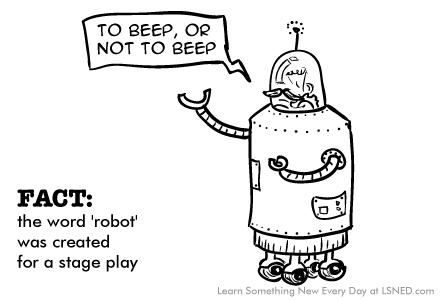
This is where the word ‘Robot’ came from!

Do you remember the movie iRobot? That Will Smith movie had delved deeper into the scenario of Robots taking over the humans and that too in a well calculated manner. The movie wasn’t of course the first in this genre.

Robot

There have always been discussions and arguments about the probability of robots taking over the humans and the earth and till now they all have been based on cinematic or some fiction novels. Even if you think that ‘robots taking over the world’ is a far-fetched idea then the very recent ‘robots taking over our jobs’ isn’t that unconvincing. Robots have indeed entered in various spheres of our life. But do you wonder why do we call a robot a ‘robot’?

The word robot derives its roots from the Czech word ‘robotnik’ which means ‘slave’. ‘Robotnik’ comes from ‘rabota’ which is an Old Church Slavonic word for servitude. The English language first used the word ‘robot’ in a translation of Czech playwright Karel Capek’s 1920 sci-fi drama ‘RUR’ or ‘Rosum’s Universal Robots’. Capek’s play described a company that manufactures and sells workers that look and act like humans, but lack souls.

The intelligent servants then rebel against their human masters. And this is something that has been recreated in many films and novels long after that. Whether robots will snatch away our jobs or not, whether they will take over our world or not is a question better left unanswered because as long as humans aren’t too dependent on robots and robots aren’t too intelligent, the chances are quite bleak.

[adinserter block=”7″]

Author: Technology and Beyond
Tagged : /

This wonder machine consumes greenhouse gas and yields Gasoline

Handling and reducing Greenhouse gas is always a concern for us. Keeping that into account, having a machine sucking carbon emissions from the air and converting it into gasoline, sounds like a science fiction movie.

However, a Canadian company, Carbon Engineering, is currently working on a massive project which aims to absorb massive amount of carbon Dioxide emissions. The amount of emissions we are talking about is equivalent to CO2 produced by 300,000 cars on yearly basis. In order to achieve that, they deployed a big-ass machine which is housed at University of Calgary.

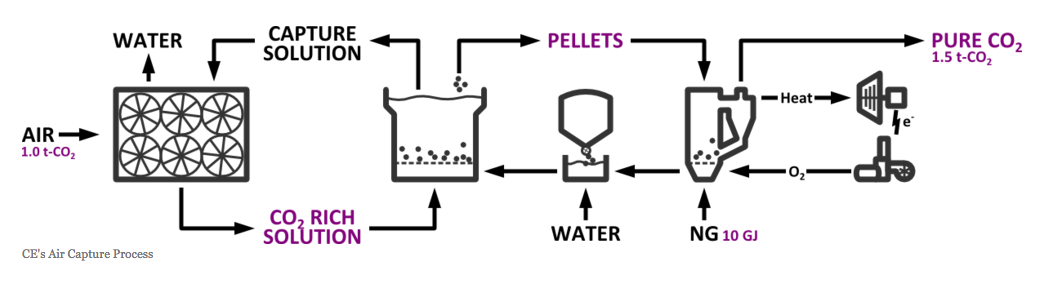
The working principle is simple. The absorbed CO2 goes to a scrubber where Air and CO2 absorbent liquid flows in cross-current orientation. The corrugated PVC sheets positioned in the scrubber increases the contact area and absorption efficiency. The resultant carbonate solution is collected in a chamber placed at the bottom of the scrubber.

carbon-sucking-4 carbon-sucking-2

Currently, the carbonate liquid is being disposed in a safe way. At present, the prototype machine is absorbing around 100 kg CO2 on daily basis.

carbon-sucking-3

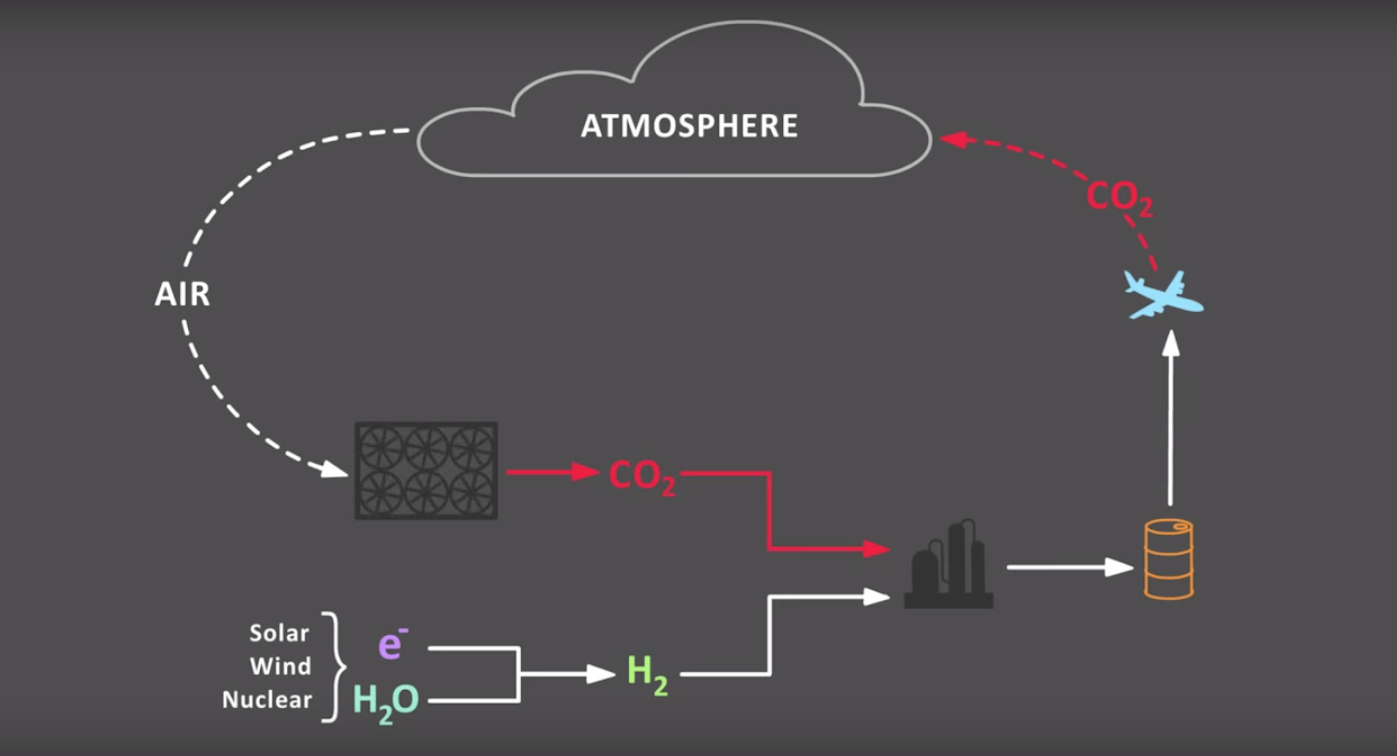
Apart from reducing carbon content in the air, this project is trying to convert the emissions into hydrocarbon products, such as gasoline and jet fuel. For this purpose, the carbonate is needed to be converted into hydrocarbon with the help of Hydrogen. Once the hydrocarbon is produced, it can be burnt to produce energy. The resultant emission can again be converted into hydrocarbons. So, the machine should be able to run in a cycle.

The good thing is that, Carbon Engineering is already having the technology in prototype scale. They just need to scale up the operation so that the project works in much bigger scale.

“We can and must transition to sustainable sources of low carbon energy. We’re doing that, but it will take time. With the appropriate design, and the right scale, we can start today,” clarifies David Keith, the President of Carbon Engineering.

[adinserter block=”7″]

You may be interested in the video below:

width="697" height="697" allowfullscreen="allowfullscreen">

Author: Technology and Beyond

Tagged :

Believe it or not! Microwave Oven Was invented by a pure accident

Modern day kitchen is pretty much incomplete without a microwave oven. According to the statistics given by Popular Mechanics, 90% kitchen in America is equipped with microwave ovens and it’s not a surprise at all.

microwave-oven-1

Nowadays, microwave is being used for almost everything, starting from heating to cooking food. The main reason for its popularity is the ease of use. It is really difficult to believe that such a useful gadget was invented purely by accident.

It was probably originated about 70 years ago (during 1946) when engineer and inventor Percy Spencer was working with a military grade magnetron. He was focusing on enhancement of power level of the magnetron so that it can be used in a radar set. At this point, he was trying to take out a peanut cluster bar from his pocket. To his surprise, it was totally melted. In his own language it was “a gooey, sticky mess.”

George “Rod” Spencer Jr, the grandson of the inventor, mentioned:

“He loved nature (due to his childhood in Maine)… especially his little friends the squirrels and the chipmunks,” young Spencer continued, “so he would always carry a peanut cluster bar in his pocket to break up and feed them during lunch.”

He was curious about melting of the bar and had some doubt in mind that it was something to do with the magnetron experiment. Spencer again conducted a magnetron test and this time he put an egg under the tube. The egg was exploded after some time and Spencer really got interested about it. Next day, when he conducted the same experiment by placing some corn kernels under the tube, those became popcorns.

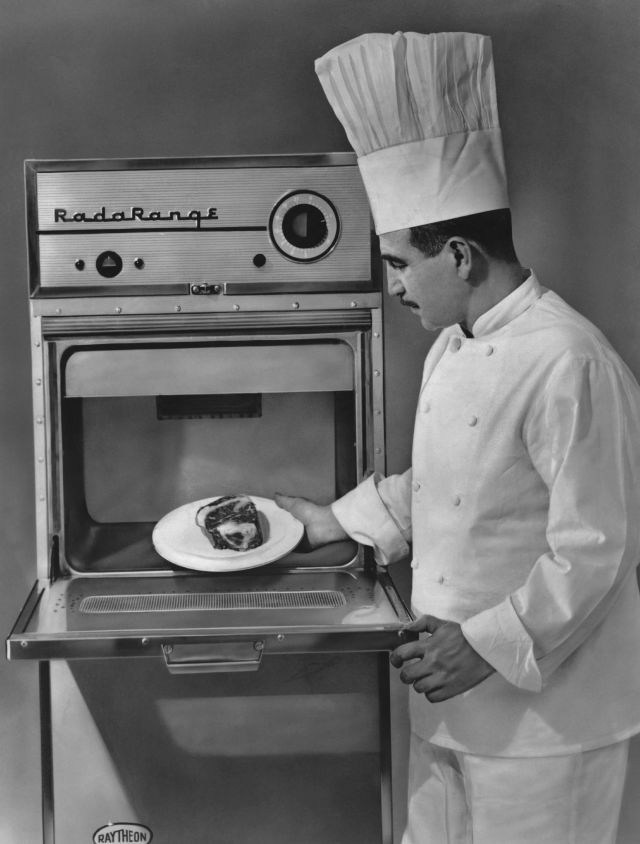
During 1947, Spencer introduced Radarange, the first generation microwave oven. It was heavy weighing almost 750 pounds and had a price tag of over $2,000. Due to its heavy weight and high price tag, it didn’t become popular at that point of time.

During 1955, Spencer introduced his first domestic microwave but the technology still didn’t gather momentum. Long after that, during 1967, Amana introduced a compact version of the Radarange which got traction from the market. It got popular and from 1975 onwards, over I million microwave ovens were sold each year.

During 1958, Percy Spencer introduced Raytheon Radarange III, which was an early version of a commercial microwave oven.

Junior Rod Spencer, who is also an engineer, is currently writing a book about his grandfather, mentioned:

“Gramps was loud, wanted to make everything happen at all times… There were no ‘challenges,’ simply everything was a goddamn problem that needed to be solved. Everyone trusted him to do just that.”

[adinserter block=”7″]

Author: Technology and Beyond

Tagged :

This is WHY two pieces of breads with a filling is called a “Sandwich”!

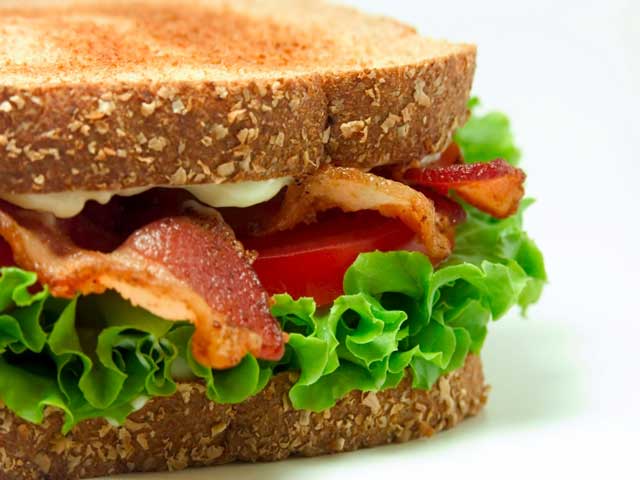
It is said that sandwich was invented by the John Montagu, the fourth Earl of Sandwich who was addicted to gambling and did not want to leave his table even for meal. He asked his servant for a meal between two pieces of bread and thus sandwich was invented.

sandwich-02

Another story doing the rounds is with regard to sage Hillel born in the first century BC in Babylonia. It is said that he devoted his time to study the Torah during the time of debate on the Jewish law. During the celebration of Passover, roasted lamb was eaten with bitter herbs and matzah. During those times, the traditional meal made from meat of lamb was shared among friends and family and Hillel interpreted to make it in the form of a meat stack and herbs bound together between the slices of unleavened bread. It was known as “korech” which is the Hebrew word for “to wrap”. That’s how the ancient sandwich was created.

The first recorded sandwich is said to be made by mixing nuts, apples and spices with wine and placing it between two pieces of flat bread. Bread was used as plates during the 6th to 16th century and then meat and vegetables were placed on the bread and people ate with their fingers. These open sandwiches as they were called were known as trenchers in those times.

One more anecdote relates to Edward Montagu who was John Montagu’s successor. Edward’s original title was as Earl of Portsmouth and he was active in the admiralty. His fleet was docked on the coast of Sandwich. It is said that Edward decided to take the title of Earl of Sandwich to have a connection to his family. Montagu’s travels to the Mediterranean led him to observe how the mezze platters were served. Items like Dips, cheese and meat were sandwiched between layers of bread and he replicated it to avoid getting up from the gambling table.

[adinserter block=”7″]

Next Page For More

Tagged :
Verified by ExactMetrics