India’s Chandrayaan 3 Mission: A Countdown to History
The countdown is on for India’s Chandrayaan 3 mission, which is scheduled to launch at 2.35 pm today ( Friday, July 14th 2023). The mission will attempt to soft-land a lander and rover on the lunar surface, and will also conduct a number of scientific experiments. Chandrayaan 3 is the third lunar mission by the Indian Space Research Organisation (ISRO), and is a follow-on to the Chandrayaan-1 and Chandrayaan-2 missions. The lander and rover on Chandrayaan 3 are similar to those used on Chandrayaan-2, but the mission will not have an orbiter.
The main objectives of Chandrayaan 3 are to:
1 Demonstrate safe and soft landing on the lunar surface.
2 Demonstrate rover roving on the moon.
3 Conduct in-situ scientific experiments.
The lander on Chandrayaan 3 is called Vikram, and the rover is called Pragyan. Vikram is equipped with a number of scientific instruments, including a camera, a magnetometer, and a seismometer. Pragyan is a robotic rover that will be able to travel up to 500 meters on the lunar surface.
The scientific experiments that will be conducted on Chandrayaan 3 will focus on the study of the moon’s surface, its composition, and its history. The mission will also look for signs of water on the moon. The launch of Chandrayaan 3 is a major milestone for India’s space program, and it is expected to make a significant contribution to our understanding of the moon. The mission is also a testament to the growing technological capabilities of India, and it is sure to inspire future generations of scientists and engineers.
The Launch
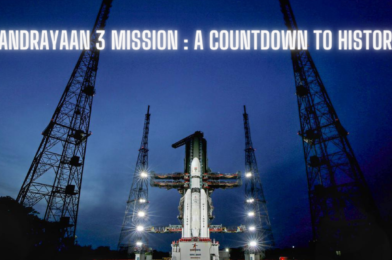
The Chandrayaan 3 mission is scheduled to launch on Friday, July 14, at 2:35 p.m. IST from the Satish Dhawan Space Centre in Sriharikota, India. The launch will be broadcast live on ISRO’s website and YouTube channel.
The mission will use a GSLV Mark 3 (LVM 3) heavy lift launch vehicle to place the lander and rover into orbit around the moon. The lander and rover will then separate from the launch vehicle and descend to the lunar surface.
The landing is scheduled to take place on August 23 or 24. If the landing is successful, Chandrayaan 3 will be the first Indian mission to soft-land on the moon since Chandrayaan-2 in 2019. In the Chndrayaan -2 mission Chandrayaan-2 spacecraft inserted into lunar orbit and then on September 2, 2019; Vikram Lander was separated while orbiting the moon in a 100kms lunar polar orbit, however, communication from the lander to the ground stations was lost at an altitude of 2.1 km from the surface of the moon.
The Significance of the Mission
The Chandrayaan 3 mission is a significant milestone for India’s space program. It is the third lunar mission by ISRO, and it is the first mission to attempt a soft-landing on the moon since Chandrayaan-2. The success of Chandrayaan 3 would be a major achievement for India, and it would boost the country’s reputation as a spacefaring nation. The mission would also help to advance our understanding of the moon, and it could lead to future missions to explore the lunar surface.
The Future of Space Exploration
The Chandrayaan 3 mission is a stepping stone to future space exploration missions. If the mission is successful, it could pave the way for future Indian missions to the moon, such as a human mission.The mission could also help to inspire future generations of scientists and engineers to pursue careers in space exploration. The success of Chandrayaan 3 would show that India is a leading nation in space exploration, and it would encourage other countries to pursue their own space exploration programs.
Conclusion
The Chandrayaan 3 mission is a major milestone for India’s space program, and it is sure to have a significant impact on the future of space exploration. The success of the mission would be a major achievement for India, and it would boost the country’s reputation as a spacefaring nation. The mission would also help to advance our understanding of the moon, and it could lead to future missions to explore the lunar surface.