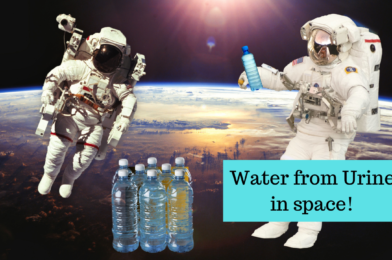
NASA recovers water from urine : A new milestone to help in space exploration missions!
NASA has achieved a new milestone in water recovery on the International Space Station (ISS). The space agency has announced that it has successfully recovered 98% of the water used by astronauts on the ISS, including urine and sweat. This is a significant improvement over previous water recovery rates, which were only around 80%.
The water recovery system on the ISS is called the Urine Processing Assembly (UPA). The UPA first distills the urine and sweat, separating the water from the solids. The water is then further purified using a process called reverse osmosis. Reverse osmosis is a process that uses pressure to force water molecules through a semi-permeable membrane. The membrane allows the water molecules to pass through, but it blocks the passage of the solids.
The purified water is then stored in tanks and can be used by the astronauts for drinking, cooking, and bathing. The UPA can recover up to 98% of the water used by astronauts on the ISS. This means that for every 100 gallons of water used by the astronauts, only 2 gallons need to be brought up from Earth. This is a significant savings, as it reduces the amount of cargo that needs to be transported to the ISS.
The UPA is a critical part of the ISS’s life support system. It helps to ensure that the astronauts have a sustainable supply of water, even on long-duration missions. The UPA also helps to reduce the amount of waste that needs to be disposed of on the ISS.
The successful recovery of 98% of the water used on the ISS is a major achievement for NASA. It is a testament to the ingenuity and hard work of the engineers and scientists who designed and built the UPA. The UPA is a critical technology that will help to support future long-duration missions in space.
Jill Williamson, ECLSS water subsystems manager said : “the drinking water has been reclaimed, filtered and cleaned such that it is cleaner than what we drink here on Earth.”
