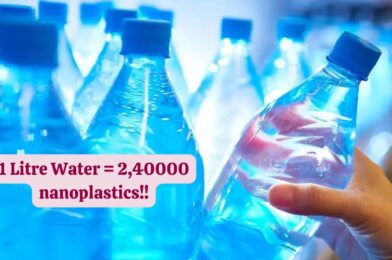
1 Litre of Water? More Like 240,000 Plastic Fragments: Your Bottle’s Dirty Secret

1 Litre of Water? More Like 240,000 Plastic Fragments: Your Bottle’s Dirty Secret
Imagine popping open a refreshing bottle of water, only to discover it teeming with 240,000 tiny plastic fragments. That’s the unsettling reality revealed by a recent study, raising serious concerns about the ubiquitous presence of nanoplastics in our bottled water.

While the dangers of microplastics (plastic pieces under 5 mm) have been a growing cause for concern, this study shines a spotlight on the even more alarming threat posed by nanoplastics. These minute particles, measuring less than 100 nanometers (about 1,000 times smaller than the width of a human hair), can easily slip through filtration systems and into our bodies.

Nano vs. Micro: Why Size Matters?

So, why are nanoplastics potentially more dangerous than their larger counterparts? Here’s why:

  • Increased absorption: Due to their miniscule size, nanoplastics can easily bypass biological barriers and infiltrate organs like the lungs, brain, and even the placenta in pregnant women.
  • Greater toxicity: Smaller particles often exhibit higher surface area to volume ratios, making them more efficient at adsorbing toxins and heavy metals from the environment, which, once inside the body, can lead to various health problems.
  • Unknown long-term effects: The long-term consequences of ingesting nanoplastics are still largely unknown, but early research suggests potential links to inflammation, organ damage, and even cancer.

A Global Dilemma:

The presence of nanoplastics in bottled water is not an isolated incident. They have been found in a wide range of food and beverage products, as well as in the air we breathe and the water we drink. This pervasive pollution, stemming from plastic production, breakdown, and improper waste disposal, poses a significant global challenge.
What Can We Do?

While research on the precise health risks of nanoplastics is ongoing, it’s clear that we need to act to address this emerging threat. Here are some ways we can help:

  • Reduce dependence on single-use plastics: Opt for reusable bottles, bags, and food containers whenever possible.
  • Demand transparency from corporations: Hold manufacturers accountable for their plastic footprint and advocate for sustainable production practices.
  • Support research and policy changes: Fund research to understand the health impacts of nanoplastics and encourage stricter regulations on plastic production and disposal.

    The startling revelation of 240,000 plastic fragments in a single bottle of water is a wake-up call. We must act now to curb plastic pollution and protect ourselves from the potential dangers of nanoplastics. By advocating for change and making conscious choices, we can take a stand for a healthier planet and ourselves.

Remember, every small step counts. Together, we can turn the tide on plastic pollution and ensure a cleaner future for all.
Tagged : / / /

ISRO Chief’s Confidence : ‘Chandrayaan-3 Will Land Even If Everything Fails’

ISRO Chief’s Confidence : ‘Chandrayaan-3 Will Land Even If Everything Fails’
In a recent interview, Indian Space Research Organisation (ISRO) chairman S Somanath said that Chandrayaan-3 will be able to make a soft landing on the Moon’s surface even if all of its sensors and engines fail. This is a remarkable feat of engineering, and it speaks to the level of confidence that ISRO has in its Chandrayaan-3 mission.

Somanath explained that the Chandrayaan-3 lander, named Vikram, has been designed with a number of fail-safe mechanisms. For example, if one of the sensors fails, the lander will use another sensor to take its place. And if all of the sensors fail, the lander will use its onboard computer to make a landing based on its current position and velocity.

In addition, the Vikram lander has been designed to be able to withstand a number of different failure scenarios. For example, if one of the engines fails, the lander will be able to use the other engines to make a landing. And if all of the engines fail, the lander will be able to use its parachutes to slow down its descent and make a soft landing.

Of course, no mission is without risk, and there is always the possibility that something could go wrong with Chandrayaan-3. However, the level of redundancy and fail-safe mechanisms that have been built into the Vikram lander give ISRO a high degree of confidence that the mission will be successful.

The Chandrayaan-3 mission is a significant milestone for India’s space program. It will be the country’s third lunar mission, and it will be the first time that India has attempted a soft landing on the Moon’s surface since the Chandrayaan-2 mission in 2019. The success of Chandrayaan-3 would be a major achievement for India, and it would put the country in a strong position to lead future lunar exploration missions.

The Chandrayaan-3 launch was done on July 14, 2023. The lander is expected to make a soft landing on the Moon’s surface on August 23, 2023. ISRO will be closely monitoring the mission, and it will provide updates on its progress as it happens.

ISRO’s confidence in the Chandrayaan-3 mission is a testament to the hard work and dedication of the scientists and engineers who have been working on the project. It is also a sign of India’s growing capabilities in the field of space exploration. ISRO is a world leader in space technology, and the Chandrayaan-3 mission is a further demonstration of its expertise.

For every Indian, it is exciting to see the Chandrayaan-3 mission unfold. It has the potential to be a major success for India, and it will be a significant step forward for lunar exploration. Every Indian will be following the mission closely, and we too will be cheering on the ISRO team as they work to make history.

Tagged : / / / /
Verified by ExactMetrics