ISRO Brings Back Chandrayaan-3 Propulsion Module to Earth Orbit, Demonstrating Advanced Retrieval Capabilities

ISRO Brings Back Chandrayaan-3 Propulsion Module to Earth Orbit, Demonstrating Advanced Retrieval Capabilities
In a landmark achievement, the Indian Space Research Organisation (ISRO) has successfully brought back the Propulsion Module (PM) of the Chandrayaan-3 spacecraft to Earth’s orbit. This remarkable feat showcases India’s growing prowess in space technology and its ability to not only launch objects to the Moon but also retrieve them.

The Chandrayaan-3 mission, initially intended for lunar operations, surpassed its objectives, prompting ISRO to demonstrate its advanced retrieval capabilities by bringing the PM back to Earth’s orbit. This ambitious maneuver involved intricate orbital adjustments and precise engine control, highlighting ISRO’s expertise in spacecraft navigation and propulsion.

The successful retrieval of the PM underscores India’s growing confidence in space exploration and its commitment to pushing the boundaries of technological advancements. This achievement paves the way for future missions that require the ability to return payloads from the Moon or other celestial bodies.

Beyond its technical significance, the return of the PM also holds immense scientific value. The module carries valuable data and equipment that can be analyzed to gain further insights into the lunar environment. This information will be crucial for future lunar missions and may even contribute to the search for extraterrestrial life.

This remarkable feat by ISRO serves as a testament to India’s unwavering dedication to space exploration and its commitment to becoming a global leader in the field. The successful retrieval of the Chandrayaan-3 PM marks a significant milestone in India’s space journey and opens doors to a future filled with exciting possibilities.
Tagged : / / / /

This Is What Chandrayan-3 Has Found On The Moon’s Surface Till 30th August ’23!

This Is What Chandrayan-3 Has Found On The Moon’s Surface Till 30th August ’23!
On August 23, the Chandrayaan-3 Lander Module successfully touched down at the South Pole of the Moon. Following this momentous achievement by the Indian Space Research Organisation (ISRO), the Pragyan Rover has been conducting investigations at the lunar South Pole in an effort to solve some of the moon’s mysteries. The mission had a total of three objectives. Two of these goals have already been met: the first was a successful soft landing in the lunar south pole, and the second was to safely land the rover on the surface of the moon. Experiments are currently being carried out on the moon in order to fulfil the third objective, which is currently being worked on.
The following is a list of some intriguing discoveries made by Chadrayaan-3 in the south polar region of the Moon so far:

Temperature at the moon’s South Pole

On August 27, ISRO published a graph that detailed the changes in temperature on the surface of the moon. The graph focused on the temperature at the moon’s South Pole. The senior scientist at the space agency was taken aback by the readings of the unexpectedly high temperature that were obtained from the surface of the moon. ISRO released an update in which they explained that in order to evaluate the temperature profile of the soil around the pole on the moon, they utilised a tool known as ChaSTE, which was located on Chandrayaan-3’s Vikram Lander. This was done in order to get an understanding of how the surface of the moon reacts to heat. ISRO scientist B H M Darukesha noted in an interview with the news agency PTI that they had estimated the temperature might vary from roughly 20 to 30 degrees Celsius on the surface, but it’s actually 70 degrees Celsius, which is far greater than what they initially anticipated. This information was provided by ISRO.

Crater Encounter

On August 27, the Chandrayaan-3 rover was investigating the surface of the Moon when it came across a crater that was 4 metres wide. This presented a problem for the rover. An update from the ISRO indicated that the crater was actually located three metres in front of where they first assumed it was. ISRO told the Rover to go in the opposite direction in order to tackle the situation and informed it that it was now on a different path and proceeding in a secure manner.

Elements on the Moon’s Surface

Moving forward in time to the 30th of August, the Laser-Induced Breakdown Spectroscope that was mounted on the Pragyan Rover discovered some fascinating elements on the surface of the moon close to the South Pole. They were able to establish that sulphur was present, in addition to discovering the presence of other elements such as aluminium, calcium, iron, chromium, titanium, manganese, silicon, and oxygen. The researchers are not giving up their search for hydrogen just yet.

At the moment, the Rover is working within a time limit, which can be metaphorically seen as “racing against time.” According to ANI’s report, Nilesh M. Desai, who is in charge of the Space Applications Centre and revealed on Sunday that they have a total of just 14 days for this entire mission, which is equivalent to just one day on the moon, said that they only have one day on the moon. They have already used up four of those days as of right now. He underlined that it is vitally crucial for them to make the most of the remaining ten days by conducting as many experiments and research as possible in order to get the most out of their time. In addition to that, he stated that each and every scientist working for ISRO is contributing their best efforts.

Tagged : / / / / /

Why 23rd August Was Chosen As The Date Of Landing For Chandrayaan -3? What Is So Special About This Date?

Why 23rd August Was Chosen As The Date Of Landing For Chandrayaan -3? What Is So Special About This Date?
The Indian Space Research Organisation (ISRO) successfully landed the Chandrayaan-3 lander and rover on the lunar south pole on August 23, 2023. The landing was a major milestone for India’s space program and a testament to the ingenuity and determination of the Indian scientists and engineers who made it possible.

This is to note that the lunar south pole is a region that has never been visited by a spacecraft before. This made it a challenging but also an exciting target for the Chandrayaan-3 mission. The landing date was chosen to coincide with the beginning of the lunar day at the landing site. The timing of the landing was chosen taking into account the amount of local sunshine. On August 23, the sun will rise over the landing location, and it will set two weeks later. As the Vikram lander is solar-powered, these 14 sunlight days are crucial for Thermal, seismic, and mineralogical observations and Vikram lander and rover using a variety of equipment. A spectrometer investigation of the lunar surface’s mineral makeup is part of this. This would ensure that the lander and rover would have access to sunlight, which is needed to power their systems.

The landing date was also chosen to avoid the lunar eclipse season. Lunar eclipses can interfere with communications between the spacecraft and the ground, so it was important to avoid this during the landing. The successful landing of Chandrayaan-3 is a major achievement for India’s space program and a stepping stone to future missions to the moon. The Pragyaan rover, which is deployed from the lander, will now spend the next two weeks exploring the lunar south pole and searching for signs of water ice. The findings of the Pragyaan rover will help us to better understand the moon and its potential as a resource for future human exploration.

In addition to the factors mentioned above, there were also some technical considerations that influenced the choice of August 23 as the landing date. For example, the lander and rover needed to be in a specific position relative to the sun in order to land safely. The landing date was also chosen to ensure that the lander and rover would have enough time to complete their mission before the lunar day ended.

Overall, the choice of August 23 as the landing date was a careful and deliberate one. It was a date that met the scientific, technical, and operational requirements of the Chandrayaan-3 mission. The successful landing of Chandrayaan-3 is a testament to the hard work and dedication of the ISRO team. It is a proud moment for India and a significant step forward in our exploration of the moon.

Tagged : / / / /

As Chandrayan 3 Reaches The Moon, What Will The Pragyaan Rover Do? Will Chandrayaan 3 Come Back to Earth?

As Chandrayan 3 Reaches The Moon, What Will The Pragyaan Rover Do? Will Chandrayaan 3 Come Back to Earth?
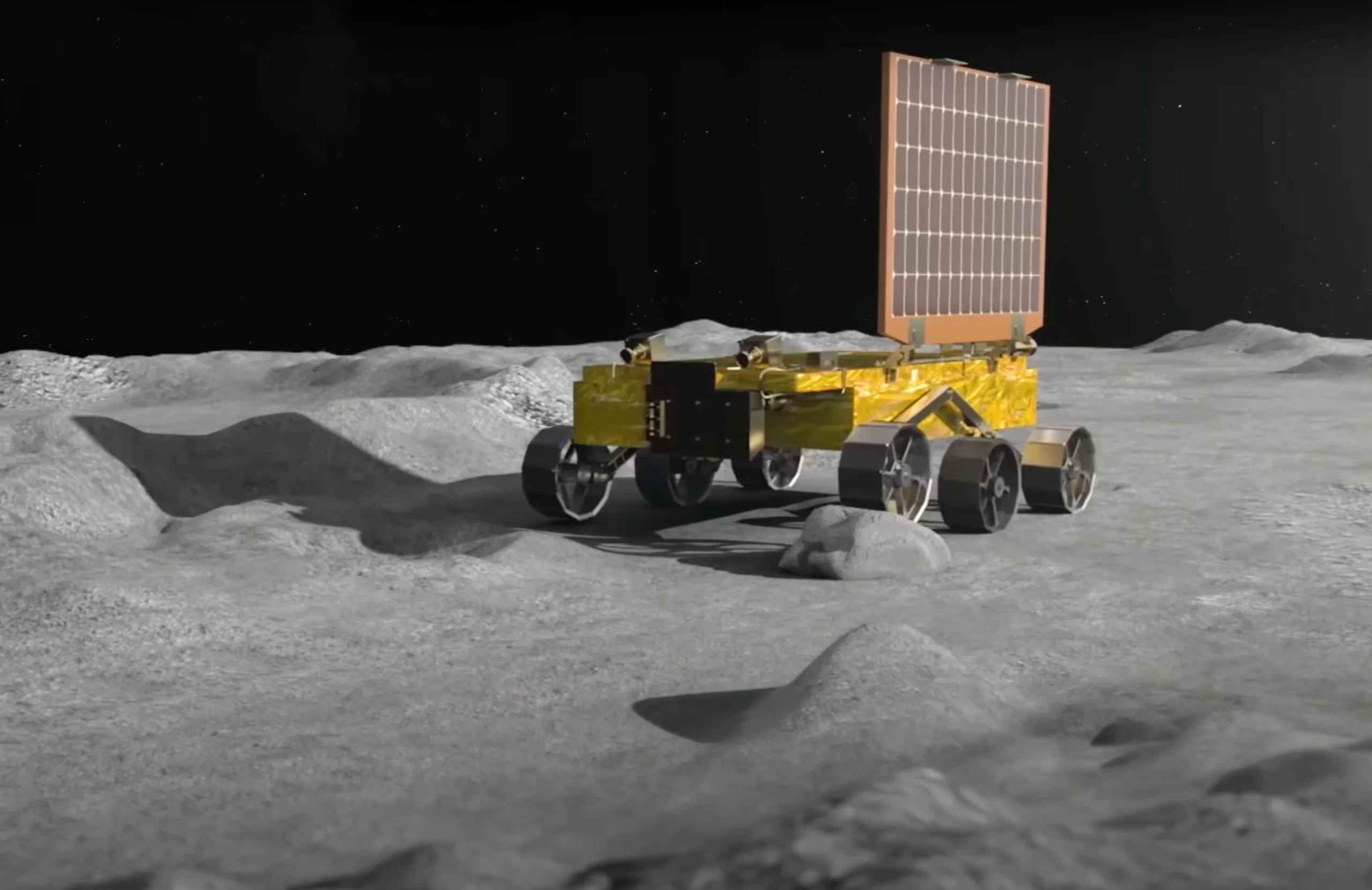
The Pragyaan rover has successfully rolled out of the Vikram lander and is now ready to begin its mission on the surface of the moon. The rover is named after the Sanskrit word for “wisdom” and is designed to explore the lunar south pole, a region that has never been visited by a rover before.

What will Pragyan Rover do?

The rover is equipped with six wheels and a variety of scientific instruments. ISRO claims that the lander and the Rover each have five research payloads that have been put inside of the Lander Module (LM) of the spacecraft.

1. The Alpha Particle X-Ray Spectrometer (APXS) aboard the Rover will be utilised to determine the chemical composition of the lunar surface and to infer the mineralogical composition in order to further expand our understanding of the lunar terrain.

2. The Laser Induced Breakdown Spectrometer (LIBS) will analyse the soil and rocks around the landing site on the Moon to identify their elemental make-up. ISRO has stated that the use of Rover to conduct scientific experiments on the moon in their natural environment would take lunar exploration to a whole new level.

3. The RAMBHA-LP (Langmuir Probe) that is part of the Lander Payloads will monitor the density of the plasma (ions and electrons) near the surface as well as how it varies over time.

4. ChaSTE Chandra’s Surface Thermo Physical Experiment will carry out the measurements of the thermal characteristics of the lunar surface in the vicinity of the polar area.

5. The Instrument for Lunar Seismic Activity, or ILSA, will be used to delineate the structure of the lunar crust and mantle as well as measure the seismic activity that is occurring close to the landing site.

Over the next 14 days, which is equivalent to one lunar day, the Pragyan rover will travel up to 500 meters from the lander and conduct a series of experiments to study the geology, mineralogy, and history of the lunar south pole. The rover will also look for signs of water ice, which is believed to be present in the permanently shadowed craters of the region.

The Pragyan rover is a major milestone for India’s space program and is expected to make significant contributions to our understanding of the moon. The rover’s mission is also a testament to the ingenuity and determination of the Indian scientists and engineers who made it possible.

What will happen to Chandrayaan 3 after 14 days?

Following the passage of 14 days, the moon will experience a nighttime phase that will also last for 14 days. Because Vikram and Pragyan can perform their jobs only when the sun is shining, they will become inactive after 14 days because the weather would be extremely chilly. In addition, both the lander and the rover have been built with a lifespan of fourteen days in mind. However, the researchers at ISRO have not ruled out the chance that Vikram and Pragyan would regain consciousness when the sun once more rises on the moon. If this is the case, then it will be a bonus benefit for India’s expedition to the moon.

Will Chandrayaan 3 come back to earth?
No, Vikram and Pragyan are not supposed to come back to the earth. They will remain on the moon.

Tagged : / / / / / / /
Verified by ExactMetrics