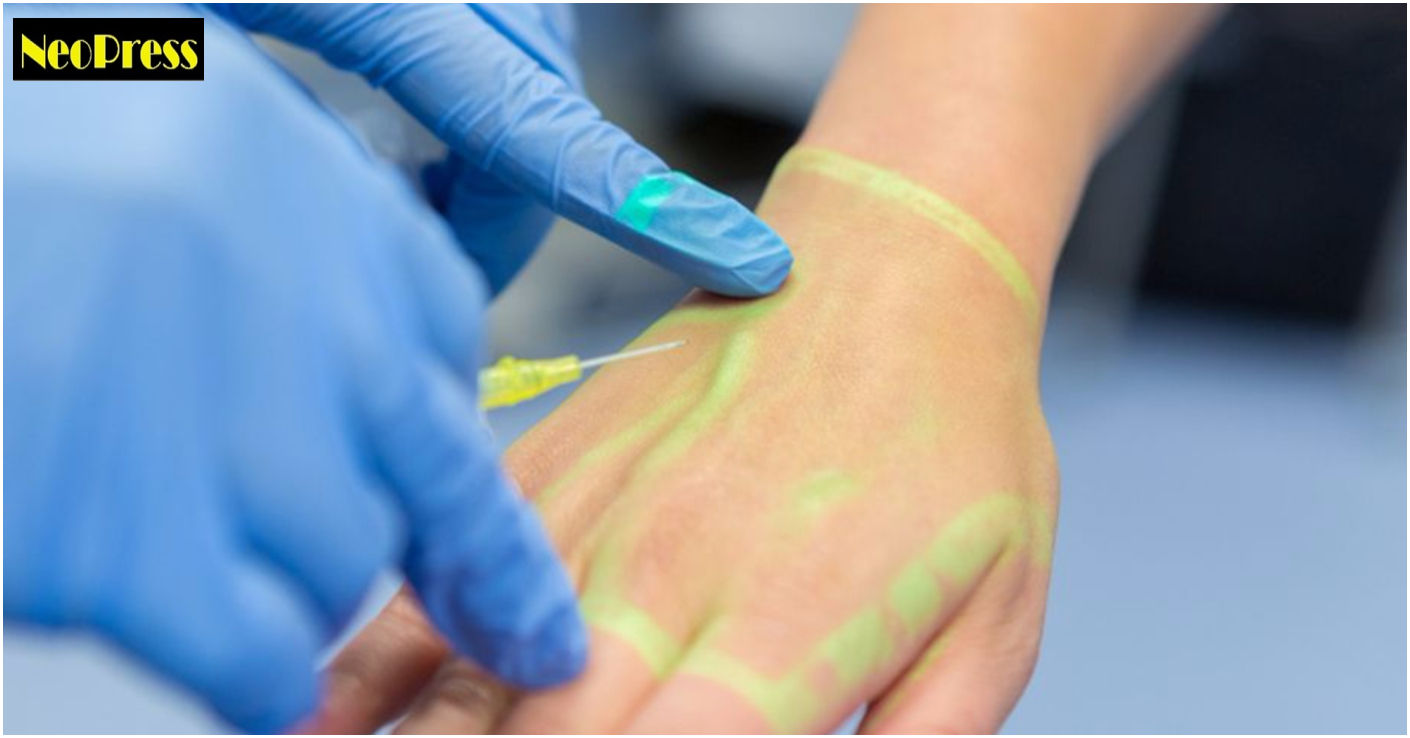
Kochi-based Medtra Innovative Technologies has come out with a device to identify veins easily for intravenous treatment and at a cost lower than in the global market.
The device named Veineux was launched on Friday and is expected to make intravenous treatment easier and affordable for patients and hospitals.
There are several issues with identifying veins for injecting medicines or drawing blood samples which get complicated if the vein is that of a child, an obese or aged person or the languid vein of a chemotherapy patient.
Such situations which warrant repeated slapping, pressing, warming and palpating the veins with repeated jabs are often clumsy and painful, with even experienced nurses and anesthetists finding it difficult to trace some veins, a statement said.
Sujith Surendran, MD of Medtra Innovative Technologies, and Saj Sulaiman, chairman of the company, both of who are biomedical engineers, developed the new instrument. It works using infra red technology and costs less than half those made in the US and China.
“The Veineux uses augmented reality based technology to find the vein. Medtra has set up a production facility here and is now listed under ‘Make in India’ project,” said Surendran.
As a technology lover you may like our daily important technology news series. It’s a playlist and you can retrieve the total day-wise videos. Please consider subscribing our YouTube channel:
Chinese smartphone maker Lenovo will unveil its flagship device K8 Note in India on August 9.
“New KillerNote uncaging on 09.08.17,” the company said in a statement on Monday. Earlier, it was expected the new addition in Lenovo’s Note series would be K7 Note.
The reason Lenovo decided to skip on the K7 Note remains unclear. Chinese smartphone manufacturer OnePlus also skipped on the number 4 and launched OnePlus 5 after OnePlus 3T.
Similarly, South Korean tech giant Samsung skipped Galaxy Note 6 and unveiled Note 7 last year. Specifications of the upcoming K8 Note were recently leaked on Geekbench benchmarking site which suggests that it is likely to house a deca-core MediaTek Helio X20 Helio SoC coupled with 4GB RAM.
The smartphone will run Android 7.1.1 Nougat OS out of the box, the listing adds. It is also expected to sport a 5.5-inch screen with a resolution of 1920 x 1080 pixels.
As a technology lover you may like our daily important technology news series. It’s a playlist and you can retrieve the total day-wise videos. Please consider subscribing our YouTube channel:
In 1957 the Soviet Union shocked the world by flying the first artificial satellite, Sputnik 1, an 83-kilogram metallic orb about twice the size of a basketball that broadcast a radio message to anyone listening down on Earth. Now, we have Breakthrough Starshot, the $100 million initiative aiming to send robotic missions to nearby stars by the mid-21st century. It has been successful in lifting its first spacecraft—the smallest ever launched and operated in orbit.
Breakthrough Starshot sent not one but six satellites into low-Earth orbit, riding as supplementary payloads on an Indian rocket launching two other educational satellites built by the European space company OHB System AG.
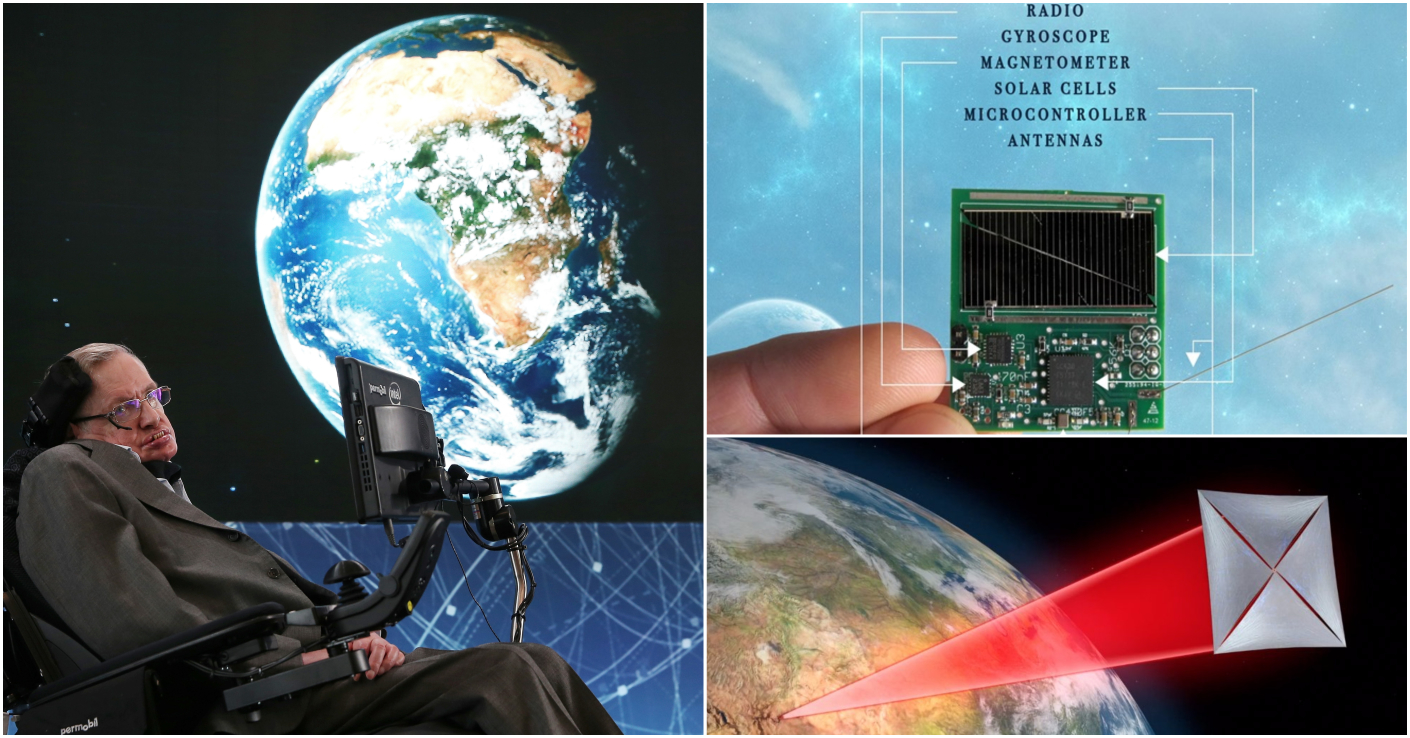
These six satellites are comparatively dainty, but punch far above their weight. Called “Sprites,” each is a 4-gram flake of circuit-board just 3.5 centimeters on a side, packing solar panels, computers, sensors and communications equipment into an area equal to a U.S. postage stamp.
Manufactured in bulk, low-cost Sprites could be deployed and networked by the hundreds or thousands to create space-based sensor arrays of unprecedented breadth, with each craft so lightweight that it could operate without propellant, shifting or maintaining its orbit solely through the radiation pressure of starlight or the forces imparted by a planet’s magnetic field.
Representatives of Breakthrough Starshot, which is funded by the Russian billionaire Yuri Milner, brokered the deal that sent the Sprites piggybacking to orbit. They also worked with the U.S. State Department to ensure the project did not violate strict federal regulations limiting exports of spaceflight hardware.
More wildly, future iterations of Sprites could become Breakthrough’s hoped-for “StarChips”—spacecraft integrated with gossamer-thin, meter-wide “lightsails” that would travel at 20 percent the speed of light to Alpha Centauri or other nearby stars, propelled by high-powered pulses of photons from a gargantuan ground-based laser array.
“This is a very early version of what we would send to interstellar distances,” says Pete Worden, Breakthrough Starshot’s executive director and former director of NASA’s Ames Research Center. “In addition, this is another clear demonstration that it is possible for countries to work together to do great things in space. These are European spacecraft with U.S. nanosatellite payloads launching on an Indian booster—you can’t get much more international than that.”
The Sprites’ revolution, however, is not being televised, and is presently struggling just to be heard on the radio. One Sprite apiece is attached to the outside of each mothership—the Latvian Venta satellite and the Italian Max Valier satellite, the latter of which also holds four additional Sprites awaiting deployment into space as wholly independent spacecraft. Radio telemetry from minuscule magnetometers and gyroscopes on the deployed Sprites would then be used to track the spacecraft as they shift, spin and tumble, to better understand their orbital dynamics.
“We’ve gotten signals from at least one Sprite, but we’re not sure which because we haven’t received two signals simultaneously,” says Zac Manchester, a post-doctoral researcher at Harvard University who is helming the project for Breakthrough Starshot.
Ground stations in California and New York have received radio signals from at least one of the exterior-mounted Sprites, but mission controllers are struggling to establish communications with the Max Valier, which may have failed to deploy its own radio antenna.
Despite the setback, Worden is bullish on the mission’s value. “Our primary objective was to show that a Sprite’s communications and power systems could work in space—that’s the baseline data we need to pursue further steps,” he says. “From our perspective, this experiment has been 100 percent successful.”
Manchester says each Sprite generates only 100 milliwatts of electricity in direct sunlight. That’s scarcely enough to sustain a typical wireless router’s antenna, but sufficient in ideal circumstances to transmit data down from low-Earth orbit at a rate akin to that of a fax machine. More impressively, those 100 milliwatts are also enough to operate Sprite’s onboard microprocessors, which surpass many full-sized satellites from the 1990s in terms of raw computing power.
In 2011 during its penultimate mission the Space Shuttle Endeavour delivered three to the International Space Station (ISS), where they were mounted outside for three years as part of a materials-science experiment. That mount faced away from Earth, preventing their signals from reaching the planet. But once brought back from space the Sprites were still in working order- Sprites have previously withstood long-term exposure to space.
Another demonstration attempt occurred in 2014, when a crowd-funded, shoebox-sized “KickSat” ferried a hundred of the featherweight spacecraft into orbit. But those Sprites could not be deployed from the short-lived KickSat due to concerns that they might create (or become) uncontrollable pieces of space debris that could pose grave risks to astronauts who were in a Soyuz rocket en route to the ISS at the time.
Before they ever reach the stars, Manchester says, Sprites are more likely to first form three-dimensional antennas in deep space to monitor space weather that could threaten Earthly power-grids and orbiting spacecraft.
According to Worden, that would be a powerful new paradigm for space science. “Eventually, every mission that NASA does may carry these sorts of nanocraft to perform various measurements,” he says. “If you’re looking for evidence of life on Mars or anywhere else, for instance, you can afford to use hundreds or thousands of these things—it doesn’t matter that a lot of them might not work perfectly. It’s a revolutionary capability that will open up all sorts of opportunities for exploration.”
Manchester believes larger interplanetary probes could deploy swarms of Sprites to pepper promising asteroids, moons and planets with sensors seeking out mineral deposits or signs of extraterrestrial life.
As a technology lover you may like our daily important technology news series. It’s a playlist and you can retrieve the total day-wise videos. Please consider subscribing our YouTube channel:
Days after Tesla CEO Elon Musk said that artificial intelligence (AI) was the biggest risk, Facebook has shut down one of its AI systems after chatbots started speaking in their own language defying the codes provided.
According to a report in Tech Times on Sunday, the social media giant had to pull the plug on the AI system that its researchers were working on “because things got out of hand”. “The AI did not start shutting down computers worldwide or something of the sort, but it stopped using English and started using a language that it created,” the report noted.
Initially the AI agents used English to converse with each other but they later created a new language that only AI systems could understand, thus, defying their purpose. This led Facebook researchers to shut down the AI systems and then force them to speak to each other only in English.
In June, researchers from the Facebook AI Research Lab (FAIR) found that while they were busy trying to improve chatbots, the “dialogue agents” were creating their own language. Soon, the bots began to deviate from the scripted norms and started communicating in an entirely new language which they created without human input, media reports said.
Using machine learning algorithms, the “dialogue agents” were left to converse freely in an attempt to strengthen their conversational skills. The researchers also found these bots to be “incredibly crafty negotiators”.
“After learning to negotiate, the bots relied on machine learning and advanced strategies in an attempt to improve the outcome of these negotiations,” the report said. “Over time, the bots became quite skilled at it and even began feigning interest in one item in order to ‘sacrifice’ it at a later stage in the negotiation as a faux compromise,” it added.
Although this appears to be a huge leap for AI, several experts including Professor Stephen Hawking have raised fears that humans, who are limited by slow biological evolution, could be superseded by AI. Others like Tesla’s Elon Musk, philanthropist Bill Gates and ex-Apple founder Steve Wozniak have also expressed their concerns about where the AI technology was heading.
Interestingly, this incident took place just days after a verbal spat between Facebook CEO and Musk who exchanged harsh words over a debate on the future of AI. “I’ve talked to Mark about this (AI). His understanding of the subject is limited,” Musk tweeted last week.
The tweet came after Zuckerberg, during a Facebook livestream earlier this month, castigated Musk for arguing that care and regulation was needed to safeguard the future if AI becomes mainstream. “I think people who are naysayers and try to drum up these doomsday scenarios — I just, I don’t understand it. It’s really negative and in some ways I actually think it is pretty irresponsible,” Zuckerberg said.
Musk has been speaking frequently on AI and has called its progress the “biggest risk we face as a civilisation”. “AI is a rare case where we need to be proactive in regulation instead of reactive because if we’re reactive in AI regulation it’s too late,” he said.
As a technology lover you may like our daily important technology news series. It’s a playlist and you can retrieve the total day-wise videos. Please consider subscribing our YouTube channel: