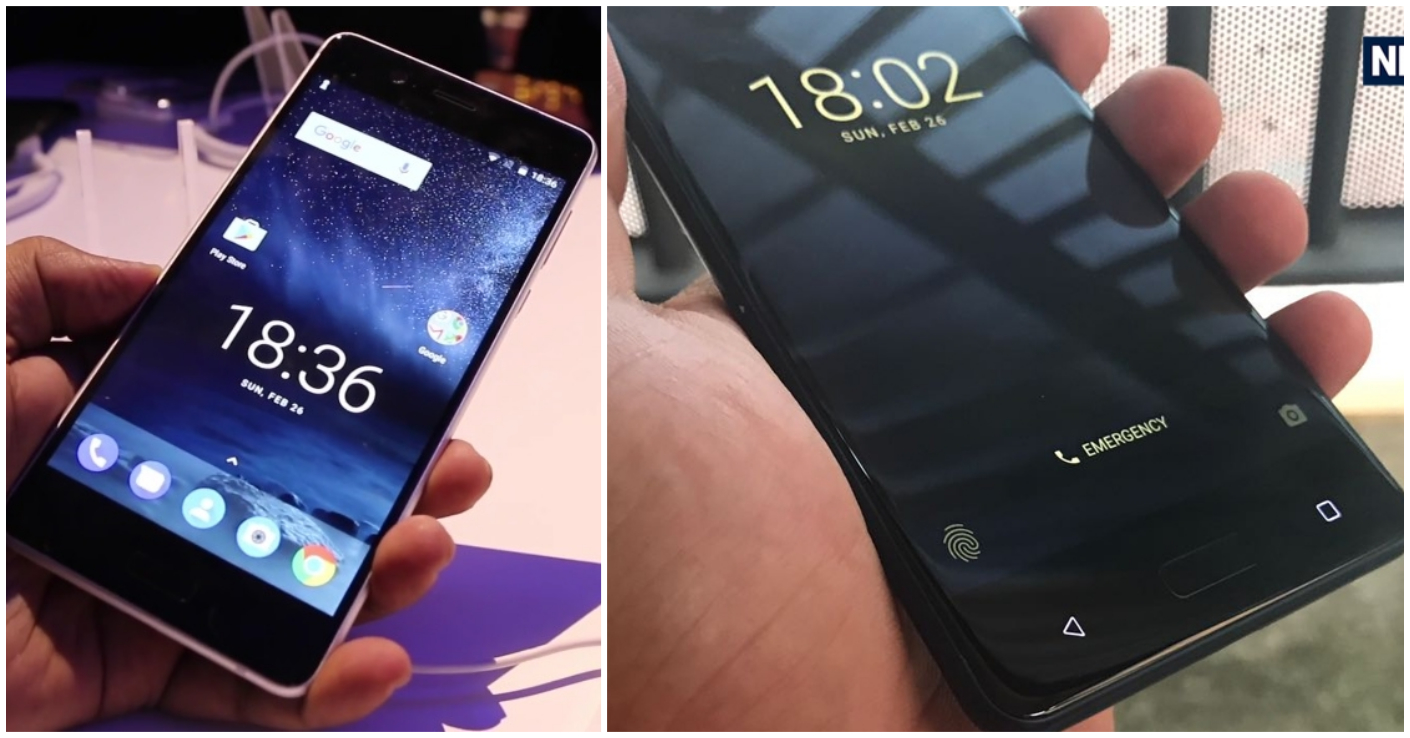
The new Nokia Android smartphone phones are manufactured by Foxconn and while Nokia 3 started selling in India a few weeks back, the Finnish startup has announced when the mid-range phone is expected.
It seems that given the overwhelming demand for Nokia 3 across all markets, HMD Global had focussed its manufacturing resources on this phone initially.
“We are humbled by the response to Nokia 3. Currently, we are ramping up our production for Nokia 3 on priority to meet the existing consumer demand. In the coming weeks, we will start production of Nokia 6 and Nokia 5 to get them ready for sales start by mid-August,” an HMD spokesperson said.
While the Nokia 6 pre-bookings will be on Amazon India, the Nokia 5 pre-bookings were announced for “select mobile retail outlets” across Delhi NCR, Mumbai, Bengaluru, Chennai, Chandigarh, Jaipur, Kolkata, Lucknow, Indore, Hyderabad, Pune, Ahmedabad and Kozhikode.
HMD Global has announced a network of over 400 distributors to support its new range of Nokia Android smartphones and feature phones. This network, HMD hopes, will help the new Nokia devices to be made available at more than 80,000 retail outlets across the country.
The Nokia 3, priced at Rs 9,499 has been a huge hit in India. The Nokia 5 and Nokia 6 are priced at Rs 14,999 and 12,899, respectively.
HMD Global announced the availability of Nokia 3, Nokia 5 and the Nokia 6 smartphones in India this June. While Nokia 3 went on sale June 16, the company had just announced pre-bookings for the Nokia 5 starting July 7 and Nokia 6 from July 14.
As a technology lover you may like our daily important technology news series. It’s a playlist and you can retrieve the total day-wise videos. Please consider subscribing our YouTube channel:
A handful of people advising Musk urged him to make small, cheap rockets that would bring the cost of getting something into orbit down to $5 million from the going rate of about $100 million. This was before SpaceX, and in the years that followed, Space Exploration Technologies Corp. did manage to lower launch prices drastically, but it stuck to making bigger spaceships instead of pursuing the radical approach that some of Musk’s advisers desired.
Two people who were formerly on Musk’s team have now emerged with their own rocket startup called Vector Space Systems. They have radical plans and then some. Vector’s goal is to make a $1.5 million rocket that can carry small satellites into orbit. It expects to conduct 100 launches per year—a figure that would match the annual capacity of the entire aerospace industry. To help meet this goal, Vector told Bloomberg that it raised $21 million from some of Silicon Valley’s largest venture capital firms, including Sequoia Capital, Shasta Ventures and Lightspeed Venture Partners.
“While Elon made space safe for investors, he did not fix the launch problem,” said Jim Cantrell, co-founder and chief executive officer of Vector. “We are making the rockets as simple as they can be made, building them like sausages and launching by the hundreds.”
One of the rocket builders Musk visited in Los Angeles during the early years of SpaceX was John Garvey, a former engineer at manufacturer McDonnell Douglas. Garvey had long fantasized about making very small, very cheap rockets and maintained a workshop to pursue his designs. He’s now chief technology officer at Vector, and Cantrell has helped find the money to turn his prototypes into a commercial business.
Cantrell is something of a connector in the aerospace world. He’s spent decades helping companies arrange deals for launches and assessing the business plans of startups. Most famously, Cantrell accompanied Musk on a handful of trips to Russia in a bid to negotiate the purchase of intercontinental ballistic missiles that Musk hoped to use as rockets. When those negotiations fell apart, Musk set off to start SpaceX in 2002 and build his own rockets.
While SpaceX’s workhorse is the Falcon 9 rocket, which stands 230 feet tall and can take 50,000 pounds of gear to low-Earth orbit. Typically, the Falcon 9 will carry a bus-sized satellite or ferry supplies to the International Space Station for about $60 million a pop—about a fifth of what its rival United Launch Alliance LLC charges, Vector, though, is betting on the coming wave of smaller, cheaper satellites known as CubeSats to be the core of its business.
These devices are about the size of a shoebox and have just started becoming popular in recent years as improvements in electronics and software have made it possible to shrink satellites drastically. Planet Labs Inc., a startup in San Francisco, is the best-known CubeSat maker. It has a constellation of 160 satellites circling the Earth, taking daily pictures of the planet’s landmass. Other small satellite makers are rushing to market with machines that take pictures, perform communications and conduct experiments in zero gravity.
The top performers in the launch business, like SpaceX and Europe’s Arianespace SA, conduct about one liftoff per month. Both Rocket Lab and Vector want to ratchet up this cadence. “We think the market will be on the order of 400 to 500 launches a year,” said Cantrell. “There is room for four or five launch providers.”
Several rocket-launch companies have appeared in the U.S. and overseas to serve as ferries for small satellites. The most successful to date is Rocket Lab, which just completed its first test launch from New Zealand. Its rockets can carry more weight than Vector’s and cost $5 million per flight.
Vector, which started operations 18 months ago, has been testing early versions of its rockets in the Mojave Desert, although it has not yet tried to reach orbit. While Rocket Lab has a private spaceport, Vector will be looking to fly from government-run launch pads in Alaska, Florida and Georgia. “We will be able to launch in three to four hours from standing the rocket up, to fueling it, to gone,” said Cantrell.
About eight small satellites could fit inside of a Vector-R rocket and close to 30 could fit in the larger Vector-H rocket that is due to be built over the next 18 months, according to Cantrell. The company will have its next test flight in late July or early August and aims to be flying commercially by mid-2018.
The price per pound on the large rockets from SpaceX and others is still more economical. But it’s the flexibility of requesting a launch, almost like you’d order something on Amazon.com, that could end up being more attractive than pure cost.
As a technology lover you may like our daily important technology news series. It’s a playlist and you can retrieve the total day-wise videos. Please consider subscribing our YouTube channel:
Nokia 3, Nokia 5 and Nokia 6 release plans are out of the way and all we can think of is Nokia 8. Press renders of the smartphone have been outed, giving away the Nokia 8 design details with Carl Zeiss optics and dual camera setup. This leak comes a day after a report pegged July 31 as the launch date for the smartphone.
Considered the true Nokia flagship after the mid-range budget handsets unveiled so far, the Nokia 8 flagship’s blue colour variant is seen sporting a metal body and a vertical dual camera setup at the back. The lenses are Zeiss branded, making this the first smartphone to be leaked with this after the announcement of HMD Global and Zeiss partnership earlier this month. This press render has been posted by tipster extraordinaire Evan Blass (aka @evleaks).
Also leaked was the dual camera module separately showing two camera lenses, a flash at the bottom, and an extra hole presumed to be for laser autofocus. The Nokia 8 is tipped to run on Android 7.1 Nougat and sport a 5.3-inch QHD display. It is expected to be powered by the Snapdragon 835 processor.
There’s a Home Button in the front with hardware capacitive keys on either side for navigation. The volume and power keys both are seen situated on the right edge of the device, while the 3.5mm audio jack is seen sitting on the top edge. It is largely expected to be priced at EUR 589 (roughly Rs. 43,400) and at launch, will be available in four colour options – Blue, Steel, Gold/Blue, and Gold/Copper.
Nokia 8 may launch with 4GB RAM and 64GB storage initially, though the rumoured 6GB RAM and 8GB RAM variant may see the light of the day a little bit later. Two 13-megapixel rear lenses from Carl Zeiss are a possibility, and a 13-megapixel front camera is expected as well. The dimensions are tipped to be at 151.55×73.7mm.
As a technology lover you may like our daily important technology news series. It’s a playlist and you can retrieve the total day-wise videos. Please consider subscribing our YouTube channel: