Scientists Finally Developed a Model for Time Travel- But Will It Ever Be a Reality?

Countless fiction like H.G Wells’, The Time Machine and the iconic Hollywood movie ‘Back to the Future’ have done nothing but aggravate the hype surrounding time travel. Now, bringing the fictional concept closer to reality, a US scientist has developed a mathematical model for a viable time machine.

“People think of time travel as something as fiction. And we tend to think it’s not possible because we don’t actually do it. But, mathematically, it is possible,” said Ben Tippett, from University of British Columbia in Canada, who used Math and Physics to create the brilliant formula.

In 1915, German scientist Albert Einstein announced his theory of general relativity, stating that gravitational fields are caused by distortions in the fabric of space and time. And more than 100 years later, the LIGO Scientific Collaboration – an international team of physics institutes and research groups – announced the detection of gravitational waves generated by colliding black holes billions of lightyears away, confirming Einstein’s theory.

“The division of space into three dimensions, with time in a separate dimension by itself, is incorrect,” said Tippett.

Using Einstein’s theory, Tippett said that the curvature of spacetime accounts for the curved orbits of the planets. The four dimensions should be imagined simultaneously, where different directions are connected, as a space-time continuum.

In “flat” spacetime, planets and stars would move in straight lines. In the vicinity of a massive star, space-time geometry becomes curved and the straight trajectories of nearby planets will follow the curvature and bend around star.

“The time direction of the space-time surface also shows curvature. There is evidence showing the closer to a black hole we get, time moves slower,” said Tippett. “My model of a time machine uses the curved space-time to bend time into a circle for the passengers, not in a straight line. That circle takes us back in time.”

Now, for the question of actually making this model a reality- “HG Wells popularised the term ‘time machine’ and he left people with the thought that an explorer would need a ‘machine or special box’ to actually accomplish time travel,” Tippett said.

“While is it mathematically feasible, it is not yet possible to build a space-time machine because we need materials – which we call exotic matter – to bend space-time in these impossible ways, but they have yet to be discovered.”

As a technology lover you may like our daily important technology news series. It’s a playlist and you can retrieve the total day-wise videos. Please consider subscribing our YouTube channel:

Author: Technology Vista

Tagged : /

Surprise Your Friends! You Can Schedule Whatsapp Messages by Following This!

Scheduling a text/email/reminder/notification is always convenient. It could help you remember and greet people on birthdays, without having to stay up till midnight and could prevent you from forgetting to pick up groceries. Did you know you could schedule your WhatsApp texts?

There are a handful of apps available on the Google Play Store that let you schedule not just WhatsApp messages, but also images and videos. The best part is that the basic functionality works on both rooted and unrooted Android smartphones. Of course, there might be limitations with the basic version, and you may have to upgrade to premium for all the functions to work. But, let’s look at some of the WhatsApp scheduler apps available in Store.

‘Scheduler for WhatsApp’ and ‘Scheduler NO ROOT’ are among the ones that are easy to use, and worked well for me. And for those who have a rooted Android device, the ‘Seebye Scheduler ROOT’ would do the trick.

After installing any of the mentioned apps, simply open it and give the required permissions. Next, you’ll also have to head over to Settings -> Accessibility -> Services and enable the service. Once this is done, you’re all set to go.

Do note, for the message to be sent, the device’s screen should be unlocked, and there should not be any screen lock – such as PIN, Pattern or Fingerprint lock. This may sound odd, but due to security concerns, these apps cannot bypass security screen. So, if you have set a schedule to send a WhatsApp message at 12:00PM, and you unlock the screen at 1:00PM, it only will be sent then. However, if you have a rooted Android device, the app can bypass the security screen and send the message right away.

Now, to schedule WhatsApp messages, open ‘Scheduler for WhatsApp’ and tap on the ‘+’ icon on the bottom left. Here, you’ll have to select choose between WhatsApp group or individual contact, followed by selecting the recipient. Next, you’ll have to select the date and time when you want to send the message, followed by frequency and message. The frequency of the scheduled messages can be once, daily, weekly, monthly or yearly.

Have fun!

As a technology lover you may like our daily important technology news series. It’s a playlist and you can retrieve the total day-wise videos. Please consider subscribing our YouTube channel:

Author: Technology Vista

Tagged : /

GSLV Mk III Launch Success Means India Can Realise Manned Space Mission Dream

After more than 33 years of Rakesh Sharma being the only Indian citizen to travel to space, the Indian Space Research Organisation (ISRO) is ready with a plan to put a two-three member human crew into space soon.

The Indian Space Research Organisation (ISRO) today successfully launched a 3,136-kg GSAT-19 communication satellite into space through a monster launch vehicle, GSLV Mk-III. Now, besides reducing India’s dependence on foreign launch vehicles to place its satellites in space, the GSLV Mk-III can help India realise its dreams of launching its own manned space mission.

“In principle, it will be the GSLV Mk-III or its variant that will be human rated in future,” ISRO chairman A S Kiran Kumar was quoted by PTI. The GSLV Mk-III, or the Geosynchronous Satellite Launch Vehicle-Mark III, can place up to eight tonnes in a low Earth orbit–this is enough to carry India’s crew module into space.

In October 2016, China sent two astronauts on longest-ever manned mission to space. It is also working towards establishing its permanent space station by 2022. According to some reports, the estimated cost of India’s manned space mission is pegged at Rs 12,400 crore. The project is already running late, and the ISRO is now looking at 2024 deadline to put Indians on space.

Currently, India uses the French Ariane-5 rocket launched from Kourou in South America to place its heavy four-tonne class of communication satellites. If the manned space mission takes off, India would join the United States, Russia and China to have a human spaceflight programme.

The GSLV Mk-III will help India save millions of dollars that it spends to use launch vehicles of other countries to put its heavier satellites into space. With the GSAT-19 launch, the ISRO has almost doubled its capacity to launch satellites from 2.3 tonnes to almost four tonnes.

“After a couple of developmental flights to establish, I am sure there will be opportunities for launching even foreign communication satellites,” former ISRO Chairman K Radhakrishnan was quoted by PTI.

ISRO’s success with GSLV Mk-III will also open up new markets where other countries can use it as a launch vehicle to put their satellites in space.

width="560" height="314" allowfullscreen="allowfullscreen">

As a technology lover you may like our daily important technology news series. It’s a playlist and you can retrieve the total day-wise videos. Please consider subscribing our YouTube channel:

Author: Technology Vista
Tagged : /

Three Stunning Changes iPhone 8 Is Rumoured to Bring

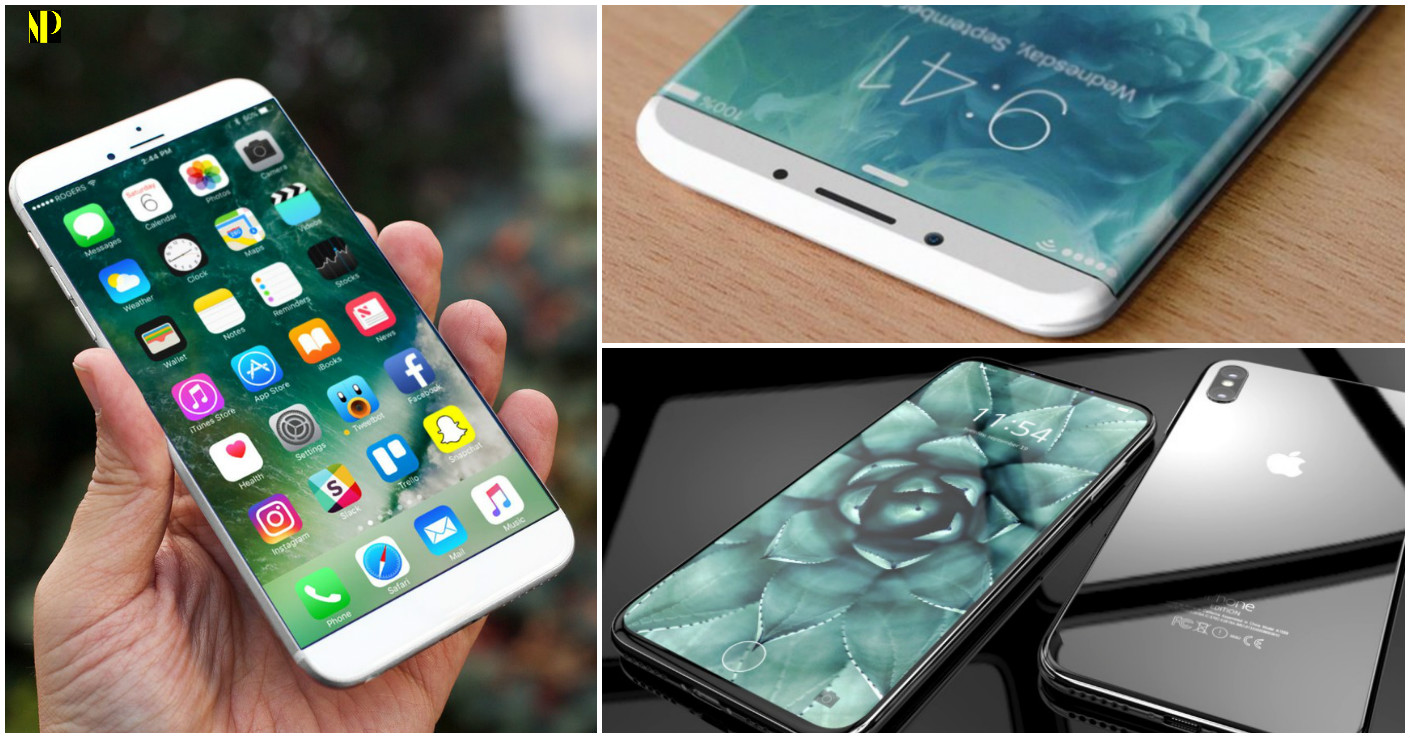
Since September last year we have been speculating about how the next iPhone would turn out to be. As per latest details coming in from some confirmed sources, there would be three major changes in the iPhone 8 design that will renew our entire notion of iPhones.

As per Forbes, which has received some insider details about the new design, Apple will introduce an aspect ratio of 18:5:9, which is more or less like that of Samsung Galaxy S8 and LG G6. With this aspect ratio, the new iPhone 8 will have an elongated look, which is a massive alteration in their design module. This new design of the screen will help Apple to increase the display size, while at the same time keeping it narrow enough to help the user to hold it comfortably.

This has been revealed by chipset maker TSMC.

But, the problem with this design is that the back button becomes somewhat harder to reach. We suppose Apple is working on this. Or maybe they’re going to get rid of the back button altogether!

The new elongated size of the display area means that the overall design of the handset needs to be altered and drastically changed. And, the report from Forbes suggests that the home button may be scrapped for good, and Touch ID mechanism shall be integrated into the display.

Such massive design changes also mean that the new iPhone 8 shall have a nearly bezel-less design, and the front camera will not be under the display. The key function area, which is below the screen, would be modelled on MacBook Pro style touch bar, which can replace the Home Button with contextual controls.

Lastly, the biggest, most exciting change is the Augmented Reality ready camera. The new camera would be equipped with invisible infrared image sensors, which will not only enhance the quality of the camera but will also enable AR applications.

The new iPhone 8 would be launched in the month of October 2017, according to reports.

width="560" height="314" allowfullscreen="allowfullscreen">

As a technology lover you may like our daily important technology news series. It’s a playlist and you can retrieve the total day-wise videos. Please consider subscribing our YouTube channel:

Author: Technology Vista
Tagged : /

Your skin is the next hi-tech smart wearable but would you like it?

Smart wearables have entered the lives of all of us. When they were introduced they made us wonder and gawk at them or people wearing them but now when they are quite common people react to them quite normally. Smart watches have found place in almost everybody’s life but not everybody likes them. Well you know the reason… the space constraint. You feel tied up when you have to see things in such a small space. But you also feel loaded when you have to carry those heavy smartphones in your pocket. Humans never seem to get satisfied with anything.

photo05

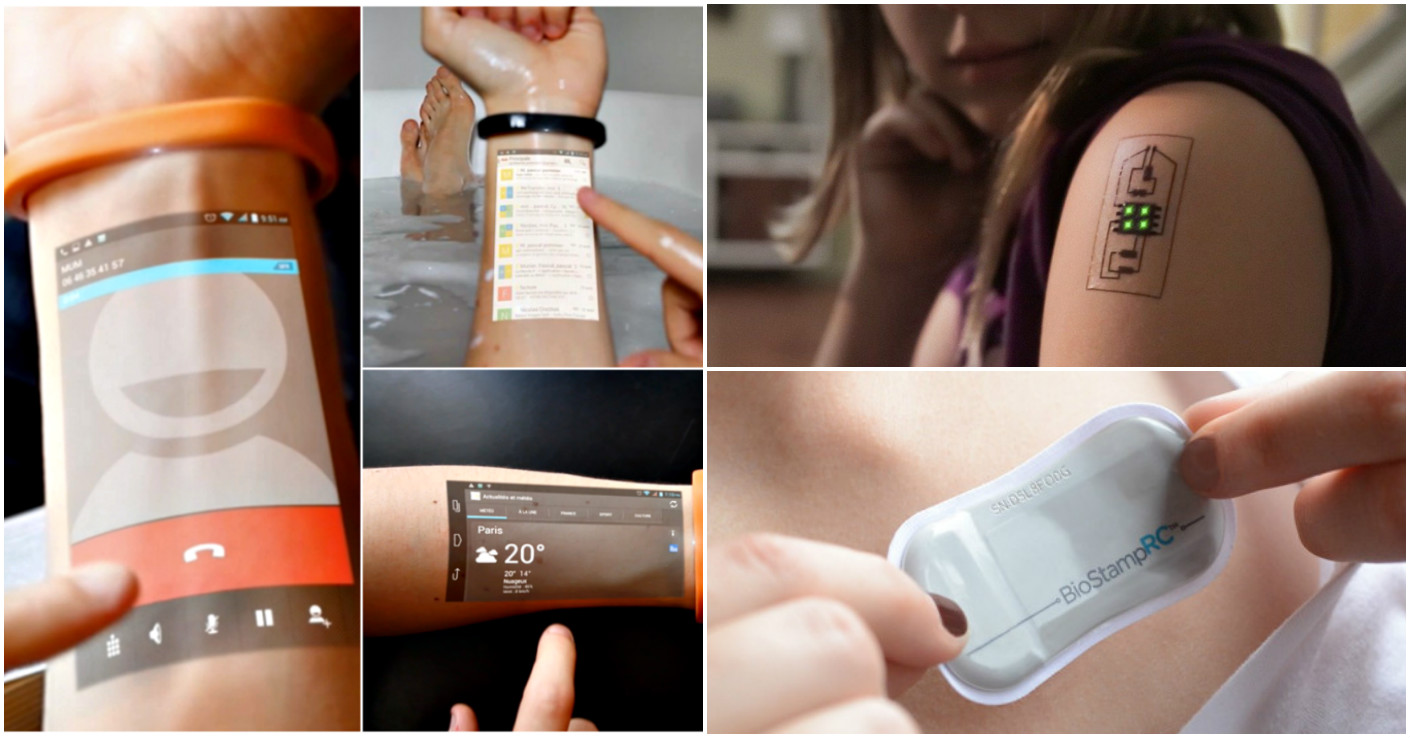
But imagine, what would happen if your skin became your smartphone? Yes you may laugh at that but the day is not too far when you will be among many people using your skin as your favourite smartphone. Believe it or not, artificial electronic skin (e-skin) could be a real possibility one day. Researchers at this very moment are busy developing flexible, bendable and stretchable electronic circuits that can be applied directly to the skin. This will simply turn your skin into a touchscreen.

The components of a typical e-skin are: flexible transistors, organic LEDs, sensors and organic photovoltaic (solar) cells – connected to each other by stretchable or flexible conductive wires. We actually have e-skin devices now that can detect approaching objects and measure temperature and applied pressure. This technology has also lead to the creation of bendable screens which has prompted one company to turn the human skin into a real smartphone using pico sensors and a pico projector.

As exciting as it may sound, the questions will still linger in the air! Will organic electronics be as reliable as their metallic or plastic or fibre counterparts? Do wrinkles on skin affect the capability of these? Because atoms in organic materials like skin are more chaotically organised than the inorganic materials used to make traditional electronics. This means electrons move 1,000 times slower in organic materials, so devices made from them will operate much more slowly and wouldn’t deal as well with the heat the circuits generate.

next-wearable-technology-could-be-your-skin-3

The other big issue is the ethical one, who can ensure that the integrating e-skin with the human body will not lead to any medical complications in the long run? What is the guarantee that these devices will not lead to horrible tumours in the body of the person using it? How many of you would actually want to wear your smartphones on your skin and how many of you would feel comfortable doing that for hours in a day? All these questions are sensible and need to be addressed with responsibility. As long as these questions remain unanswered or are left ignored, there is no point in supporting technology like e-skin. Human body is too great a cost to pay for a little comfort.

width="560" height="314" allowfullscreen="allowfullscreen">

As a technology lover you may like our daily important technology news series. It’s a playlist and you can retrieve the total day-wise videos. Please consider subscribing our YouTube channel:

Author: Technology Vista

Verified by ExactMetrics