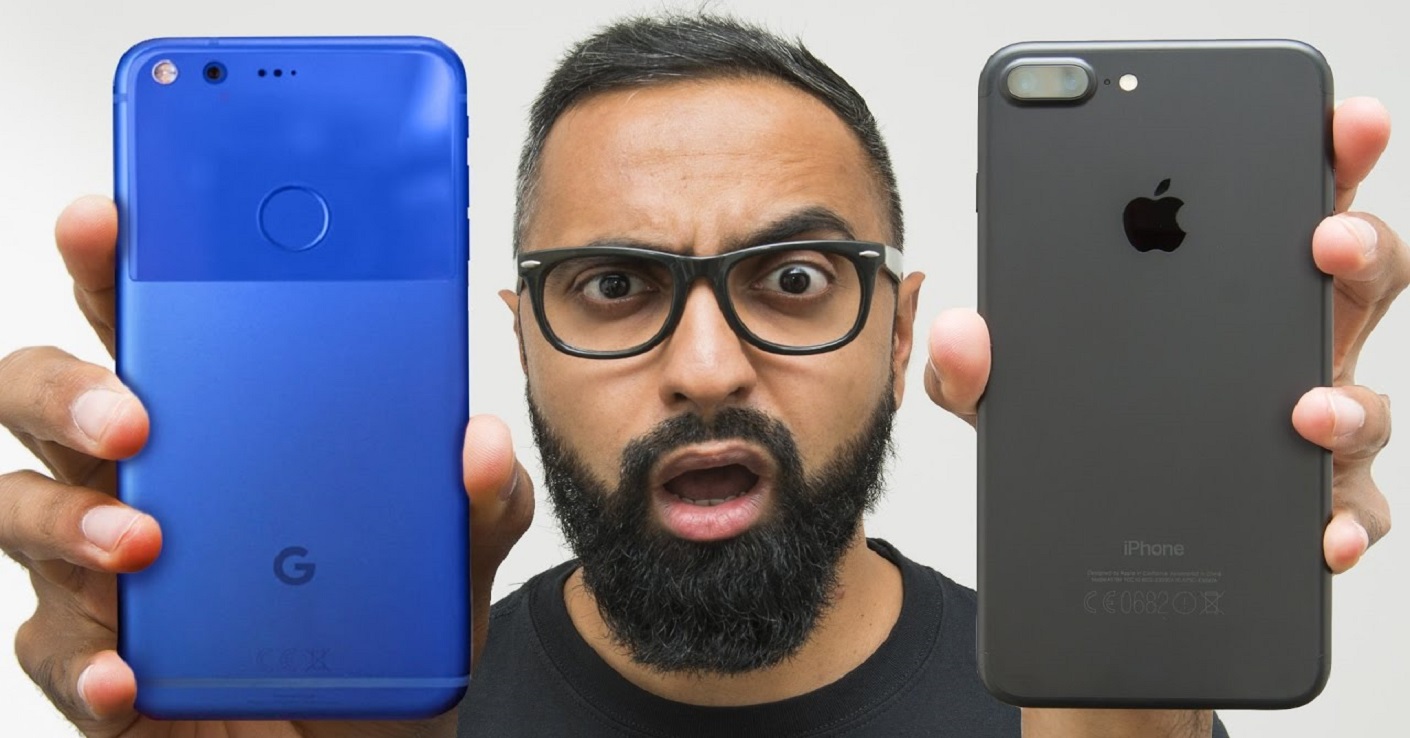
Why do people continue to buy iPhone 7 after the great success of Google Pixel XL?

Although receiving brilliant reviews, Google Pixel XL sales still shy away when it comes to Apple’s iPhone 7. Why is that? What’s ensuring this strong customer loyalty?

It is somewhat ironic that the iPhone 7 Plus considerably outperforms the Google Pixel XL in this area, considering that Apple has often been criticized for the relatively paltry battery life of its mobiles. Also, the stereo system included in the iPhone 7 Plus is simply superior and has been compared to the BoomSound Hi-Fi of the HTC 10, providing the Apple phablet with an extra kick in this department.

In tests, the iPhone 7 Plus delivered over nine hours of battery life on a single charge, which is around 20 percent more than the Google Pixel XL was able to deliver. It is surprising that there is such gulf between the two, but this can perhaps be explained by the superior screen resolution in the Google device. While, the bass speaker and tweet included in the iPhone 7 Plus ensures that music and sound quality produced by this smartphone are simply outstanding, enhancing music, video and games and resulting in many happy iPhone consumers.

On the question of durability, while the Pixel XL will receive updates for at least two more years, with security updates lasting three years, the iPhone 7 Plus is guaranteed four years of software updates. This will ensure that the Apple phablet is functional until iOS 14 is released in 2020. On this basis, there is no doubt that the iPhone simply has a longer shelf life. Apple has also made a big deal of the health-tracking capabilities of its product range in 2016, and among this was the inclusion of waterproofing in the iPhone 7 range. While the Pixel XL is pretty resilient in most respects, it is not actively water-resistant, or at least is not acknowledged as such by the manufacturer.

The iPhone 7 is officially certified IP67 for water and dust-resistance, meaning that the phablet is simply more durable than its Google rival.

While the Google Pixel XL is a pretty exciting device when first taken out of its box, over time it begins to slow down rather rapidly. There are various reasons for this, but what can be said in response is that Apple devices are notorious for retaining the same quality of performance over a staggering length of time. The MacBook series is particularly renowned for this quality, but it is almost equally applies to the iPhone 7 range as well.

Next Page For More

Tagged : /

Here’s how India’s ISRO managed to Launch 104 Satellites from a Single Rocket!

Fifteenth day of February saw a new record when the Indian Space Research Organisation (ISRO) launched 104 satellites in one go on a single rocket.

ISRO’s workhorse PSLV (C37) with 104 satellites launched from the Satish Dhawan Space Centre in Sriharikota in Andhra Pradesh. With the exception of three satellites from India, the rest are from other countries.

Explaining how all the satellites will be placed in orbit, Dr. K. Sivan, Director of the Vikram Sarabhai Space Centre (VSSC), Thiruvananthapuram, said: “The satellites will be separated from the launch vehicle in different directions. The separation angle and time of separation will be such that one satellite will not collide with another.”

In June last year, ISRO launched 20 satellites in one go. It took about 26 minutes to launch all the 20 satellites. In 2008, ISRO launched 10 satellites in a single mission. The highest number of satellites launched in a single mission so far has been 37 by Russia in 2014; NASA launched 29 satellites in one go in 2013.

Even one degree difference in separation angle combined with relative velocity will ensure that no two satellites would collide. “The satellites will be injected into orbit at different locations at different angles, at different times and different orientations,” Dr. Sivan said.

The satellite separated from the launch vehicle will have a relative velocity of one metre per second. So after 1,000 seconds the distance between a satellite and the rocket will be 1,000 metres. “The satellite that gets launched first will move at a relatively faster velocity than the next satellite that is launched. Due to different relative velocities, the distance between the satellites will increases continuously but the orbit will be the same,” he said.

“When the vehicle reaches the orbital condition, we will wait for the disturbances to die down before the preparation for separation begins,” Dr. Sivan explained. At an orbital altitude of around 500 km, it would take the vehicle 90 minutes to complete one orbit. “So we have sufficient time to launch all the 103 satellites,” he added.

As a technology lover you may like our daily important technology news series. It’s a playlist and you can retrieve the total day-wise videos. Please consider subscribing our YouTube channel:

Author: Technology Vista

Tagged : /
Verified by ExactMetrics