We are probably in an accelerated path towards getting an Apple Car!

Alexander Hitzinger is the latest auto specialist to be recruited by technology giant Apple as it explores building its own car. In case you’re confused, he’s the guy who helped engineer the sports car company’s (Porsche’s)  victorious return to the Le Mans endurance race. Hitzinger helped hire and build a development team and organisational structure at Porsche, expanding from ten staff to over 150 employees. He also helped them return to endurance racing and to develop the 919 hybrid sports car from scratch. Hitzinger’s LinkedIn profile states he left Porsche in March and joined a ‘Technology Company’ located in the San Francisco Bay Area as an engineering executive in April.

Apple was recently been awarded a patent that suggests it’s much rumoured ‘Project Titan’ car project is getting closer to being revealed. The document describes technology for a collision avoidance system that is designed for robots, or self-driving cars. It is the first public patent granted for the project – although the firm last week revealed its ‘interest’ in the area in a government filing.

The patent, filed on June 7, 2015, is entitled ‘Collision Avoidance Of Arbitrary Polygonal Obstacles’. A new patent describes technology that could be the key to self-driving cars – a system that can operate in both 2D and 3D area, which computer visions systems have had difficulty doing. It describes a technique capable of avoiding collisions and navigating through unfamiliar areas by calculating distances and shapes.

The system is described as having a memory, display unit ‘and one or more processors coupled to the memory and the display unit and configured to execute program code stored in the memory to cause the one or more processors to,’ reads the patent.

If the technology detects that the edges of the object are not in its path, the vehicle will keep driving in the same motion. But if it a potential collision is predicted, ‘the system selects the edge vector closest to the vehicle’s current position and calculates the force needed to avoid the obstacle,’ reports Mikey Campbell with Apple Insider.

width="560" height="314" allowfullscreen="allowfullscreen">

As a technology lover you may like our daily important technology news series. It’s a playlist and you can retrieve the total day-wise videos. Please consider subscribing our YouTube channel:

Author: Technology Vista

Tagged : / /

There is a high probability that the Earth crashes with a Dino-Killing like Asteroid! NASA Warns

Dr Nuth, speaking at Nasa’s Goddard Space Flight Centre in San Francisco, said that if a potentially dangerous object was on a crash-course with our planet “there’s not a hell of a lot we can do about it at the moment”, according to The Guardian.

Earth had a “close encounter” with a comet in 1996 and again in 2014, when one passed “within cosmic spitting distance of Mars”, he said. Scientists had only 22 months’ warning time for the second pass, less than half the time currently needed to get a craft capable of deflecting such an object into space, Dr Nuth said. He said he had recommended Nasa build an interceptor craft and keep it in storage in order to cut down on the time it takes to organize such a mission.

He said: “They are the extinction-level events, things like dinosaur killers, they’re 50 to 60 million years apart, essentially. You could say, of course, we’re due.”

On the other hand, Dr Cathy Plesko, of Los Alamos National Laboratory, told the Guardian that humans could deflect an Earth-bound asteroid or comet with either a nuclear warhead or a “kinetic impactor, which is basically a giant cannonball”.

Large objects from outer space that could cause mass extinctions have tended to hit Earth about 50 to 60 million years apart. The dinosaurs were wiped out 66 million years ago by an asteroid that struck what is now the Gulf of Mexico. The planet is overdue for an extinction-level event involving a giant space object – such as an asteroid or comet – following a number of close encounters over the last 20 years, is what Dr Joseph Nuth.

As a technology lover you may like our daily important technology news series. It’s a playlist and you can retrieve the total day-wise videos. Please consider subscribing our YouTube channel:

Author: Technology Vista
Tagged : /

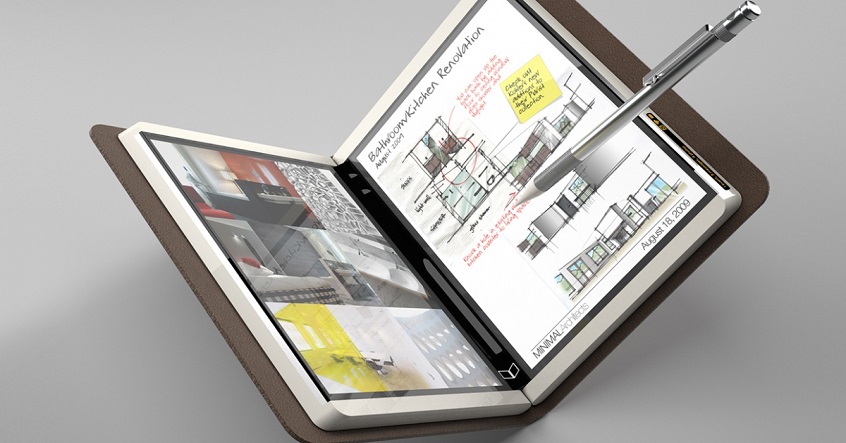
LG’s Working On Foldable Display Panels with Apple, Microsoft and Google

It’s not the first time we’re hearing about LG’s endeavors in the foldable display space. It’s actually been years since the company showed prototype units, so mass production can’t be that far ahead.

A report out of South Korea states that LG’s Display subsidiary has partnered up with Apple, Google, and Microsoft for the task of creating foldable display panels. The report doesn’t say much on when to expect actual consumer devices with foldable displays, though it does hint at a flexible OLED panel for the 2017 iPhone. But ‘flexible’ in this sense might just mean ‘curved’, and not actually foldable, not to mention that rumor has it it will be Samsung that will be delivering the bulk of those displays to Apple.

Samsung might be the pioneer in the field. It won’t be alone, though, that’s for sure, as LG Display is developing foldable OLED panels itself, with some heavyweight device manufacturers joining its team. Still, analysts speculate that Samsung might have more experience when it comes to mass producing flexible displays and thus have the upper hand.

As a technology lover you may like our daily important technology news series. It’s a playlist and you can retrieve the total day-wise videos. Please consider subscribing our YouTube channel:

Author: Technology Vista

Tagged : / /

Driverless Ship! US Navy’s 132ft Long Sea Hunter Drone Needs No Crew At All

Dubbed the ‘Sea Hunter’, the 132ft ship is designed to travel thousands of miles out at sea without a single crew member on board. It marks the first step toward sending unmanned cargo vessels between countries, according to military officials, who showed off the ship in San Diego today before it was put in the water. The Pentagon’s research arm, the Defense Advanced Research Projects Agency (Darpa) developed the ship along with Virginia-based Leidos. When it enters service, Sea Hunter will operate for around 30 to 90 days at sea without a crew, and will leave and return to port on its own. In initial testing of Sea Hunter’s autonomy capability, the ship successfully executed a multi-waypoint mission with no person directing course or speed changes.

Leidos also completed a test of the Remote Supervisory Control Station (RSCS), which allows remote supervisory control of the vessel and enables new mission tasking from a remote location, either afloat or ashore. Testing of the Sea Hunter autonomy system in a variety of mission scenarios is scheduled to continue through fall 2017 as part of a two-year test program jointly funded by DARPA and the Office of Naval Research (ONR).

Experts say the vessel has the potential to revolutionise not only the military’s maritime service but also commercial shipping. Testing in upcoming months is scheduled to include testing of sensors, the vessel’s autonomy suite, compliance with maritime collision regulations, and proof-of-concept demonstrations for a variety of U.S. Navy missions.

‘Sea Hunter is at the forefront of new autonomy technologies for the U.S. military,’ said Mike Chagnon, president of the Leidos Advanced Solutions Group.

‘The operational testing is designed to showcase the unprecedented capabilities that this type of unmanned vessel could offer our military forces.’

Next Page For More

Tagged : / /
Verified by ExactMetrics