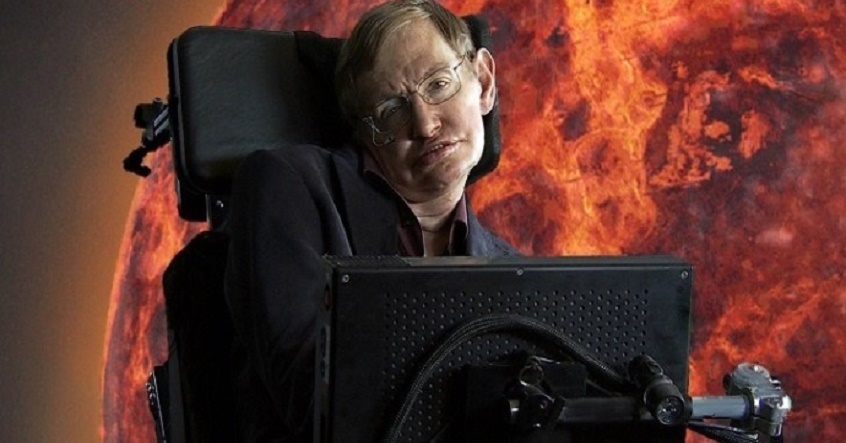
During a talk at Oxford Union debating society this week, Stephen Hawking, the renowned theoretical physicist said that humanity probably only has about 1,000 years left before we go extinct. He has also previously warned that the development of artificial intelligence could end mankind.
In his 74 years, Hawking has spoken several times about our doomed fate, with the risk of things like nuclear war increasing as well as the oncoming threat of global warming. Our only hope of escaping these dangers, says Hawking, is by finding another habitable planet.
NASA launched its Kepler spacecraft in 2009, whose mission is to do just that. It was designed to search the nearby region of our galaxy for Earth-sized planets orbiting in the habitable zone of stars similar to our sun. This zone is also called the “Goldilocks zone” because it is the range where pressure and temperature are “just right” for liquid water to exist on a planet’s surface.
“We must also continue to go into space for the future of humanity,” he said. “I don’t think we will survive another 1,000 years without escaping beyond our fragile planet,” Hawking said.
Hawking’s speech ended with him encouraging the students to stay curious and told them to remember to “look up to the stars and not down at your feet.”
This year, the astronomers were excited by the discovery of Proxima B, which is an Earth-size planet orbiting in the star Proxima Centauri’s habitable zone. It also lies just 4.2 light-years away from us, which in space terms is pretty close. So far, Proxima B looks like our best chance of escape.
As a technology lover you may like our daily important technology news series. It’s a playlist and you can retrieve the total day-wise videos. Please consider subscribing our YouTube channel:
Author: Technology and Beyond

