THIS is how future warships will look like!

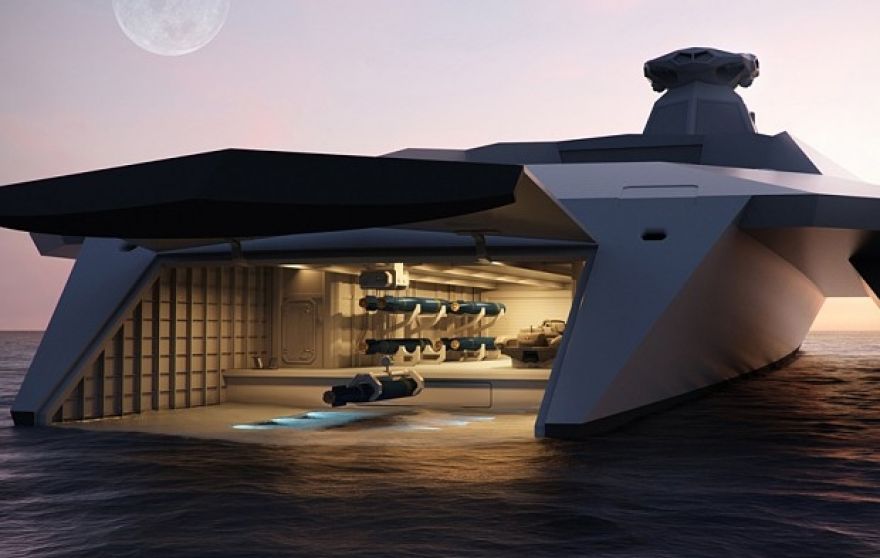
In the honour of the 1906 HMS Dreadnought, The British Ministry of Defence and Royal Navy challenged and asked young scientists to make their creative scientific horses run at full gallop to come up with the design ideas for future warships. The concept dubbed as Dreadnought 2050 invited one and all among the young scientist community to design futuristic warships with innovations in weapons, assault, etc. As a result of this invitation, the Ministry of Defence got a design of the warship which envisages the ship’s structure made of ultra-strong acrylic composites that can be turned translucent so that the crew can see through it. The futuristic warship amazed many in terms of many things like:

War-4

Command Table: Dreadnought 2050 envisages an Ops Room with a 3-D holographic command table. It is smart in terms that the holographic image can be rotated and commanders can zoom in on specific parts of the battlefield. This command table concept is amazing as few as five or six people can control all operations from the deepest parts of the ocean through to outer space. Not only this, all areas of operation from the ocean to land to air can be displayed and reviewed. The crew can even use smaller holographic pods to manage specific areas of operation. In addition to this, it will have the facility of transmitting real-time data to the chosen location.

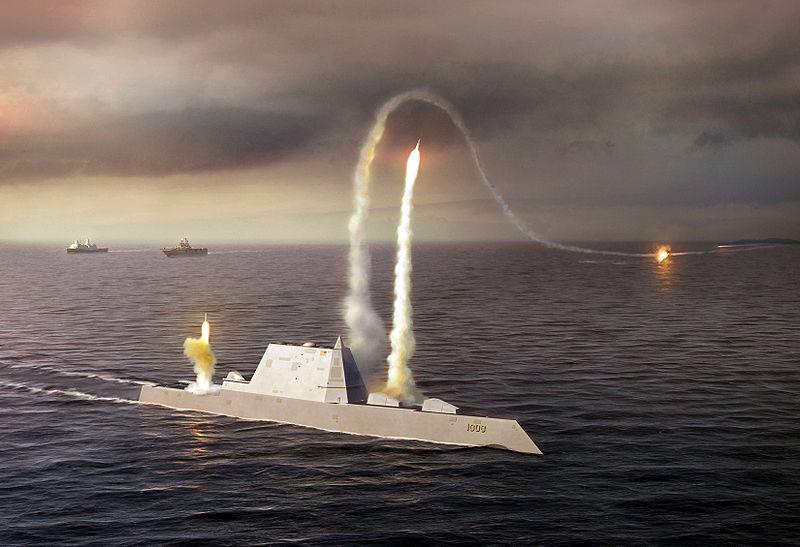
Weapons: The futuristic design of Dreadnought 2050 assumes the warship to have a super strong graphene coated hull and envisages the machine to be equipped with weapons like high-velocity torpedoes, speed-of-light weapons and drones constructed on the ship using 3D printers. The sides of the warship would have missile tubes which would be able to launch missiles with a speed more than the hypersonic. The bow would boast of an electromagnetic railgun that can fire projectiles as far as long-range cruise missiles can go today. The outrigger hulls will house torpedo tubes to fire supercavitating torpedoes that move through water in a sort of air bubble that reduces drag and friction resulting in whopping speeds. A tethered quadcopter equipped with multi-spectral sensors to provide critical data and armed with a laser to take out threats like enemy aircraft, missiles and more will replace the standard mast in Dreadnought 2050 which will fly above the ship. To provide adequate power for these technologies, the quadcopter’s tether would be made of cryogenically cooled carbon nano-tubes.

Power: The future warship would be powered by a fusion reactor or highly efficient turbines. The graphene coating on the hull will reduce the drag and hence enhance the speed. The warship will also boast of a low profile to make it hard to detect.

Assault: ‘Moon Pool’ is the highlight of the future warship. Basically it will be a floodable dock to help amphibious teams of SEALs or Royal Marines for a rapid deploy. The moon pool could also be used to deploy unmanned underwater vehicles on missions such as searching for explosive devices. There would be an extendable flight deck and hangar above the deck that can be used for a fleet of weaponized drones. Another plus is that this futuristic warship would require lesser number of crew people on board. For example, as against 25 sailors required to run the Ops Room of a current warship Dreadnought 2050 Ops Room requires only five.
War-2

Future has many things in store for us and we hope against hope that war isn’t a part of these but still we need to be prepared.

width="560" height="314" allowfullscreen="allowfullscreen">

As a technology lover you may like our daily important technology news series. It’s a playlist and you can retrieve the total day-wise videos. Please consider subscribing our YouTube channel:

Author: Technology Blog

Another Earth? THESE Five exoplanets that are quite like our Mother Earth!

Space research is a fascinating field. Searching new planets and stars and galaxies, studying the existing ones, comparing two different celestial bodies etc. are some of the interesting aspects of it. One of the fixation of space scientists is searching planets similar to Mother Earth. Finding a planet and life (or even probability of life) on it has been a fetish since long for these scientists.  The habitability of these planets is calculated on the basis of Earth Similarity Index (ESI).

image_2387_2e-Kepler-438b

This number is calculated from the exoplanet’s radius, density, surface temperature and escape velocity, which is the minimum speed needed to break free from the planet’s surface.  The ESI varies from 0 to 1 and anything with an ESI above 0.8 may be considered ‘earth-like’. Based on these ESI values we present you a list of five exoplanets that are quite like our beloved planet.

Kepler 438b

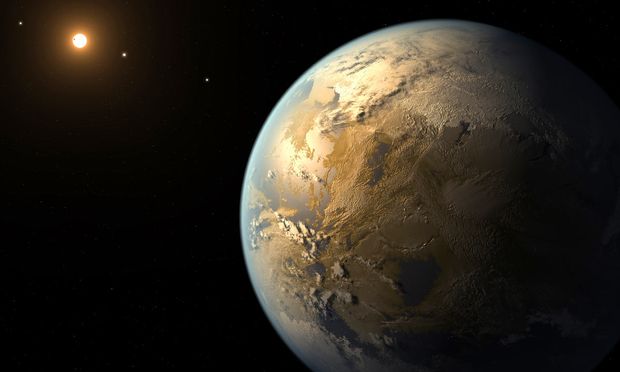
kepler 438b

Of all the exoplnets known this has the highest ESI of 0.88. It was discovered in 2015 around a red dwarf star that was way smaller and cooler than our very own sun. The star is nearly 470 light years from earth. It has a radius only 12% larger than Earth’s and orbits its star every 35 days. The mass of the planet hasn’t been measured yet but if it has a rocky composition it may be 1.4 times that of the Earth’s with a surface temperature between 0°C and 60°C. But according to a recent finding, the host star of this exoplanet sends out powerful flares of radiation, which may render the planet uninhabitable after all.

Gliese 667Cc

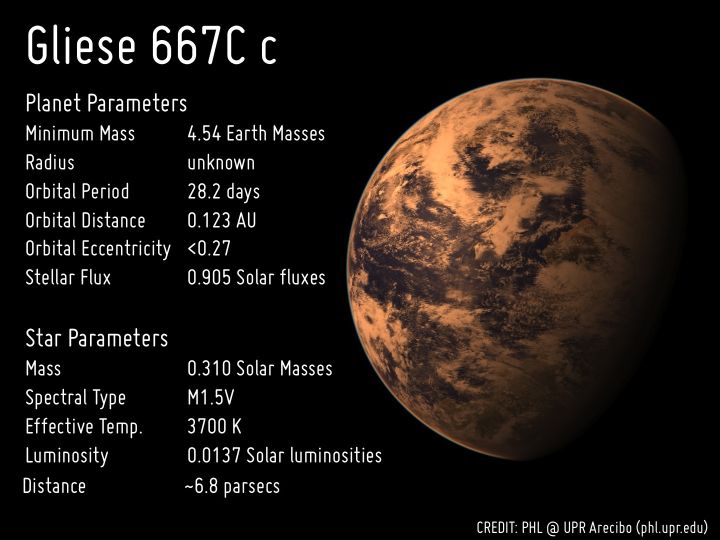
Gliese667Cc_Facts

Discovered in 2011, orbiting a red dwarf in the Gliese 667 triple star system, just 24 light years away, the exoplanet has an ESI of 0.85. The planet’s mass has been estimated at 3.8 times the Earth’s, and its size is unknown as yet. This is because the planet does not pass in front of the star, which helps us to measure the planet’s radius. It has an orbital period of 28 days and lies in the habitable zone of the cool star with a possible surface temperature of around 5°C.

Kepler 442b

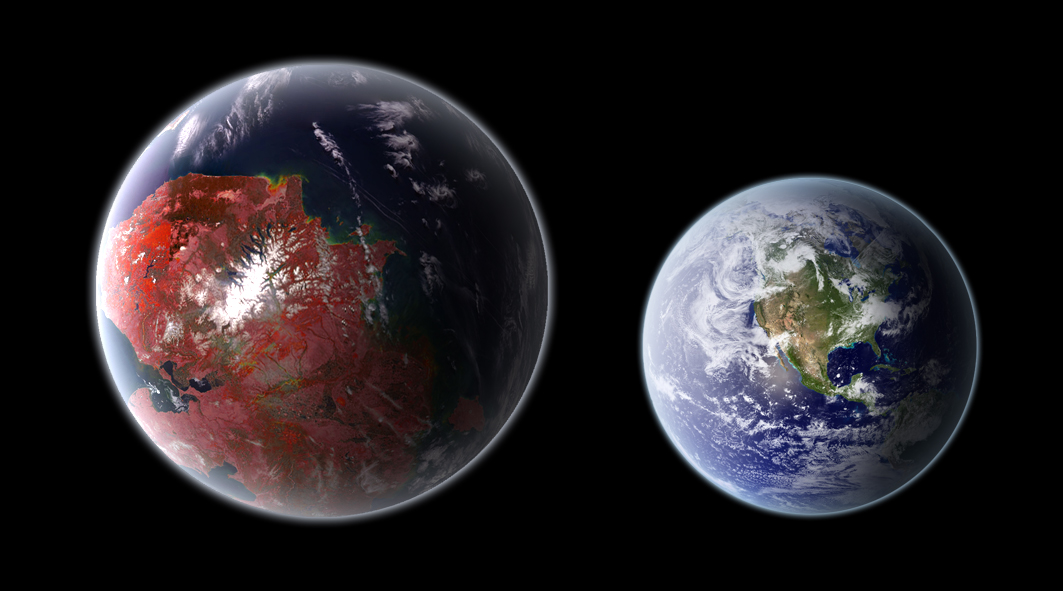
Kepler442b(comp)

It was discovered in 2015. It has an ESI of 0.84 and a size 1.3 times the size of the earth. With an orbital period of 112 days, it is orbiting a star cooler than the sun about 1100 light years away. It may be hospitable but with a surface temperature as low as -40°C. Once again, the exoplanet’s mass is not known, but if it has a rocky composition, it may be only 2.3 times the mass of the Earth.

Kepler 62e and 62f

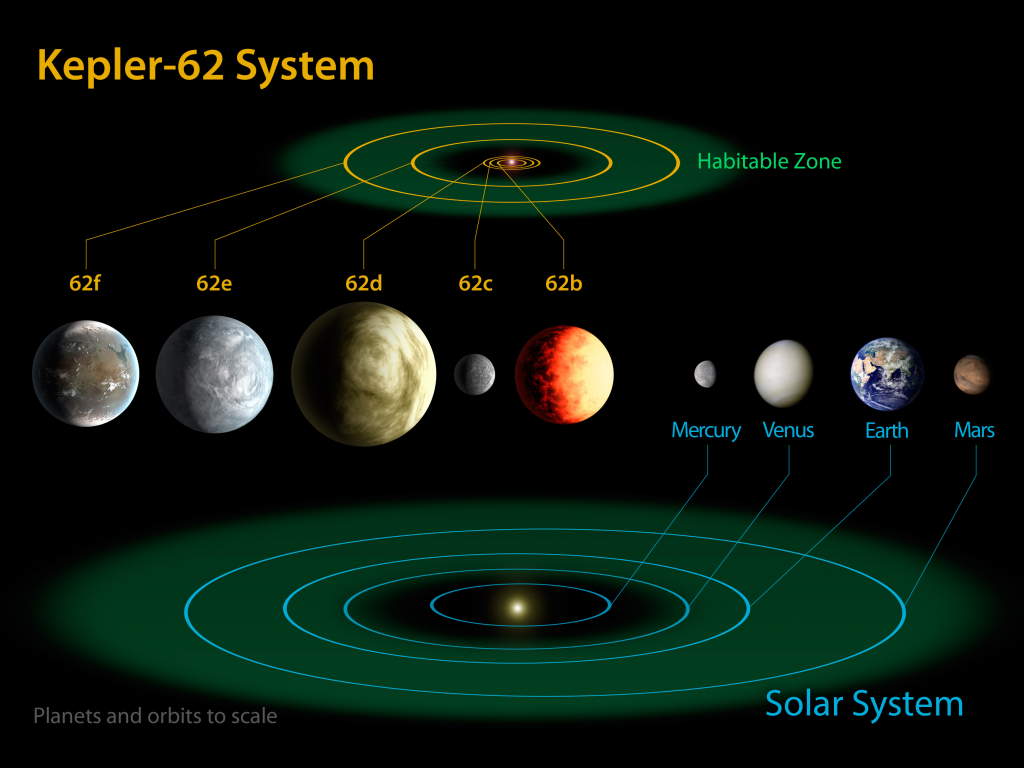
Kepler-62-systemBoth these exoplanets were discovered in 2013 and have an ESI of 0.83 and 0.67 respectively. These were discovered in with the help of Kepler telescope which spotted their transit in front of their host star. This star is located at a distance of 1200 light years from us and is a bit cooler than the sun. They both have planetary radii of 1.6 and 1.4 times that of the earth and their orbital periods of 122 and 267 days mean that they both fall within the star’s habitable zone. As with many other planets discovered by Kepler, their masses have not been measured, but are estimated at over 30 times the mass of the Earth in each case. The temperatures of each could permit liquid water to exist on their surfaces, depending on their atmospheric composition.

Kepler 452b

Kepler-452b_System

Discovered in 2015 and an ESI value of  0.83 it was the first potentially Earth-like planet orbiting in the habitable zone of a star similar to our Sun. The radius of the planet is 1.4 times that of the earth and it takes 385 days to orbit its star. This star is 1400 light years away from our planet. Because the star is too faint to measure its movement due to the gravitational tug by Kepler 452b, the planet’s mass is unknown. However it has been predicted to be at least five times that of the Earth and the planet’s surface temperature is estimated between -20°C and +10°C.

Considering all the facts, one may notice that despite many similarities even all these planets are not much habitable if you consider the atmosphere of earth. But nothing can beat hope. Let’s hope we find one that is actually like our Mother Earth and habitable.

[adinserter block=”7″]

Author: Technology Blog

Tagged : /

THIS is how GM mosquitoes are all set to eradicate malaria

Malaria is a fatal disease claiming a large number of lives every year in different parts of Africa, Latin America and other tropical parts of the world. Researchers have been working around the world, day and night to find a way to combat this dreadful disease. There are medicines available but the best way to fight with this disease is to nip it in the bud that is to make the mosquito unable to carry the fatal parasite Plasmodium which is responsible for spreading this disease. Genetically engineering a mosquito such that it rejects the plasmodium parasite is one way of doing this. Though theoretically, this theory is good enough but when it comes to real world tests, only about 50 percent of the offspring insects will acquire the resistance from its parents.

mosquito-2

A new technique it seems has come to the rescue. The technique is called “gene driving” and papers claim that it ups the inheritance percentage up to 100 percent. Gene driving is basically a method of manipulating DNA in such a way that it ensures a gene is passed from a parent to its progeny at a rate as close as possible to 100 percent. Scientists used the genome editing CRISPR–Cas9 system to do this. This system allows the researchers to target a particular area on the DNA for cutting and insertion of a mutated gene. In the next step, the same mutation is transferred from one chromosome to another making it mandatory that all offspring inherit at least one copy of the modified gene. The high point is: because all the offspring receive a copy of the mutation, the modified gene can be transmitted quite fast through an entire population in the wild.

As exciting as it may sound, the technique is under much criticism because it clashes with the natural process of evolution by literally altering an entire population which in turn can cause huge side effects on the ecosystem as a whole.

[adinserter block=”7″]

Next Page For More

Tagged : /

These companies will give tough competition to Google’s self-driving car

Consumer Electronics Show (CES) is a paradise for technology lovers. Everything that isn’t here but soon will be makes an appearance in this tech-carnival. The recent one held at Las Vegas was no exception to that. Among numerous new innovations dotting the CES, self-driving cars grabbed many eyeballs. Car makers from around the world were present at the event to showcase their respective versions of autonomous cars. Google has been a front runner in this regard from quite a long time, but it seems the equation is changing with many traditional car manufacturers making a foray into this field.

Google500KmilesLexus

Driverless cars may sound all-exciting and cool, but a lot has to be achieved before they see the light of the day. The primary objective of these cars is to be able to sense obstacles and hazards, such as other cars and pedestrians. They do this using a range of sensors, but to pick out hazards effectively; the car must be able to separate them from the background. This means the car needs a detailed, static picture of the world with which to compare what it sees. That is the car needs a map and that too an extremely detailed one. Google does seem to have an edge over other companies in this regard and it has proven so because it is their prototype autonomous cars that have driven farther than any other counterpart. But Google still has way to go in terms of collecting more data to make the maps fool proof.

Meanwhile, General Motors has made an announcement that it would spend $500 million with car-hailing service Lyft to build “an integrated network of on-demand autonomous vehicles in the US”. Toyota is building a new research institute to work on autonomy, while Audi, BMW, Ford and others also announced progress in their efforts to develop driverless cars. Mercedes has developed a self-driving research vehicle and taxi app Uber has already announced billions of dollars in autonomous car investment.

2015-05-22-image-5

Data is the key here!

Presently, Google and the other companies are almost at par as far as data related to the maps is concerned. Add to that the new approach that the car manufacturers are trying. These car manufacturing giants are banding or tying together to make their own maps and they do seem better poised in this situation. So while Google controls its entire driverless car operations, gathering the map data itself and processing it for the intelligent software that drives its cars (it can also use Street View to get its map data, collected by a dedicated fleet of cars) making the procedure very expensive; the other car makers are using the sensors on new car models to collectively gather mapping data, rather than having an expensive fleet of dedicated vehicles.

Next Page For More

5 Most Advanced Attack Submarines till Date

cover photo

Advanced Attack Submarines

War among nations or more precisely to speak war business always helped new technology to evolve and new breakthroughs to open. Thus like fighter jets, marine fighters or attacking UAVs, advanced attack submarines also continued to evolve and offer more advanced and lethal underwater warfare technologies. Today, submarines are no longer just shrewd observers of enemy movement, they can launch offensive as lethal as any fighter ships. While approaching enemy ships and boats undetected is the key to their offensive success, precision of attack and defense mechanism are also important for an advanced attack submarine. Here, we would introduce 5 most state of the art submarines till date from around the world.

USNavySeawolfSubmarine

attack submarines

Seawolf Class (USA)

You should not only designate the boats of Seawolf Class as the most advanced submarines but also as the truly future-ready submarine class in the world. These submarines developed with all the technological edges that US army enjoyed for years since the Cold War era. The submarine was first planned to destroy the ballistic missile submarines of Russia such as Typhoon Class and Akula Class. Seawolf Class is also the most expensive submarine class in the world having a maintenance and development budget which is even too heavy for the US Army. This is also known to be the quietest submarine that can hide from any type of underwater detection and stealthily attack other submarines and marine objects. It can even operate even in extreme marine conditions such as under the ice cap of the polar region. Capable with most lethal range of torpedoes and anti-ship missiles these submarines are unarguably the most dangerous war beasts under water.

Astute class submarine_UK2

HMS Ambush

Astute Class (UK)

Astute Class is the nuclear powered advanced attack submarine belonging to Royal Navy of United Kingdom. Launched on 2010 so far only 7 boats have been planned and these boats are supposed to replace previous generation Swiftsure Class attack submarines. The boats of this class are quieter than any other previous class of submarines and can reach offensive target more stealthily than others.  Equipped to launch Spearfish torpedoes, anti-ship missiles and Tomahawk cruise missiles these submarines are one of the most lethal ones.

Russia 2 Russia


Graney Class (Russia)

This is the latest addition in the formidable nuclear powered attack submarines of Russia. The project completed not long ago the boats were commissioned to Russian Navy only on 2013. These boats are basically planned as the successor to the previous Akula Class submarines. Graney Class boats are a lot quieter compared to previous generation Russian submarines and are more equipped with stealthy and deadly offensive capabilities. There are 24 vertical launch tubes for various types of cruise missiles besides 650mm torpedo tubes for torpedo attacks and anti-ship missiles.


Next Page For More

Tagged :

Want to have a look at your humble abode 100 years from now?

100 years is a long time and who doesn’t like imagining about future? This is what some people did. Commissioned by Samsung, space scientist Dr. Maggie Aderin-Pocock, University of Westminster architects and lecturers Arthur Mamou-Mani and Toby Burgess, and urban planner and designer Linda Aitken and Els Leclercq, compiled a report that talks about human life hundred years from now. The report was prepared after taking into account the population growth of the world, current technology trends and energy needs.

article-2641501-1E437FE900000578-373_964x448

The report presents a very interesting picture of our Earth 100 years hence. It predicts many interesting things:

According to the report, by 2116, humans will have underwater cities because of the stress created by the ever expanding population. They also predicted that there will be floating cities which will move all over the world to avoid harsh climates. Future generations may also plan to live in earth-scrapers which will be basically multi-storeyed buildings burrowed deep into the ground.

Just like the location of the futuristic homes, the interiors of these homes will also be in tandem with the future. Those living underground need not live in gloom because virtual reality or LED surface projectors will create beautiful views based on the inhabitant’s inclination.

The walls will not just be walls but dynamic structures that will change their shape in 3D by using small actuators pushing and pulling a flexible skin, creating temporary seats or shelves.

Each home will have its own 3D printer to make small objects as per the need and demand.

There is a high probability that with a high strain on earth’s resources down the line, say 100 years from now, homes will have to become sustainable on their own. People will grow their own food with hydroponics and produce their own gas and water through a digestion tank using anaerobic digestion. All houses will be “off the grid,” storing energy in lithium-ion batteries generated by sun, wind, or other means.

Homes will become the epicentre of human existence because more and more people will become home-bound. The report rightly predicts: “Homes will increasingly become self-contained, autonomous spaces generating their own oxygen and food; we will effectively all be creating our very own little planet Earths.”

width="560" height="314" allowfullscreen="allowfullscreen">

[adinserter block=”7″]

Author: Technology and Beyond

Tagged :
Verified by ExactMetrics