
The paper shows that the ‘impossible’ propulsion system really does appear to work, and that is surprising as it defies Newton’s third law, which states that everything must have an equal and opposite reaction. Yet in test after test it continues to work. Last year, NASA’s Eagleworks Laboratory team got their hands on an EM Drive to try to figure out once and for all what was going on.
In case you’ve missed the hype, the EM Drive, or Electromagnetic Drive, is a propulsion system first proposed by British inventor Roger Shawyer back in 1999. Instead of using heavy, inefficient rocket fuel, it bounces microwaves back and forth inside a cone-shaped metal cavity to generate thrust. According to Shawyer’s calculations, the EM Drive could be so efficient that it could power us to Mars in just 70 days.
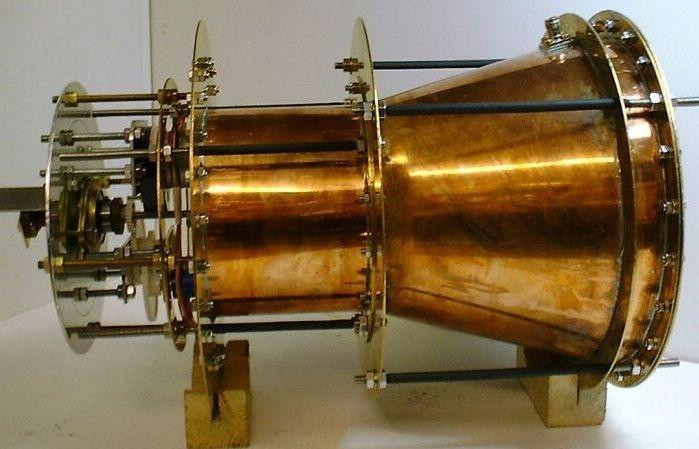
But, according to Newton’s Third law, for a system to produce thrust, it has to push something out the other way. The EM Drive doesn’t do this.
The new peer-reviewed paper is titled “Measurement of Impulsive Thrust from a Closed Radio-Frequency Cavity in Vacuum“, and has been published online as an open access ‘article in advance’ in the American Institute of Aeronautics and Astronautics (AIAA)’s Journal of Propulsion and Power. It’s very similar to the paper that was leaked online earlier this month and, most notably, shows that the drive does indeed produce 1.2 millinewtons per kilowatt of thrust in a vacuum:
“Thrust data from forward, reverse, and null suggested that the system was consistently performing at 1.2 ± 0.1 mN/kW, which was very close to the average impulsive performance measured in air. A number of error sources were considered and discussed.”

