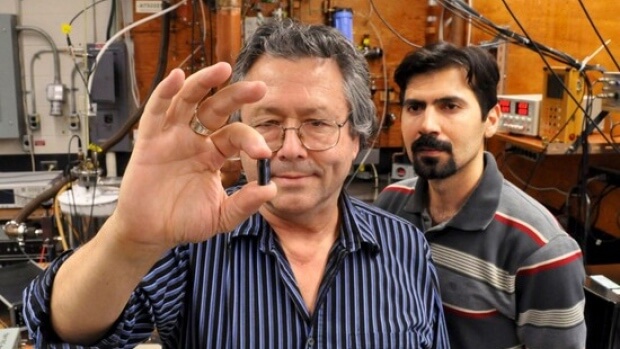
In a never before event, researchers from the University of New South Wales (UNSW) in Australia, have succeeded in creating for the very first time: the fundamental blocks of a quantum computer in silicon. Using standard manufacturing techniques and modifying current-generation silicon transistors, the device was created. It was also found that the device could scale up to include thousands, even millions of entangled quantum bits on a single chip.

Why do we need quantum computers?
The machines that we have been building since the 1950’s have been made with an objective of making them as deterministic and reliable as possible, so that a certain input will always give the same output. In a Qunatum Computer, this predictability is sacrificed and incredible speeds take their place. A quantum bit or qubit has two properties. First, it can set itself to both 0 and 1 at the same time. And second, it can commune (or entangle) with other qubits to compound this ability. This means five entangled qubits can store and process as much information as 32 (two to the power of five) classical bits; 10 qubits can do as much as 1,000 classical bits; and 300 fully entangled qubits can manipulate as many classical bits of information as there are atoms in the Universe. Based on these facts you would think that this will dramatically increase the speed as compared to a regular computer, but this will be just half the truth. A quantum computer can perform any operation a classical computer can, but its exponential speedups only take effect when a quantum algorithm can process data in a massively parallel fashion. However, if the bulk of operations have to be performed in a sequential order, flowchart-style, and no real quantum speedups are possible.
There is also a downside to these significant speed ups and that is: the results given by this quantum algorithm are not deterministic. So to say, even in the best of cases, a quantum computer is never guaranteed to return the correct result. So in order to confirm that a certain result is correct, the quantum algorithm will have to be run several times in succession. So quantum computers can make themselves useful only where massive parallelism is involved.

[adinserter block=”7″]
Next Page For More

