Something about Quantum CMOS
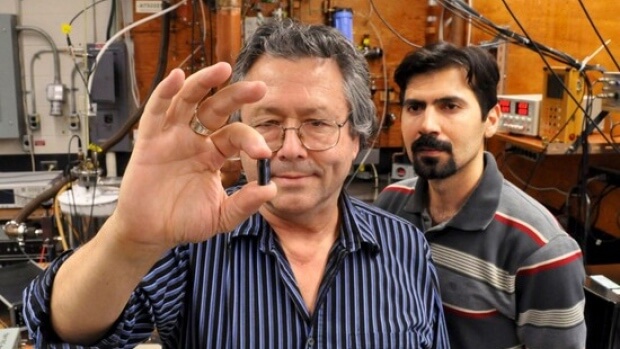
So far, most of the quantum computers developed feature a limited number of entangled qubits made from exotic and expensive materials like cesium or diamonds. However, researchers at UNSW are focusing on the potentially revolutionary approach of building quantum computers out of silicon, a material that is cheap, well-known by the industry, and which could ultimately pave the way for quantum computers with not just 300 but thousands or even millions of fully entangled qubits. UNSW scientists created single “CMOS type” qubits, last year. These qubits leveraged current transistor technology and silicon-28, a very common isotope of silicon, to achieve a very high fidelity of 99.6 percent for quantum operations.
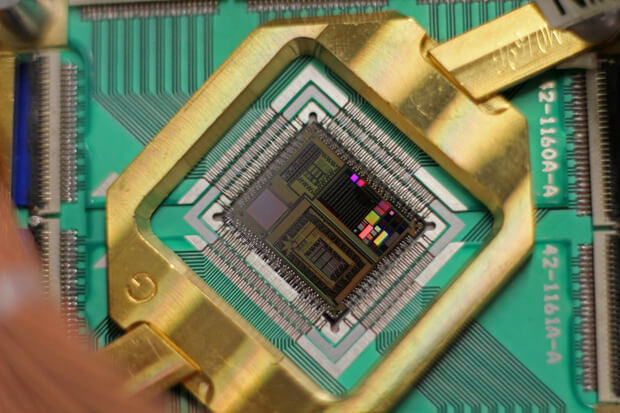
As a progressive step, the researchers have now come up with CNOT quantum logic gate. Together with a single controllable qubit, this is the basic building block of a quantum computer, and paves the way to quantum chips that can perform just about any operation. The CNOT logic gate was built by taking two standard transistors, next to each other, and reconfiguring them so they would only hold a single electron each. The spin of the electron sets a code of 0 or 1, and an external current and microwave field control the qubits and make them interact as needed.
Lead author Menno Veldhorst explained: “A CNOT gate is a […] two-qubit gate [that] flips the state of the target qubit depending on the state of the control qubit. In our case, the target qubit flips its spin if the control qubit is pointing down. If the control qubit is pointing up, the target qubit will remain in the same state. This two-qubit gate is most essential for a quantum computer and together with single qubit operations, which we have already demonstrated with very high fidelity, provides what is called a universal gate set. This means that any gate set can be constructed out of [it].”
The quantum computers can’t work at room temperatures but using this approach, the researchers can operate their device at approximately 1 Kelvin (-272° C, -458° F).
Where does it find its use?
Lead researcher Andrew Dzurak expresses: “This prototype manufacture would be done in a Si-CMOS foundry with wafer-scale manufacture, so that we can demonstrate a manufacturing process that can be scaled up to the thousands or millions of qubits.I believe that a Si-CMOS qubit prototype containing between tens and hundreds of qubits could be made within five years, provided we have the right level of investment and the right industry partners. Our main aim is to develop a prototype that can demonstrate that it is possible to go all the way with ‘Quantum CMOS’ and make a full-scale quantum processor.”

So in the long run, a powerful quantum computer like this can have applications in the finance, data security and health industry. But undoubtedly, one of the most advanced applications would be to conduct virtual experiments simulating the behavior of atoms and particles in unusual conditions, such as at the very high energies we can only recreate in the Large Hadron Collider, without actually performing the experiment.
Technology is really moving with the speed of a quantum computer.
[adinserter block=”7″]
Author: Technology Blog

