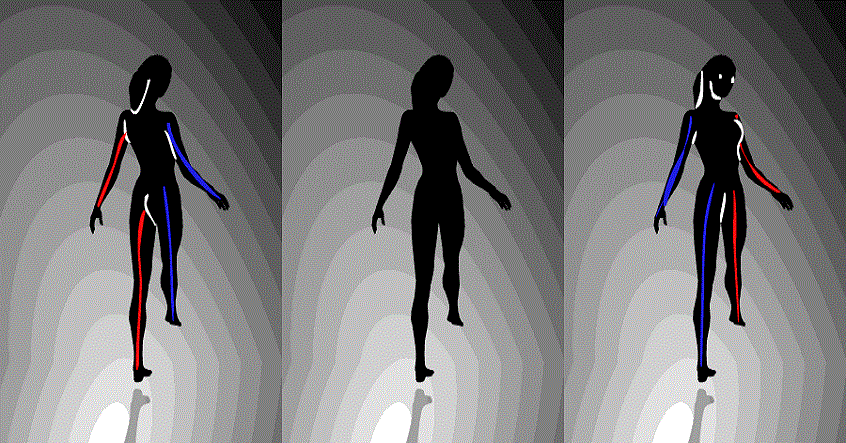
Shapiro also reveals that you don’t have to be a genius to see the dancer switch directions. ‘Cover up everything but her foot touching the ground,’ he said. Stay focused on the foot and the shadow beneath her as she spins. Now imagine you are physically moving up or down in space.’
‘If you want her to switch directions, look at her as if you’re filming her from below. Now pretend to be filming her from above. When you imagine yourself below the dancer she should spin counterclockwise and clockwise if you envision yourself above her.’
A 2010 study reveals that most people will see the figure spin around clockwise, as we tend to choose a viewpoint from above rather than below, reports BrainDecoder. And a study from 2015 says that the viewing-from-above factor is only the tip of the iceberg. The paper suggests another reason for our clockwise bias, which is an attentional bias – humans tend to lean towards the right side of the body, researchers explain.
And Shapiro and Troje tell Tonic that the reason most people see the dancer spinning clockwise also has to do with the area of our brain that deals with fear, rage and panic – the subcortical system.
Most things that can harm us are more likely to sit on the ground, such as snakes and spiders, explained Troje. So when shown ambiguous visual information, we have tendency to process the image as if they’re looking downward.
However, a second video adds small white contour lines in certain areas of the dancer’s body, which allows our brain to ‘solve the illusion faster’, said Shapiro. This is because your brain is able to gather more information from what is being presented.
As a technology lover you may like our daily important technology news series. It’s a playlist and you can retrieve the total day-wise videos. Please consider subscribing our YouTube channel:
Author: Technology Vista

