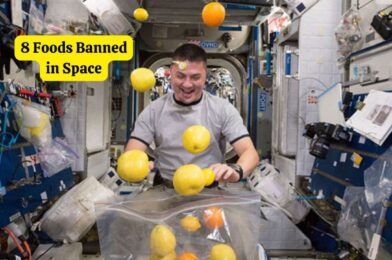
8 Foods Banned in Space : Blast Off, But Leave These Earthly Delights Behind

8 Foods Banned in Space : Blast Off, But Leave These Earthly Delights Behind
Packing for a trip to the International Space Station? Remember, it’s not just about spacesuits and zero-gravity training. You’ll also need to pack food – but not just any food. Astronauts have a surprisingly restricted menu, with certain earthly delights strictly off-limits. Let’s blast off on a culinary adventure and explore 10 foods that are banned in space:

1. Bread and Cookies: Crumbs are the enemy in microgravity! Imagine tiny bread bits or cookie crumbs floating around the cabin, potentially clogging sensitive equipment or even getting in an astronaut’s eye.

2. Carbonated Drinks: Fizzy sodas might be refreshing on Earth, but in space, the bubbles cause problems. Without gravity, the bubbles get trapped in the stomach, leading to uncomfortable burps and bloating. Plus, imagine the sticky mess if a can of soda exploded in zero-gravity!

3. Spicy Food: Spice up your life on Earth, but keep it mild in space. Spicy food can irritate the stomach lining, especially in the confined quarters of a spaceship. Additionally, spicy smells can linger in the recycled air, making things unpleasant for everyone.

4. Fresh Fruit and Vegetables: While nutritious, fresh produce is a no-go for astronauts. They spoil quickly and require refrigeration, which is limited on spacecraft. Instead, astronauts enjoy specially freeze-dried or dehydrated versions of their favorite fruits and veggies.
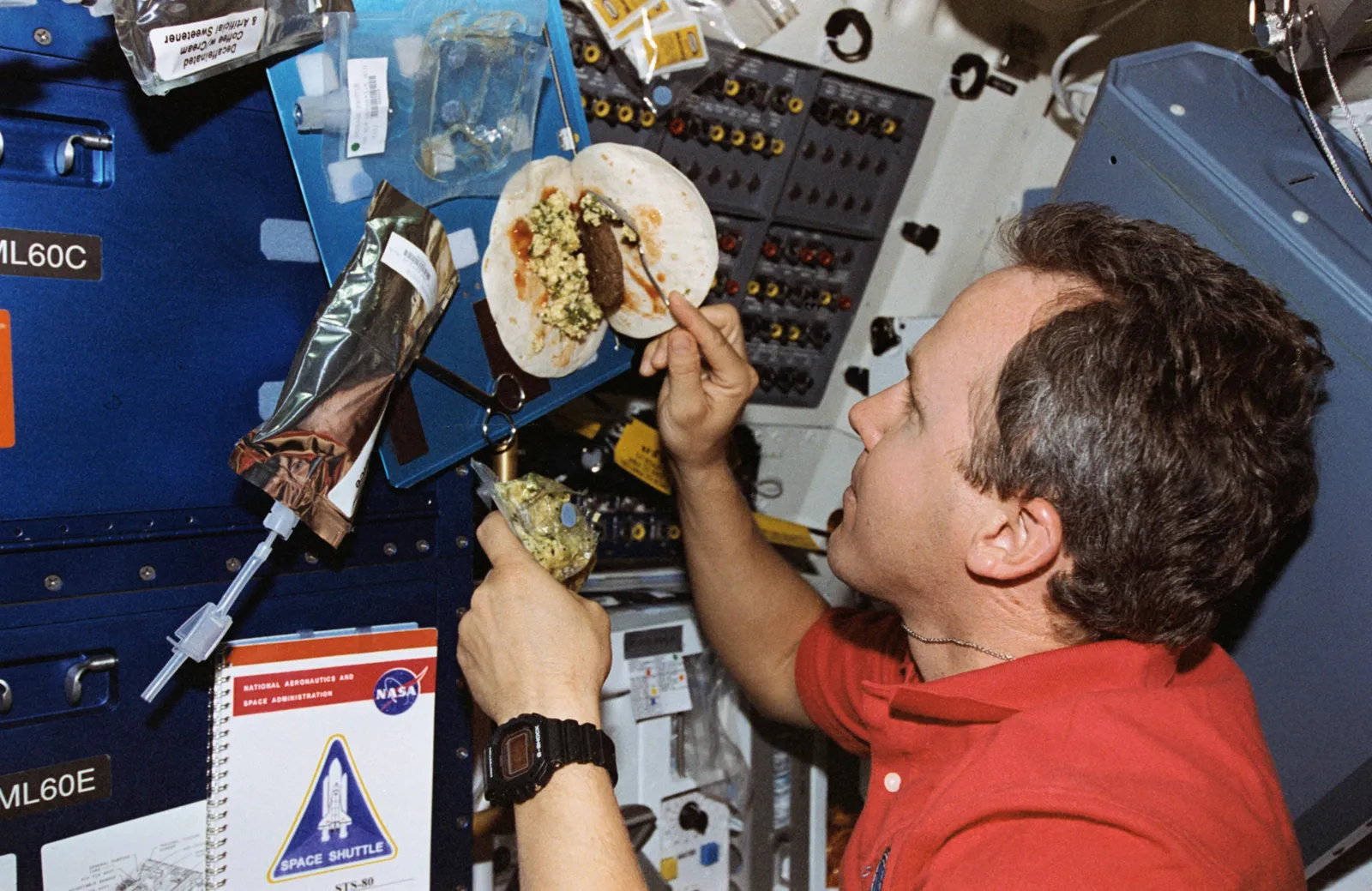
5. Alcohol: It might be tempting to unwind with a glass of wine after a long spacewalk, but alcohol is a big no-no. It can impair judgment and coordination, crucial skills for astronauts working in a delicate environment. Plus, hangovers are even worse in zero gravity!

6. Ice Cream: Imagine the melty mess! Ice cream’s creamy texture and tendency to melt make it unsuitable for space travel. Astronauts can, however, enjoy specially formulated space ice cream that comes in bite-sized tubes.

7. Salt and Pepper Shakers: Tiny grains of salt and pepper are another crumbly culprit in space. They can easily float around, contaminate food, and irritate eyes. Astronauts use specially designed condiment dispensers instead.

8. Garlic and Onion: These pungent ingredients might add flavor to our food, but their strong smells can linger in the recycled air of a spaceship, driving the crew crazy.

So, there you have it! Packing for space travel requires careful consideration, and even your favorite foods might not make the cut. But with a little creativity and ingenuity, astronauts can still enjoy delicious and nutritious meals that fuel their cosmic adventures. Who knows, maybe one day we’ll have space-friendly versions of all our favorite earthly eats!
Tagged : / / /

The Future Of Space Travel : Solar sails could reach Mars in just 26 days

The Future Of Space Travel : Solar sails could reach Mars in just 26 days
Solar sails are a type of spacecraft propulsion system that uses the pressure of sunlight to push a spacecraft through space. Solar sails are made of thin, reflective materials, and they are typically much larger than the spacecraft itself. This allows them to capture a large amount of sunlight, which can be used to accelerate the spacecraft to high speeds.

Solar sails have a number of advantages over traditional rocket propulsion systems. First, they do not require any fuel, which can significantly reduce the weight and cost of a spacecraft. Second, solar sails can generate thrust for an extended period of time, which allows them to reach very high speeds.

A recent study by researchers at the University of California, Los Angeles (UCLA) has found that solar sails could be used to reach Mars in just 26 days. This would be a significant improvement over the current travel time of 6-9 months.

The UCLA researchers developed a new type of solar sail made of aerographite, which is a material that is extremely lightweight and strong. They also developed a new trajectory that would allow the solar sail to reach Mars in a shorter amount of time.

The UCLA researchers’ study is a significant step forward in the development of solar sail technology. It shows that solar sails could be used to dramatically reduce the travel time to Mars and other planets in the solar system.

Here are some of the potential benefits of using solar sails to travel to Mars:

1. Faster travel time : Solar sails could reach Mars in just 26 days, compared to the current travel time of 6-9 months. This would allow astronauts to spend more time on Mars conducting research and exploration.

2. Reduced cost : Solar sails do not require any fuel, which can significantly reduce the cost of a mission to Mars.

3. Increased safety : Solar sails are a very safe and reliable propulsion system. They have no moving parts, and they are not prone to explosions.

Of course, there are still some challenges that need to be addressed before solar sails can be used for regular missions to Mars. One challenge is that solar sails are very fragile and difficult to manufacture. Another challenge is that solar sails are not very effective in low-light conditions.

Despite these challenges, solar sails have the potential to revolutionize space travel. They could allow us to reach Mars and other planets in the solar system much faster and more efficiently than we can today.

Here are some of the potential applications of solar sails in space exploration:

1. Planetary missions : Solar sails could be used to send spacecraft to Mars, Venus, Jupiter, Saturn, and other planets in the solar system.

2. Interstellar travel : Solar sails could be used to send spacecraft to other stars.

3. Space tourism : Solar sails could be used to send tourists to space at a much lower cost than traditional rocket-powered spacecraft.

Solar sails are a promising new technology that has the potential to change the way we explore space. It is an exciting time to be involved in space exploration, and I look forward to seeing what the future holds for solar sail technology.

Tagged : / / / /
Verified by ExactMetrics