Joe Braidwood, Chief Marketing Officer at SwiftKey, believes: “Language is such a human thing that if you can build things that think more like humans than computers you’re inevitably going to make a more useful keyboard.” Based on this belief a new SwiftKey keyboard has been introduced that utilizes a miniaturized neural network to give better typing suggestions. The method of neural network mimics the way the brain processes information.
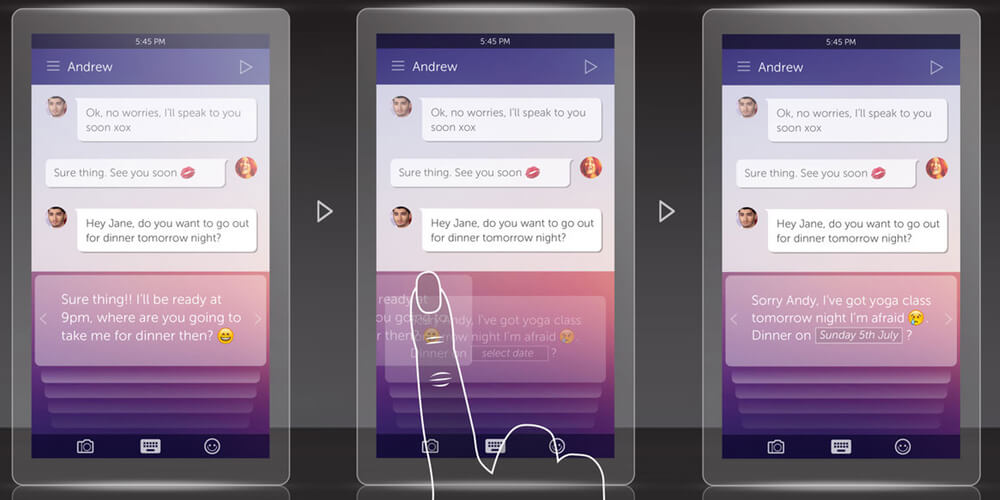
The old system of SwiftKey keyboards used a probability-based language algorithm based on the n-gram model for predictions. This algorithm reads the last two words in a sentence, looks through a large database, and spits out what it deduces is the most likely word to follow. The two-word limit is a constraint of the n-gram model, and seriously hampers predictions as reading back three or four words would be very hard to implement with n-gram, as it would require a far larger database which would in turn be harder for the app to search.
The new model of neural network approaches these predictions in a different way. SwiftKey trained the network with millions of sample sentences, and now each word is represented by a piece of code. This allows the app to better understand sentences in a number of ways. Words- that can be used in the same way, share similar codes. Because the model looks at entire sentences, it’s able to sequence together words as code to find more accurate suggestions. “Meet” is marked as similar to synonymous words like “met” and “connect.”
Less obvious is the link with “speak” or “chat,” which mean something completely different but linguistically will slide into many of the same places. If we consider the word ‘meet’ again for a sentence fragment “Meet you at the”. Using n-gram, SwiftKey typically looked at “at the,” and served you three suggestions: “moment,” “end” and “same.” Using the neural model, it looks as the sentence as a whole and services you “airport,” “hotel” and “office.”
Like everything else, the neural model also comes with its limitations. The older SwiftKey method has an ability to learn your typing style. So the regular app can scan your mails and social networks for clues, and then monitor your usage of the keyboard itself to improve suggestions. It does this by editing or adding to the language database that the n-gram model uses. Because Neural taps into a different type of database, this personalization isn’t available in the alpha as of now.
Explaining the reason behind releasing Neural as a separate app Braidwood said: “The sooner you can get an idea out of the lab and into the public, the quicker you get feedback and the more useful it becomes.” Neural is a relatively small 25MB download, but it requires more power than the current SwiftKey, using your phone’s GPU to run the math. Braidwood says there’s some more optimization to be done before this is ready to replace the regular app.
Whenever happens, one thing is for sure, the future of mobile typing is neural networks.
[adinserter block=”7″]
Author: Technology Blog

