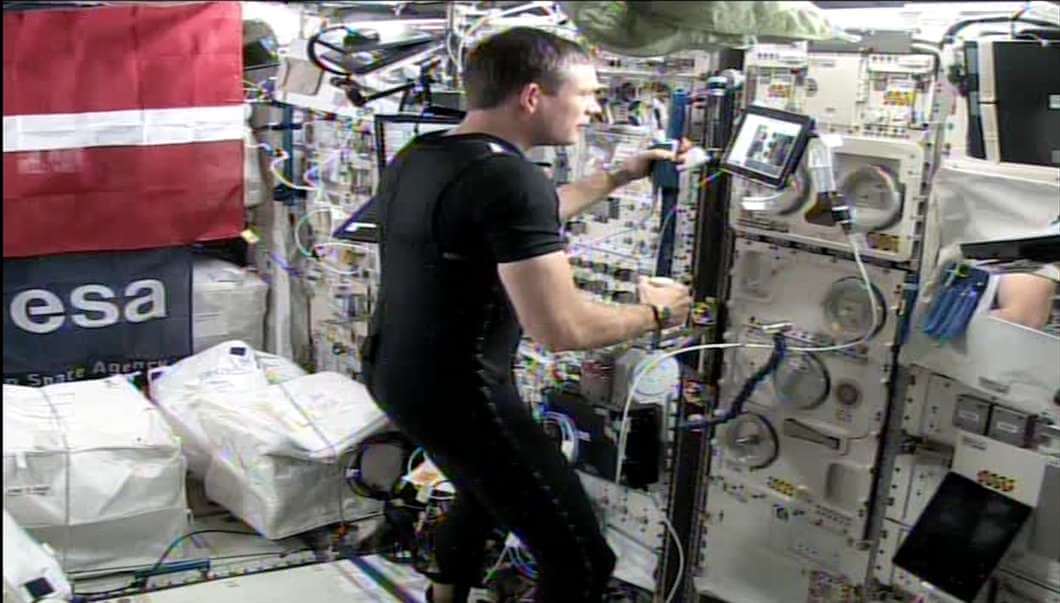
ESA astronaut Andreas Mogensen has been able to drive and control an Earth-based rover from a height of 400 km (249 miles), orbiting aboard the International Space Station (ISS). This success means that robots could replace human workforce in dangerous areas and jobs in the coming years. A sophisticated form of force-feedback allowed the connection to determine when the robot’s arm faced with resistance.
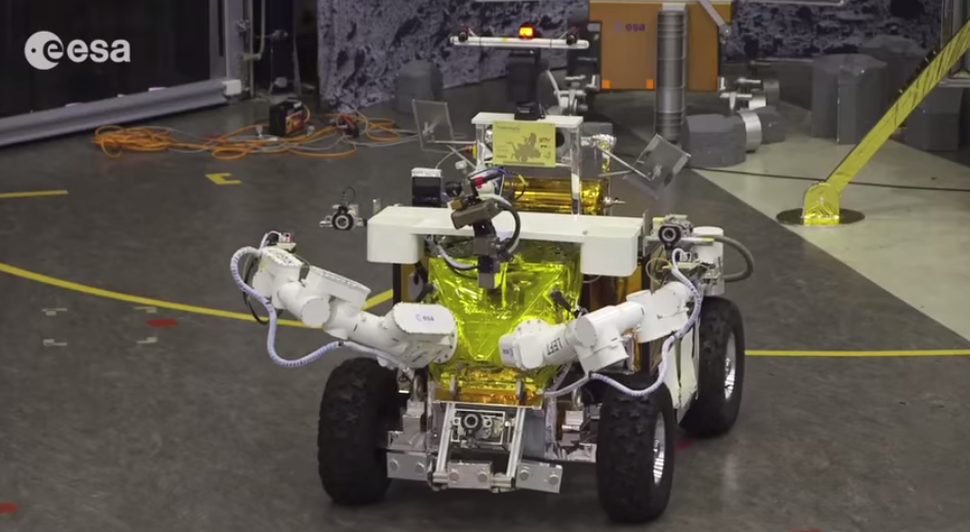
 The Interact Centaur rover used for the experiment was designed and constructed as part of a collaboration between ESA engineers and graduate students from the Delft University of Technology, in the Netherlands. The robot is equipped with many different features like a 4 X 4 design, a camera “head” and two incredibly flexible robotic arms with force-feedback sensors with which to manipulate the target object. Features also include a host of proximity sensors and an arm laser to enhance depth perception.
The tasks first performed by the rover were to retrieve a metal peg and insert it into a tiny hole, 1/6th of a millimeter. “He had never operated the rover before but its controls turned out to be very intuitive” states André Schiele, of ESA’s Telerobotics and Haptics Laboratory. “Andreas took 45 minutes to reach the task board and then insert the pin on his first attempt, and less than 10 minutes on his follow-up attempt, showing a very steep learning curve.”
There is still a long way to go, as another software had to be used to place the pilot and the rover in complete sync to combat time lag of a second against the 144,000-km (89,477-mile) journey between them.
Author: Technology Blog

