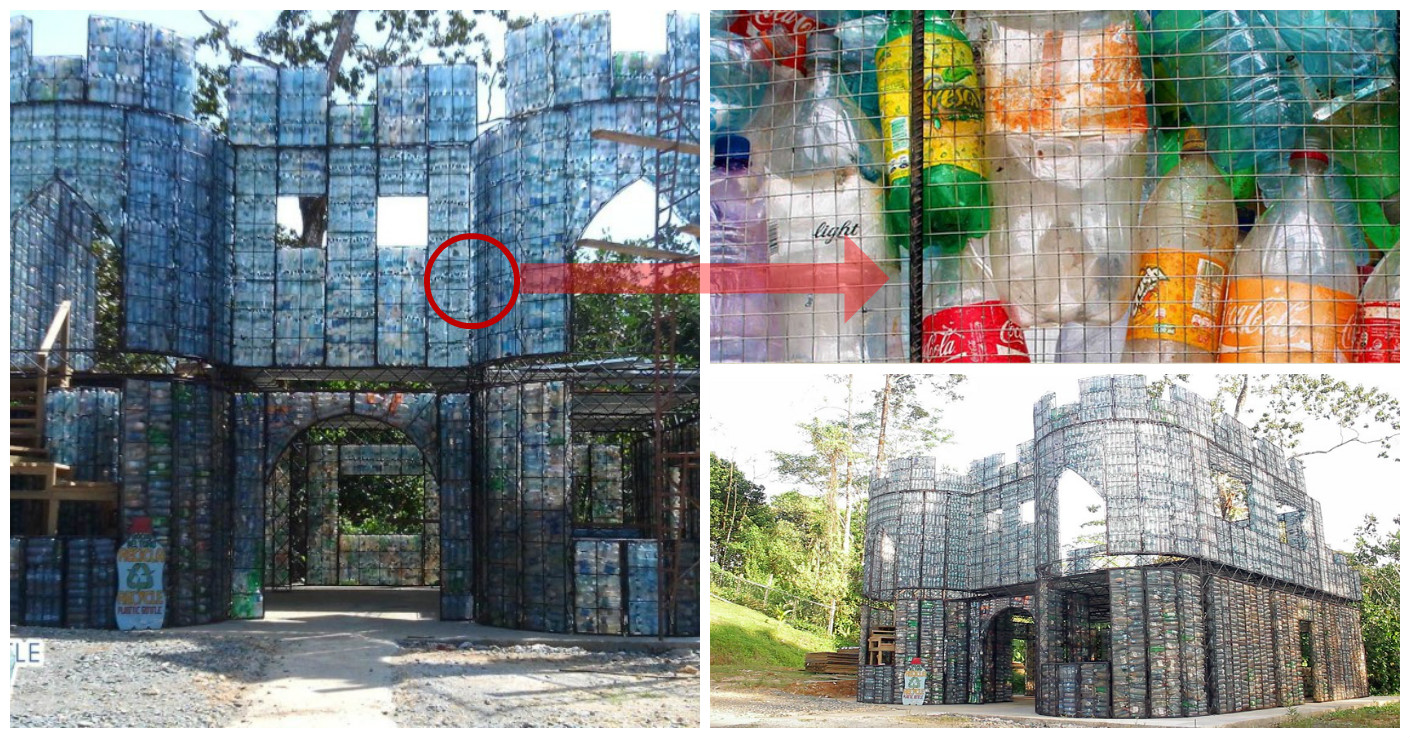
This man from Panama is establishing an entire village using waste plastic bottles!

Be it railway station, bus station or any other public place, we can see used plastic bottles lying around. People buy bottled water, cold drinks etc and after consuming the content just throw them without bothering much about the mess they create or the amount of pollution they make. These empty plastic bottles can be used in many ways. Sometimes they are just washed and reused. Some people make useful things like pen stands, flower pots, fish traps or lampshades. But mostly these are collected and sent for recycling. In India some factories use these plastic bottles to make polyester cloth, fleece and fiber used to fill cushions and pillows.

But a man from Panama has done something astonishingly different with these used plastic bottles. Robert Bezeau is building a whole village out of these bottles. In this village houses are being made with plastic bottles as main building material. Bezeau used simple cages made of wire in which bottles are stuffed. These cages are then layered over with concrete. A large house takes around 20000 plastic bottles. Bezeau accepts that his idea is a little bit weird but he is confident about his plan.

Bezeau elaborated various advantages of this bottle house. Plastic bottles are very good insulators and hence temperature inside the house will remain 20-30 degrees less as compared to the outside. Also it is quite cheap to build a house with used plastic bottles. Using bottles to erect house save electricity as otherwise if these bottles are recycled then a lot of electricity is requires in that process. Also the house build with plastic bottles is very safe if the earthquake hits the area. And in case of flood the bottle frames can act as flotation platform.

Beazeau is planning to establish a training center where people from around the world can come to learn how to build house with plastic bottles. His main motive is just to make this planet a cleaner and greener place to live.

As a technology lover you may like our daily important technology news series. It’s a playlist and you can retrieve the total day-wise videos. Please consider subscribing our YouTube channel:

Author: Technology and Beyond
Tagged : /

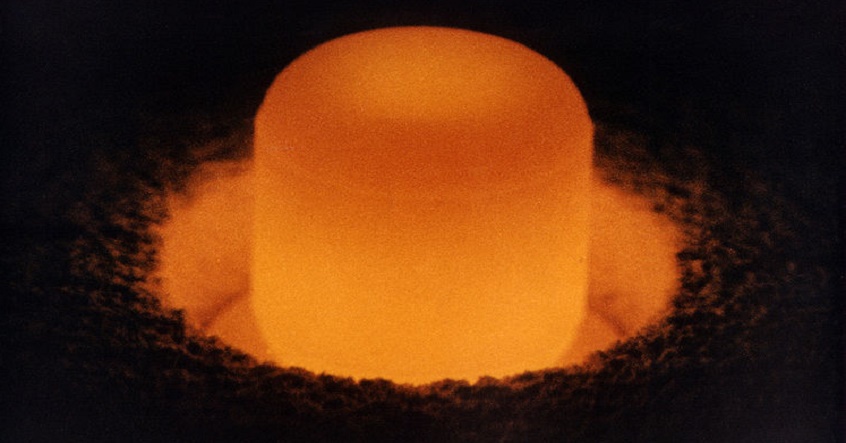
Scientists created space fuel, Plutonium-238 after 30-Year wait making deep space exploration a reality!

Scientists have produced a powder of plutonium-238 for after nearly 30 years in the United States, a milestone that they say sets them on a path toward powering NASA’s deep-space exploration and other missions.

Plutonium-238 (Pu-238) is a radioactive element, which on decaying, or breaking down into uranium-234, releases heat. That heat then is used as a power source; for instance, some 30 space missions, including the Voyager spacecraft, that explored the solar system’s outer planets in the 1970s, relied on the oxide form of the plutonium isotope. (An isotope is atom of an element with a different number of neutrons.)

During the Cold War, the Savannah River Plant in South Carolina was pumping out Pu-238. “Those reactors were shut down in 1988, and the U.S. has not had the capability to make new material since then,” said Bob Wham, who leads the project for the Nuclear Security and Isotope Technology Division at the Department of Energy’s Oak Ridge National Laboratory (ORNL). [8 Rare Elements That You’ve Never Heard Of]

After U.S. production of the isotope stopped, Russia supplied the Pu-238 needed for space missions. However, Russia has also stopped producing the material. Two years ago, NASA began funding a new effort to produce plutonium-238, giving about $15 million a year to the DOE Office of Nuclear Energy.

Plutonium-238 is an ideal power source for space missions for several reasons, including the element’s so-called half-life of about 88 years. Half-life is the time it takes for half of the atoms of an element to decay. That means the isotope’s heat output won’t be reduced to half for 88 years. Plutonium-239, which has a half-life of 24,110 years, is the isotope most commonly formed from uranium in nuclear reactors, according to the World Nuclear Association.

In addition, “it’s stable at high temperatures, can generate substantial heat in small amounts and emits relatively low levels of radiation that is easily shielded, so mission-critical instruments and equipment are not affected,” Wham said.

In the new achievement, Wham and his colleagues created 50 grams (1.8 ounces) of Pu-238 — about one-eighth of a cup (30 milliliters) — or enough to characterize the substance, he said.

Because the scientists were using existing infrastructure at the Department of Energy, they needed to adapt the plutonium-making process. “For example, the current DOE operating research reactors are smaller than those used at Savannah River,” Wham said. “Therefore, we need to modify the technology to work within the existing operating reactors.”

Next, the scientists will test the purity of the sample and work on scaling up the manufacturing process.

“Once we automate and scale up the process, the nation will have a long-range capability to produce radioisotope power systems such as those used by NASA for deep-space exploration,” Wham said.

As a technology lover you may like our daily important technology news series. It’s a playlist and you can retrieve the total day-wise videos. Please consider subscribing our YouTube channel:


Author: Technology and Beyond

Tagged : /
Verified by ExactMetrics