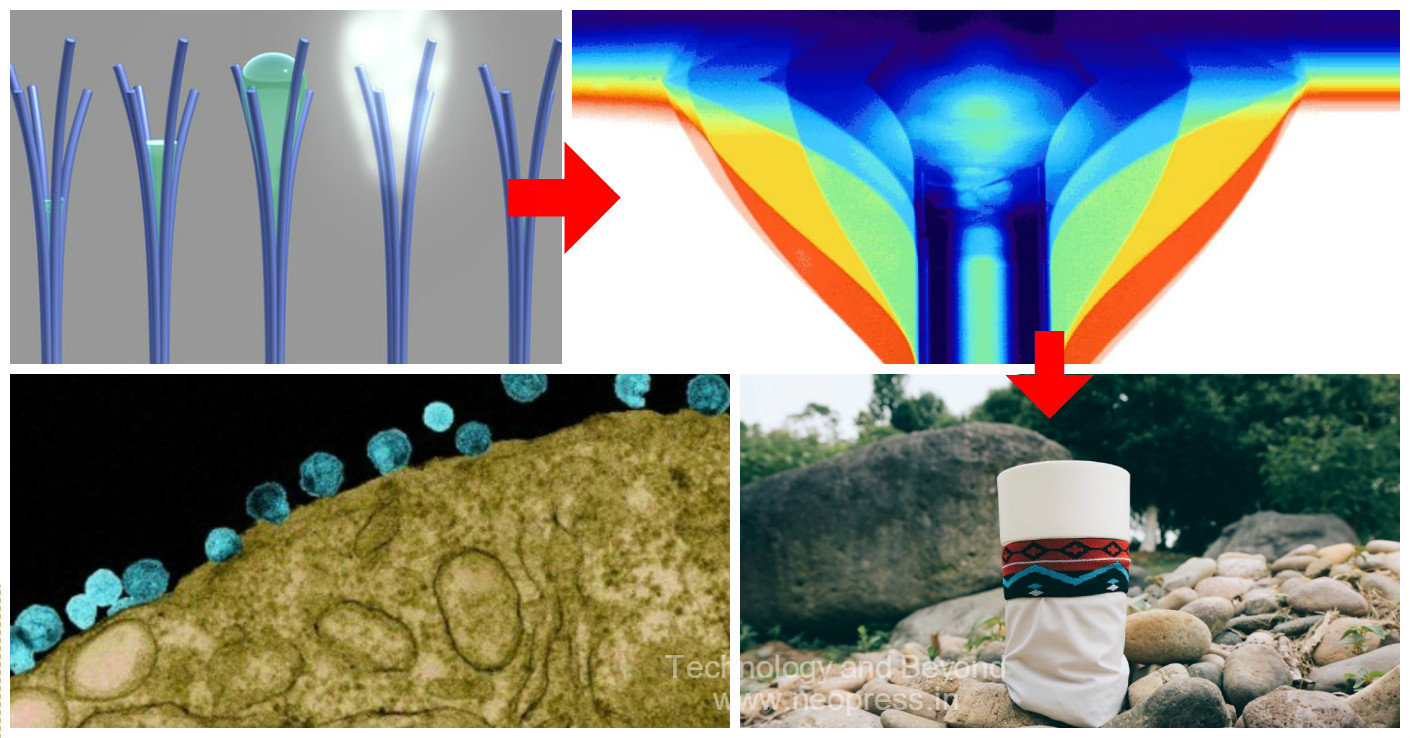
Unbelievable scientific discoveries never fail to enthrall us. With each passing day we find ourselves standing with our jaws dropped looking at how many researchers stumble onto things that haven’t even been looking for while experimenting to find newer inventions. One such discovery is the new nanorods that have the potential to harvest water from air.
These carbon-rich microscopic, inadvertently produced rods absorb and release water in a different way to all kinds of material that we are aware about. They can absorb water at low humidity levels and later on oust it as the level increases to 50-80 percent while other resources just continue to take in the excessive liquid from the air.
Gizmag’s Michael Irving emphasizes that these nanorods can ultimately be used in array of applications, starting from low-energy water-harvesting structures to possible even in the fabrics that can absorb sweat from the body.
“Our unusual material possesses qualities a bit like sponge; it squeezes itself almost halfway before it’ completely saturates itself with water,” explained David Lao from the Pacific Northwest National Laboratory (PNNL), one of the material’s Inventors.
Here’s how this happy accident took place, the team was intending to produce magnetic nanowires, but instead ended up creating these carbon nanorods in the lab. A closer inspection detailed how these nanorods apparently lost weight as the humidity in the surrounding environment rose.
Initially, the Researchers doubted their instrument to be malfunctioning but to their surprise, they realized that it was the recap of a very similar phenomenon that was considered in 1990s.
The team then started going through papers from year 2012 and 2013 that referred to the theories of how water can automatically vaporize if it’s surrounded by hydrophobic components/ materials or kept in an area not more than 1.5 nanometres wide.
The team reports that water apparently condenses and forms a bridge between the nanorods, this process is called capillary condensation. This water between the rods causes tension on the surface and pulls adjacent rods, placing them very near to each other. When this gap gets as close as 1.5 nanometres, the water starts to evaporate.
The PNNL team calls it an impending paradigm shift in the process of purification of water and also talks about their futuristic thought of how someday the sheets of these nanorods may harvest water from even the desert air. Presently a mere 10-20 percent of the material is seen to spill out water and scientists are working to increase this number considerably high.
“We’ve started to imagine the many ways it could be harnessed so as to better the quality of life that we live, now that we’ve moved on the preliminary blow of this unexpected behavior of the material”, said David Heldebrant, team engineer. “But before we can put these nanorods to use, we need to figure out a way to control them and perfect their shape and size.”
As a technology lover you may like our daily important technology news series. It’s a playlist and you can retrieve the total day-wise videos. Please consider subscribing our YouTube channel:
Author: Technology and Beyond

