This miracle device harvests wave energy and should power 1/3 of the US in near future

We have 332,519,000 cubic miles of water on the planet. That’s a staggering 352,670,000,000,000,000,000 gallons of water flowing all over the earth!

A vast majority of this water is contained by the oceans. We can barely imagine how much energy it is holding in terms of perpetually moving waves! If there is a way to harness it, it could provide a clean, green and renewable source of energy. There have been efforts in this direction and mostly by adopting windmill type of strategies. But, these efforts mostly ended with massive corrosion in salt water and problem of maintenance of the moving parts in remote sea.

VIDEO-Oscilla-Power’s-Triton-WEC

To alleviate these problems Oscilla Power developed a new technology which directs all kinetic energy towards a solid piece of metal instead of rotating the blades of an impeller. This, in turn, creates an alternating magnetic polarity in the metal which is subsequently converted into electrical current.

Oscilla’s technology, predominantly a solid-state implementation, may eventually prove far more durable than any previous effort. Once implemented, it is supposed to produce power from oceans cleanly and endlessly.

This specific mechanism is called Triton which remains on the ocean surface and generates power from the ever moving source of waves.

“As waves interact with the device, there is an alternating magnetic polarity created in the metal that is used to generate electricity,” informed Meagan Parrish for ChemInfo. “By the use of flexible tethers, themselves enabled by an asymmetric heave plate, Triton uniquely captures energy from heave, pitch, sway and roll motions”.

The basic implementation is a giant, floating, metal plate which is connected to tethers. Tethers generate electricity when they’re pushed around by waves.

Each Triton implementation is expected to generate about 600kW of power which is adequate to supply energy to 500 average homes every month. It is expected that, in its full blown form, this program should cater to 1/3 of the United States’ power requirement and about 15% of global need.

[adinserter block=”7″]

You may like to watch the video below:

width="560" height="314" allowfullscreen="allowfullscreen">

Author: Technology and Beyond

Tagged : /

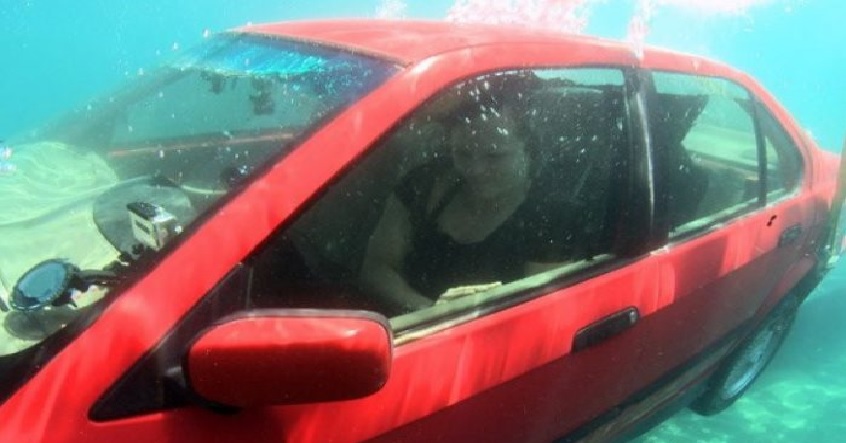
THIS is how you can escape a submerging car

According to reports, every year, on an average about 400 people die in the United States alone because of drowning in their cars.  This number can be reduced substantially once people are well aware of the facts related to escaping a sinking car.

The first and the foremost thing is to get out quickly. All you get is about a minute to escape alive according to Gordon Geisbrecht of University of Manitoba. He is a trainer and trains mainly the law enforcement officers on underwater vehicle escape.

11306967-standard

According to him, there are five golden rules that you need to follow in the highly unlikely situation of being in a submerging vehicle.

#1: Don’t try to call emergency help before you get out of the car. This is because you don’t get enough time to search out for the phone, dial the number and get a dialogue going. “Time is critical,” says Geisbrecht. “If you touch your cell phone you’re probably going to die.”

#2: Unbuckle. It sounds basic but people often forget to do that while in emergency

#3: Don’t open the door; rather, roll down the window.  Opening the door will let the water in very quickly and will make the sinking process faster. You will probably get something between 30 seconds and a minute before the water reaches at the base of the window.  This period is a so-called the float period after which the water will press with all the force and it will be nearly impossible to roll the glass down.

A caution regarding rule #3 There might be a situation where you will be forced to break the window.  Many modern vehicles have electronic windows that may get damaged by water before you have a chance to roll them down.  In this particular case, you have no other option than to break the glass with some heavy tool. Two such common and popular tools are the LifeHammer which has a hardened-steel point to break the window, and the ResQMe keychain which places a spring-loaded weight into the window to shatter it.  For underwater scenario, they will be useless unless you keep them handy and use them immediately.

Next page For More

Tagged : /
Verified by ExactMetrics