
THIS sixth state of matter could lead to superfast computers!

According to a research led by the University of Cambridge, evidence of a mysterious new state of matter has been found in a material. The state was first proposed by physicist Phil Anderson in 1973. Electrons were supposed to be indivisible building blocks of nature. But this state known as ‘quantum spin liquid’ causes electrons to break into pieces.
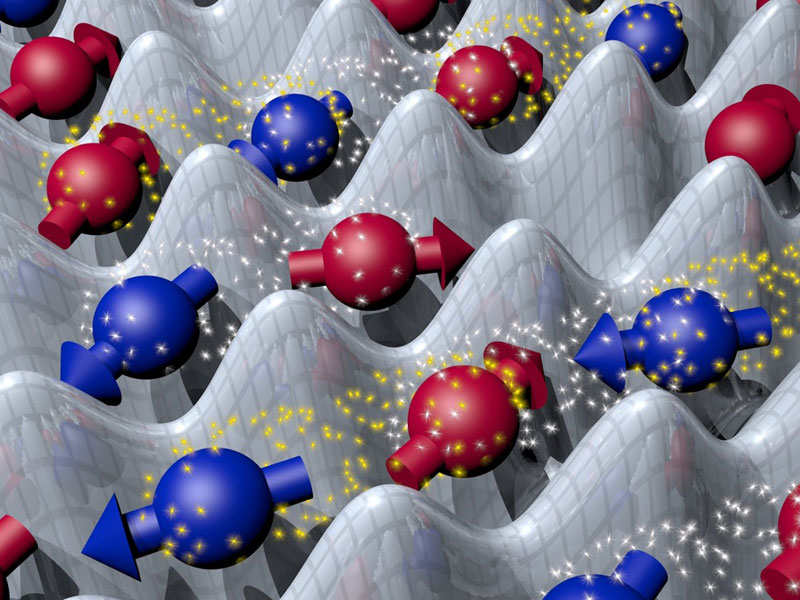
quantummagnetism_l

The discovery of electron splitting in a real material can be a revolutionary one because the fractional particles that come into being (these are known as Majorana fermions) after splitting of electrons can be used in quantum computers. Quantum spin liquids are mysterious states of matter thought to be hiding in certain magnetic materials but had not been conclusively seen in nature before.

The observation of one of their most interesting and fascinating properties of electron splitting in real materials is really important because the resulting Majorana fermions could make quantum computers far faster than conventional computers and would be able to perform calculations that could not be done otherwise.

The physicists involved in the research measured the first signatures of Majorana fermions in a two dimensional material with a structure similar to graphene. The results obtained after their experiment accurately matched with one of the main theoretical models for a quantum spin liquid known as a Kitaev model. Dr Johannes Knolle of Cambridge’s Cavendish Laboratory, one of the paper’s co-authors said: “This is a new quantum state of matter which has been predicted but hasn’t been seen before.”

This is to be noted that in a typical magnetic material, the electrons each behave like tiny bar magnets and when this material is cooled to a low enough temperature, the magnets automatically order themselves in a way that all the north magnetic poles point in the same direction.

But if it is a material containing a spin liquid state, even if the material is cooled to absolute zero, the bar magnets would not align and instead form a haphazard structure caused by quantum fluctuations. Paper co-author Dr Dmitry Kovrizhin said: “It’s an important step for our understanding of quantum matter,’ said Kovrizhin. ‘It’s fun to have another new quantum state that we’ve never seen before – it presents us with new possibilities to try new things.”

[adinserter block=”7″]

Author: Technology and Beyond

Tagged : /

How many 3s do you see on the Phone screen? (see the full picture inside the post)

Do you know what the latest internet sensation is? What is that one thing that’s driving people crazy on the internet? Well, it is our humble, simple number ‘3’. An image of an iPhone screen with a number of threes on the screen has become an internet sensation.

32B1F4F700000578-3517249-Can_you_count_how_many_threes_are_on_the_iphone_screen_If_you_se-m-23_1459436202654

Thousands of social networkers have gone berserk calculating and counting the number of threes seen on the iPhone’s screen. This photo has been widely shared with the accompanying question: “How many threes can you see in this picture?”

The most common answers are 15, 19 or 21. But to know which one is the correct answer, you will have to use a little interpretation too. There are in fact 19 threes in the picture but it can increase to 21 depending on how you interpret the question. There are eight threes in the phone number. Two threes on the keypad (number eight button has been replaced with a three).

The time on the phone shows 3.33 pm which again is three threes. Add to this, two threes which are shown in the battery power of 33%. All these sum up to 15. Now, there is something more. The ‘e’ in the contact’s name has been replaced with the number three and hence we have three more threes which takes the total to 18. Also, the letter ‘i’ on the number 4 key has been replaced by three which makes the total 19.

The puzzle, which has been widely shared on Facebook and Twitter after resurfacing again online, has instigated heated debate, with many being totally puzzled when others have arrived at a different answer.

[adinserter block=”7″]

Author: Technology and Beyond

Tagged : /

DARPA’s new Vertical Take-Off Aircraft is something unique

People familiar with aircraft industry are well aware of the fact that DARPA is trying really heard, for some time now, to create “an unmanned vertical take-off and landing (VTOL)” aircraft.

It seems DARPA is very near to achieving their goal. In this regard, DARPA (Defence Advanced Research Projects Agency) has just awarded the second phase design contract to Aurora Flight Sciences.

darpa-vtol-plane-3

In this connection, DARPA has uploaded an animated video to their YouTube channel to provide us with the first glimpse of the upcoming aircraft’s unique design.

As per the video description: “DARPA’s Vertical Takeoff and Landing Experimental Plane (VTOL X-Plane) program seeks to provide innovative cross-pollination between fixed-wing and rotary-wing technologies and by developing and integrating novel subsystems to enable radical improvements in vertical and cruising flight capabilities. In an important step toward that goal, DARPA has awarded the Phase 2 contract for VTOL X-Plane to Aurora Flight Sciences.”

This plane will be powered by a 4000 HP engine which will generate 3 megawatts of electricity. Majority of this electricity is used to propel 24 ductless fans. This aircraft will be capable of carrying a maximum load of 4500 kg with a speed range varying from 345 to 460 miles per hour.

Once completed and commissioned, the X-Plane is supposed to provide a better performance than the Bell Boeing V-22 Osprey which is another VTOL aircraft in operation. X plane can easily switch over from hover to flight mode and vice-versa.

darpa-vtol-plane-1

[adinserter block=”7″]

You may be interested about the video below:

width="731" height="731" allowfullscreen="allowfullscreen">

Author: Technology and Beyond

Tagged : /
Verified by ExactMetrics