Everybody talks about cloud! How do you store everything on Cloud and how does it work?

Right from the advent of computers storing data has been the essence of everything otherwise what good it could do? In the good old days we used computer hard drives, CDs and floppy disks to store data: text documents, pictures, videos, etc. but nowadays storing of all your data has literally become quite high-tech and high-flying! The most common way of storing data nowadays is the Cloud.

Cloud-1

For the beginners, what exactly is a Cloud? And where does all our stuff go and gets stored? Just like you keep your valuables in a bank vault or locker, Cloud is just a virtual counterpart of it. So basically, it is a virtual locker or safe or vault where you can store all your data remotely and safeguard it with a password of your choice. But that doesn’t mean all your data is hanging around somewhere in the atmosphere. What actually happens is, when you upload or store a file on a cloud based service like Google Drive or Dropbox or iCloud, the file gets copied over the internet into the data server. Data servers are no virtual places though. They are actual, physical places where companies store all your files on multiple drives. Most of the Cloud companies have hundreds of such servers known as server farms in multiple locations. So in an untoward incident you were to lose all your data in your PC you will have a backup of it on these servers. This is known as ‘Redundancy’ and it keeps your data safe from being destroyed.

Storage on Google Drive starts from 15GB no charges and can be increased up to 30 TB by paying 300 dollars a month which is what is roughly followed by other Cloud services like Dropbox, iCloud and Microsoft OneDrive. The biggest advantage of cloud storage is that you don’t have to carry all your data in a physical hard drive or something like that. You can simply access it from any internet-enabled device. Also even if your hard drive gets damaged, you would still have access to all your data stashed safely in the cloud.

cloud-3

Just like any other technology, this too comes with its limitations, for ex. In August 2014, an iCloud hack lead to the leak of numerous private photographs of many celebrities. But all in all, cloud storage can be a great way of creating space on your device, giving you an easy way to access your data from anywhere and also as a way to safeguard your data from being destroyed.

As a technology lover you may like our daily important technology news series. It’s a playlist and you can retrieve the total day-wise videos. Please consider subscribing our YouTube channel:

Author: Technology and Beyond

THIS is how the magic of breast milk works!

Since time immemorial, breast milk has been advertised as the best thing that a mother can give to her child. Doctors, parents, midwives, scientific journals all seem to echo this same fact time and again. Breast milk: the all purpose solution to your baby’s problems. It doesn’t just stop here.

ff620f922891d0f958f9405a83516ae6-otruq

Breast milk actually customizes itself to the baby’s needs over the months of its growth. Katie Hinde, an evolutionary biologist shed light on the amazing exchange between a mother’s nipple and her baby that in turn makes it understand exactly what the child needs. According to Hinde, when a baby suckles at its mother’s breast, a vacuum is created. Within that vacuum, the infant’s saliva is sucked back into the mother’s nipple. She calls it “baby spit backwash”.

Receptors in the mammary gland of the mother read the saliva as signals. The spit backwash contains the information about the baby’s immunity status. So if the mammary gland receptors detect the presence of pathogens, they compel the mother’s body to produce antibodies to fight it.

dreamstime_13195773

The antibodies thus produced, travel through breast milk back into the baby’s body, where they target the infection. This thing keeps working in a loop and based on the need of the baby, breast milk keeps making changes accordingly. This theory throws light on how the magic of breast milk works and how important it is for the baby.

As a technology lover you may like our daily important technology news series. It’s a playlist and you can retrieve the total day-wise videos. Please consider subscribing our YouTube channel:

Author: Technology and Beyond

Tagged : /

Don’t get shy, many of us don’t know. Here is your chance to know how does a solar panel actually work in simple words!

Right from the earliest civilisations, Sun has been worshipped as a God, as the ultimate source of light and power, as the entity that can make crops grow and can cause rain and draught as and when it wishes. Sun has been a dominant part of the life of homo sapiens. And as the race of homo sapiens advanced with advancement in technologies and its own ever broadening outlook, sun became much more than a God. In present times the sun is the only source of energy which won’t get depleted in the coming billion years. Earth with its ever expanding population of human beings and their ever increasing energy needs has become one huge sphere that keeps gobbling up various sources of energy like coal, wood, petroleum, natural gas etc. and the glitch is… all these sources are finite and may get depleted in near future. But then what would become of the children of earth? In order to find alternatives to the non-renewable energy sources, solar energy was tested and utilised in various forms and when it started producing electricity, human beings were ecstatic. But do you know how does this energy come to us?

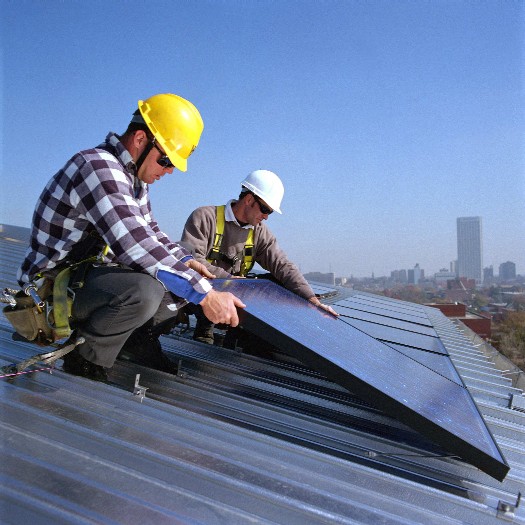
solar panel installation 3

Photovoltaics is the keyword when we talk about solar energy. The word photovoltaic derives from the Greek word “phos” (light) and the term volt, the unit of measurement for electromotive force.  Photovoltaic cells are devices constructed to capture sunlight and convert it into usable electricity. Solar panels that collect sun’s energy are basically made of numerous such photovoltaic cells.

Solar cells and semiconductors

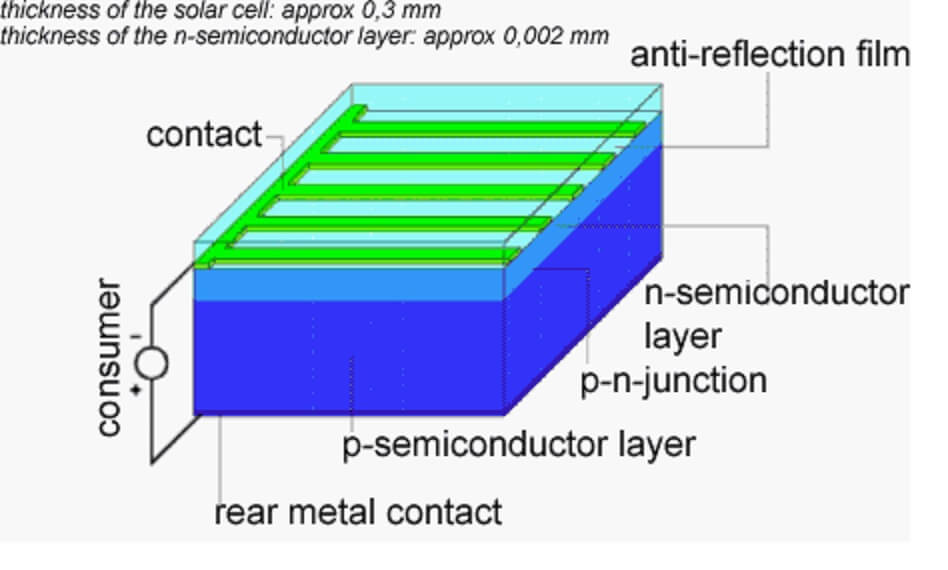
Solar cells are made of semiconductor material, such as silicon. Semiconductors are named so because of their partial capacity to let electricity to pass through them. Since they stand somewhere between conductors and insulators, they are called semiconductors. Silicon basically is a poor conductor but the crystalline structure that it possesses, makes it a good semi conductor. The outer shell of silicon atom is only half filled with electrons, so it binds strongly with other atoms to make its outer shell full and complete. To make silicon more conductive, ‘impurities’ are added in it by combining it with other elements through a process known as ‘doping’. Doping aids the free movement of electrons. A silicon conductor has two parts, each doped with a different element. The first part is doped with phosphorus, which has five electrons in its shell. When it bonds with the silicon atom, it leaves one electron unbounded which can easily be knocked loose. And when knocked loose, it produces N-type (negative) silicon. Silicon can also be doped with boron, which only has three electrons in its shell. This produces P-type (positive) silicon, which offers holes that free electrons can then fill. When energy hits the silicon, it can knock the extra electrons in the N side free, and they will move to fill the holes in the P side. Afterward, the electrons from the N-type and P-type come together and form an electrical field. The solar cell becomes a diode, allowing electrons to move from P to N, but not the other way.

solar cell Untitled

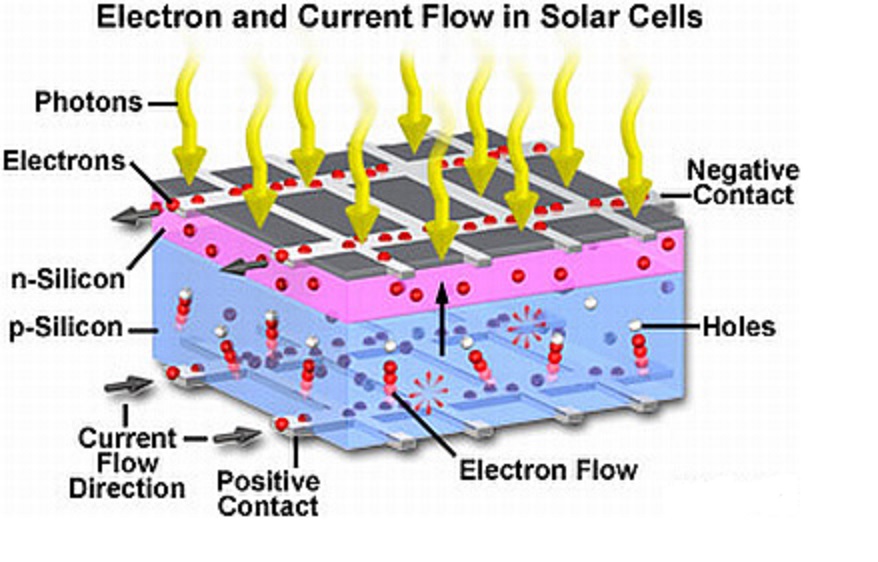
Now the energy that hits these electrons is nothing but solar energy. Sunlight is made of photons, small particles of energy that can hit the solar cell and loosen the electrons on the N side. The free electrons flow from N to P, creating an electric current as they pass. Once a continuous current is obtained, an electrical field is created. Now the only thing that needs to be done is tapping this electricity for further use. And this is done by attaching a power inverter to the solar cells. This converts the electricity running as Direct Current DC to Alternating Current AC, which can then be transmitted to homes and businesses and to places where it needs to be utilized.

[adinserter block=”7″]

Next Page For More

You got it wrong, all along! Cure for your extraordinary hunger is HERE!

The hypothalamus located above the pituitary gland and below the thalamus might just be one of the most essential part of the brain. It is what concerns itself with our hunger, thirst, sexual drive and body’s homeostasis.

548f0503c23b3_-_rbk-the-hormonal-secret-to-taming-your-appetite-omelet-s2

The hypothalamus is only able to do so because of the many, many hormones floating inside our skulls. Simply put, some hormones work to suppress hunger and some work to produce it. The hormones that work to inhibit are: Cholecystokinin (CCK), Peptide YY, glucagon-like peptide 1 (GLP-1), oxyntomodulin and uroguanylin, Amylin, insulin and pancreatic polypeptide and the most powerful to all, Leptin. Leptin quantities in your body vary proportionally with the amount of fat cells in a body.

The stimulators of hunger on the other hand are: Ghrelin, Insulin-like peptide 5 (ILP-5) etc. These hormones are only good to control the neurons in our brain.

There are several nerves that influence our hunger; the neuropeptide Y (NPY) and agouti-related peptide (AGRP) cause hunger and  cocaine and amphetamine-regulated transcript (CART) and melanocyte-stimulating hormone (αMSH) inhibit it.

Pleasure pathways also have a say in our appetite by receiving signals using dopamine, endocannabinoids and serotonin as messengers.

ae8017383050af6d_Screen_Shot_2014-09-30_at_11.18.19_AM.xxxlarge

These all factors and hormones vary appropriately in sync to make us hungry or not. All the hormones take a break to up their fasting levels three to four hours after a meal.

[adinserter block=”7″]

Author: Technology Blog

Tagged : /

What’s right for you? All you need to know about CDMA and GSM before taking a decision!

You must have heard the terms GSM and CDMA, n number of times in various conversations and there is a possibility that you still don’t know what actually these acronyms are, and if you are one of those persons then you on the right page. We will try to make you understand the nitty- gritties of these terms.

Untitled

GSM stands for Global System for Mobiles and CDMA stands for Code Division Multiple Access. These are basically two different radio technologies that perform the same task. Both these technologies wirelessly transmit voice, data and texts from and to your phone. But both these technologies have their own set of limitations and advantages. If you want to zero-in on one of these, just go through the following pointers.

What is GSM, its advantages and limitations?

While using a GSM network, your service is tied to a tiny, removable module called a SIM card, which stores your address book and phone number. So in case you want to change your handset, you just have to insert your SIM card into the other phone and it’ll download your phone number and import your contacts. In the U.S., T-Mobile and AT&T use GSM. GSM carriers are prohibited by the governing body of cellular, the ITU (International Telecommunications Union), from disallowing any GSM phones on their networks. That means as long as a phone is unlocked and supports the right bands; it’ll work on your carrier of choice. Theoretically switching to a different GSM carrier is easy but practically, it is a complicated affair. A number of cellular providers arbitrarily “lock” phones to their network via software — but thankfully, U.S. federal law requires that carriers allow subscribers to migrate to other networks upon request (as long as they’ve paid all outstanding fees, of course). Another one of GSM’s advantages is that AT&T and T-Mobile’s implementation of one of GSM’s newer revisions, HSPA+, is quite fast, with a download speed of 11Mbps. Also, all GSM networks support simultaneous voice and data so that you can talk and surf the web at the same time.

01-principles-of-the-wcdma-system-44-728

What is CDMA, its advantages and limitations?

As compared to their GSM equivalents, CDMA networks are more restrictive. CDMA phones instead of using SIMs, rely on a server-based white list of subscriber numbers to verify your plan. So if you have misplaced your SIM card, you won’t lose service but it puts the CDMA carrier a much greater degree of control. Another important thing, you will be able to switch your phone only with your carrier’s permission and even a phone compatible with a CDMA carrier’s network won’t work until it’s been approved by said carrier.

If you compare the CDMA network with GSM, it has a little edge in certain things like CDMA supports a greater number of concurrent connections, which theoretically means less congestion at cell towers. This means fewer dropped calls and internet slowdowns.

[adinserter block=”7″]

Next Page For More

Huge Solar Farms damage the Climate? You need to know THIS!

Each switch to renewable sources of energy, namely, solar power makes us feel better and more on the safe side. But unfortunately, a team of researchers from the US and China recently put together a series of potential scenarios to predict the state of the world’s climate after a hypothetical switch to full planetary solar power and the result was not too reassuring.

Solar-5

Around the world, humans regularly consume an average of about 17.5 TeraWatts of power. The problem with building too many solar farms is the excess the energy that will be produced. In the most extreme simulation, when all the deserts and urban areas of Earth were covered with solar panels, pouring 800 TeraWatts of electricity into the environment, the net global temperature saw an increase. Even when the scientists created a more practical scenario where only the deserts of Egypt were covered with solar panels, the 60 TeraWatts of power created was still in extreme excess.

[adinserter block=”7″]

The factors to take into consideration in a solar farm is the area covered and the volume of the panel. These factors, if not taken care of, could affect the environmental conditions. In the simulation where the deserts are covered with solar panels, the surrounding region is cooled down by about 2 degrees, while the regions with the panels heat up. Although, the net effect is evened out, the changes in wind and precipitation conditions could influence various climate changes and natural disasters.

Solar-3

All said and done, this possible future of the earth is still rosier than the present. Seaking in the interest of all, it would be wiser to just slow down the damage rate.

Author: Technology Blog

Wanna make your 3D printed revolver? Here is the inspiration!

With all the rage concerning 3D printing we weren’t surprised when we heard about a 3D printed revolver. Developed by mechanical engineering student James Patrick, the 3D printed pepperbox revolver known as PM522 Washbear, can fire up to 8 bullets between reloads. The gun is almost entirely 3D printed using ABS plastic or a durable nylon is the world’s first functional 3D-printed repeating firearm that has been printed using a consumer 3D printer

gun-4

except for an elastic band spring, a metal firing pin, and steel rods as detectable metal.

The design of the gun is really good and simple. It allows the user to take multiple shots without reloading. In designing this revolver, a 6-8 chamber pepperbox style removable cylinder was used which is held in place by a simple pin at the front. This pin can be easily removed allowing the user to transform a 6-round cylinder to an 8-round one. Once you load the cylinder, elastic bands that are attached to the trigger, turn the cylinder and line up the round for firing.

When you pull back on the trigger, the cylinder moves into place and the striker is pulled back with the trigger. The striker has a flat roofing nail which acts as the firing pin. When the trigger is pulled back to its furthest position, it drops down slightly into the handle, enabling the striker to move forward and hit the round with the firing pin. As the trigger moves back to its resting state, the cylinder moves to an off-centre position, which acts as a safety measure that prevents the accidental firing of the gun in case it is dropped or jostled.

gun-1

Like any other arms, in order to comply with gun regulations, adequate detectable metal has been added to this plastic gun using steel rods which are epoxied into the well of the grip. Though it is yet to be seen whether this addition will make the gun a legal one, it is no less than a feat on Patrick’s part.

[adinserter block=”7″]

Author: Technology Blog

Ever heard about the term ‘hydricity’? The concept will blow your mind!

As more and more nations are adopting renewable energy solutions in different spheres, the need to enhance its efficiency is increasing. Though solar energy is a clean and renewable source of energy, the problem with it is that its supply becomes erratic in unfavourable weather conditions. Adding to that, the efficiency of solar panels isn’t that high even when the days are sunny. It hovers somewhere around 20-23%.

hydricity

To find a solution of these genuine bottlenecks, a team of scientists from Purdue University and Switzerland’s Federal Polytechnic School of Lausanne, have developed a new energy system called ‘hydricity’. Hydricity is named so as it derives energy from sunlight as well as hydrogen fuel. As Rakesh Agrawal from Purdue puts it “Traditionally, electricity production and hydrogen production have been studied in isolation, and what we have done is synergistically integrate these processes while also improving them.”

The most prevalent two types of harnessing solar energy are photovoltaic cells and solar thermal power plants. While photovoltaic way uses solar panels to produce energy, solar thermal power plants concentrate the Sun’s rays, thereby using the generated heat to warm up water and drive turbines using the steam produced. The advantage of the solar thermal power plants is that they capture more of the sun’s spectrum but the limitation is that these are less efficient than solar panels and are good when the sunlight is direct.

hydricity-4

These reasons prompted the scientist community working in the field of renewable energy to come up with the idea of hydricity. The idea behind hydricity is improving the efficiency of both solar thermal power plants and hydrogen fuel production plants. The system that the scientists have envisaged will be an integrated one that would produce both steam for generating electricity for immediate use and hydrogen for storing it for later utilization.

The team of scientists claims that the system can produce hydrogen at an efficiency of 50 percent and electricity 46 percent (something unheard of) obtainable owing to the way the high pressure turbines can be used to run in succession of the lower-pressure ones. They claim that in a 24 hour cycle a Sun-to-electricity efficiency of 35 percent can be obtained which is a commendable number. In this process of producing electricity, the hydrogen fuel produced along with the electricity is an important factor to be considered and that is because this same fuel could be used in transportation, chemical production and other industries.

hydricity-3

The biggest advantage is that it doesn’t degrade with repeated use and doesn’t get discharged when stored. So when the sunlight is not available, the hydrogen power can take its turn and turbines can be kept running.

Though the process is still at its simulated model stage, real-world experiments are quite near in the future. And the future does seem bright with ‘hydricity’!

[adinserter block=”7″]

Author: Technology Blog

Tagged :
Verified by ExactMetrics