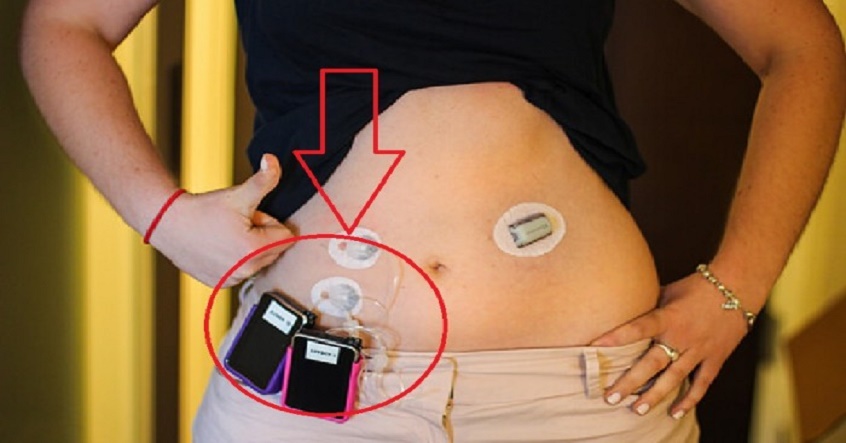
When you see these strange gadgets hanging over there, it means THIS!

Type I Diabetes patients have a hard time monitoring their  blood sugar levels and injecting the right amount of insulin at regular intervals several times a day manually. This algorithm will hopefully here to solve the problem.

uttmgreendiabetes061714640x360

All we need is a pump, a monitor and the algorithm and the patients never have to worry about self-administering insulin into their bloodstream again. The algorithm is installed in a tablet computer or an android phone and can check a person’s blood glucose levels automatically and wirelessly, with the help of a sensor implanted into the layer of fat above their abdomen.

Type I diabetes is an unfortunate condition where the destruction of cells involved in processing of insulin to control glucose levels are destroyed, and the patient is left with the lifelong task of maintaining their own blood-sugar levels. This algorithm runs checks every 12 minutes and maintains optimal glucose levels in the blood. “It tells the pump how much insulin to deliver and it does it day and night,” says Roman Hovorka of the University of Cambridge.

Hovorka’s team tested out this new system with perfect result. The tests involved three-month trial of the device with 33 adults and 25 children. Each diabetic person tried both systems- the one with the algorithm, and the one without. As far as stats go, children using the bionic device spent 25 per cent more of their time in the “ultrasafe” blood sugar target zone, up from 34 to 60 per cent. The time they spent with abnormally low sugar levels per night was halved, to just 5 minutes.
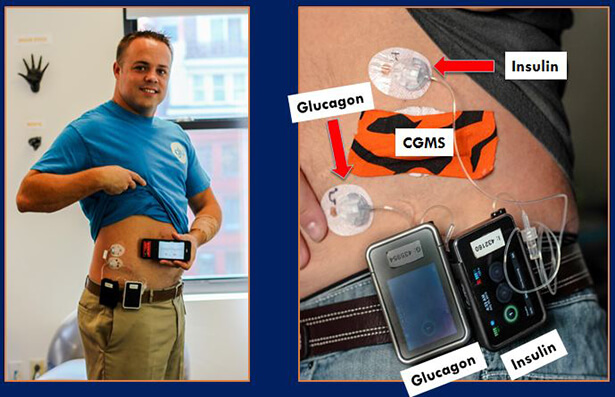
Bionic-Bill-Pic

The system worked well for the adults too, pushing them into the target zone 68 per cent of the time, up from 57 per cent with the simpler system

As a technology lover you may like our daily important technology news series. It’s a playlist and you can retrieve the total day-wise videos. Please consider subscribing our YouTube channel:

Author: Technology and Beyond

Tagged : /

Hold your breath! This Affordable personal plane is coming soon to a household near you!

ICON has come up with a foldable plane A5 that can tag along with you on weekends for camping trips of the sort, and is targeting the customers with the safety aspect of travelling or driving this automobile. To be specific, it’s selling out on its “spin resistance” feature that will eliminate the need to rely on “perfect pilots who can recover from emergency situations”. This plane was also received a Light Sport Aircraft airworthiness certificate from the FAA just this summer.

Icon-A53-537x366

“The plane is very forgiving if the pilot makes a mistake,” Kirk Hawkins, co-founder of ICON told Inc. “The plane will give you all the warning signs, but if you stay in trouble the plane will not lose control and will not drop out of the sky.”

How does the spin resistance work after all? Well, the usual problem with planes this that when the aircraft slows up less than 41%, it completely stop working and plunges to its death.

A5, on the other hand, first warns the pilot about the slowing down, then if the pilot fails to get the system under control, the aircraft autonomously takes over and as explained by NASA, “a wing cuff on the aircraft to separate the wing into two distinct parts: one that allowed a stall to begin and one that prevented it from continuing,” Flying this aircraft still requires a driver’s license though ICON promises to care of that with a two-week driving course worth $9,500.

a5folding-wing-amphibian-monoplane

These planes are a bit more costly than your average hobby plane, starting at $59,000 for a used plane and going up to $197,000. The production seems to be lagging behind as evidenced by the fact that the next batch of A5 aircrafts will not be out before 2019.

[adinserter block=”7″]

Author: Technology Blog

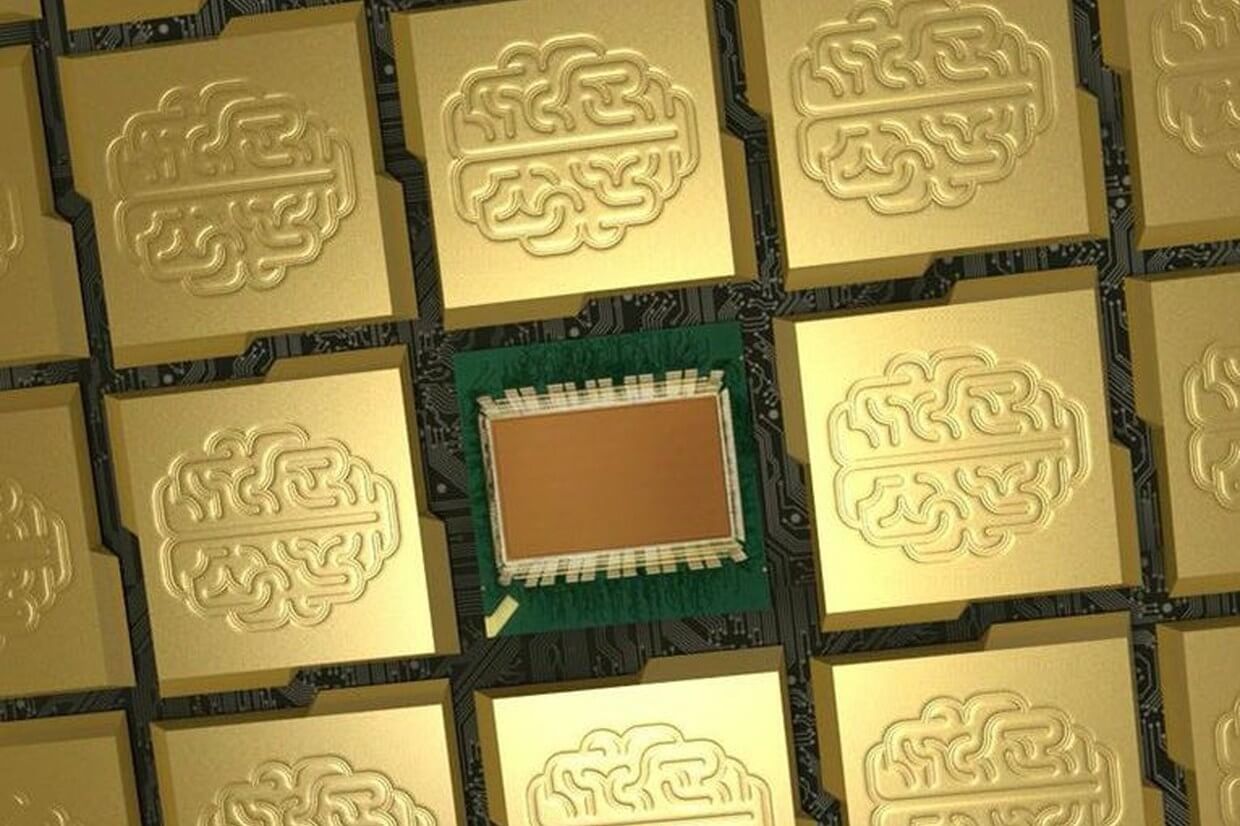
Digital human brain? This Shocking brain chip helps computers to think like humans !

The current chips used in computers drain power to perform the simplest operations, like adding or subtracting as they require the use of many transistors. They also can’t process information in parallel. This is where they differ from human brains, not to mention, they can’t recognize a visual pattern or understand human language.

IBM-chip2

Alternative chip use design that deviate from the traditional norms tackle all the above problems by using neuron-like structures or resorting to massive parallelism, but they still need human minds for shaping their software.

A research team led by professors Wilfried van der Wiel and Hajo Broersma from the University of Twente in the Netherlands have devised a new type of electronic chip that is massively parallel, and can manipulate data in arbitrary ways – even though it doesn’t need to be explicitly designed to perform any task, it takes after the human brain.

The chip itself decides the best path to follow and judges the outcome.  This proof-of-principle device consists of a network of up to 100 densely interconnected gold nanoparticles, 20 nanometers in size, each acting as a tiny transistor. This product of artificial evolution is dubbed as the natural computer as the particles and transistors that make it up are are connected in a specific pattern, the shared network is exactly like our brain’s’ neuron connections.

The nanoparticle cluster contains two input signals, one output signal, and six control voltages that are connected to the end and determine the output of the network. The entire circuit is not handmade, but instead the researchers function by knowing the exact combination of control voltages that process all the inputs into the correct outputs.

“Although we understand the generic physics principles underlying the cluster’s behavior, we do not know the actual current paths in the network on a nanoscale level,” Van der Weil said.

This method will prove cheaper and more sustainable in the long run as if the chip were to suffer damage, then it could be recovered by adjusting the voltage values for the signals that control how the nanoparticle cluster manipulates the data. A genetic algorithm (GA) in computer science, is a clever way to optimize a set of parameters for an arbitrary condition. Selection of the optimal values for the six control voltages is done by this method which takes less than an hour.

The researchers were able to indirectly “program” the chip to act as any one of the Boolean logic gates by optimizing the voltages for different functionalities.

“Natural computers have, in general, the promise to be more energy efficient,” says Van der Weil. “The promise for lower energy consumption is based on the fact that natural computers take more advantage of the computational power of matter than conventional computers, and that many computational processes occur in parallel as opposed to sequentially as in conventional computers.”

designless-electronic-circuits-4

The current drawback is that this system can only operate at temperatures close to absolute zero. This is nothing that can be improved soon enough. The next steps for the team’s research will be to “create larger networks with more complex functionality, preferably at room temperature.”

As a technology lover you may like our daily important technology news series. It’s a playlist and you can retrieve the total day-wise videos. Please consider subscribing our YouTube channel:

Author: Technology and Beyond

Tagged : /

Don’t even think about it! This technology will soon catch the criminals before crime is committed !

Future is as far as you want to see it and what it holds always intrigues the mankind; so predicting future has always been one of the common fetishes that humans in general share. Sharing this same fetish, Hitachi, the makers of TV, power tools and other business and medical equipments claims to have developed a predictive analytics system that can anticipate crimes before they happen.

hitachi-crime-predicting-technology

The system, called Hitachi Visualization Predictive Crime Analytics (PCA), has been developed by researchers Darrin Lipscomb and Mark Joules who are also the co-founders of crime-monitoring company Avrio and Pentascene. Making use of machine learning, the PCA has the ability to derive patterns from a near infinite amount of sources, creating behaviour patterns that are often overlooked by the human eye. This system unlike the traditional system removes the bias of personal variables.

It culls data such as weather patterns, public transit movements, social media activity, gunshot sensors, and many, many others. The data collected, Hitachi hopes, represents a comprehensive system capable of accurately predicting crime.

A unique aspect of this system is how it tracks and interprets data from the social networking sites as the developers believe that the social media plays a very important part in predicting and correlating what may happen. Armed with the ability to decipher colloquial text and speech, keywords, and slang native to a specific area or gang don’t go unnoticed. The PCA makes use of a latent Dirichlet allocation which sorts tweets based on their geography, then chronicles specific language to get an idea of what’s going on.

[adinserter block=”7″]

Next Page For More

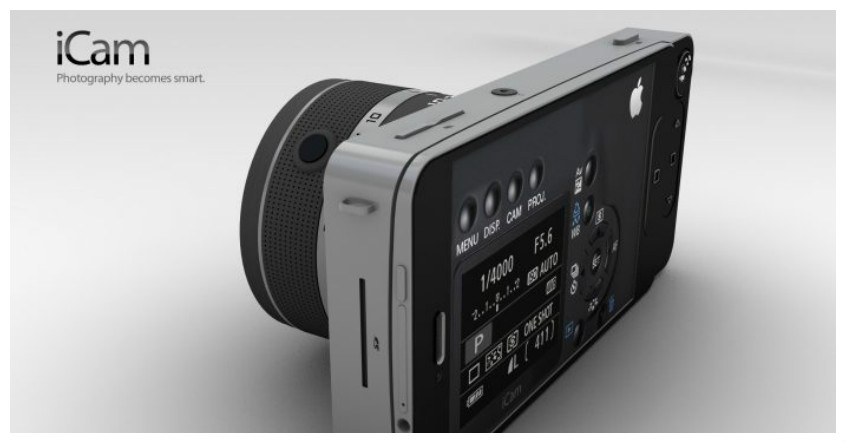
Have you seen an Apple camera? How do you like THIS?

Talk about revolutionizing high-tech markets with innovation, quality and style, Apple wins the race hands down. Be it smartphones, smartwatches, tablets or MP3 players, Apple has always managed to surprise and elate one and all. But sometimes what we miss is an Apple camera. Don’t you? Let’s see why Apple should start thinking and working on an Apple camera.

Apple QuickTake 200 Digital Camera. Manufactured for Apple by Fujifilm from 1996-1997. The QuickTake camera line was killed by Steve Jobs when he returned to Apple.

Apple is photographers’ delight: Flickr informs that a quick survey of photo-sharing site’s camera –finder shows the iPhone 6, iPhone 5s, and iPhone 5 and iPhone 6 Plus were four of the five most popular cameras in the last one year. Apple still leads the group of brands followed by Samsung, Canon and Nikon.

It has excellent image processing: We tend to buy cameras based on terminologies like megapixel, sensor size, shutter speed, aperture, etc. but the image processing also plays an important role when the final outcome of the image is discussed. And Apple always hovers around or on the top whenever it does anything. So when we talk about image processing it is amazing and has smooth software. Apple’s cameras succeeding iPhone4 have consistently had some of the best colour reproduction in the industry, and the company has pioneered easy to use features like auto-HDR, which help negate some of its sensor’s technical deficiency and a user’s lack of expertise.

If a car then why not a camera? : The news has been doing the rounds from quite some time that Apple is hell bent on manufacturing its own self-driven car. What we think is…. if it can produce something as technologically advanced and big as a car, then coming out with a camera isn’t such a big deal for the tech-giant.

[adinserter block=”7″]

Next Page For More

Tagged : /

Unbelievable but true ! This is how galaxies move away from us faster than that of light!

Whenever there is discussion about speed, everybody knows that the speed of light is the ultimate limit, nothing can move faster than that. Then how come according to a report, galaxies are moving away from us at a speed greater than the speed of light? It is simple, if you are standing and something is moving away from you then it is moving at its own speed…. but when you are moving and the thing is moving in a direction opposite to you then the thing moves with a speed which is a sum of yours and its own. The same applies to galaxies. But can two space bodies move away from each other at such speeds that their relative speed becomes even greater than speed of light?

1-r32STTVeQaeBPCCudL1Ewg

Here comes the concept of ‘Hubble Constant’. According to this, for every megaparsec of distance between us and a distant galaxy, the speed separating them increases by about 71 kilometres per second. Galaxies separated by 2 parsecs will increase their speed by 142 kilometres every second.

If you run the marathon, once you get out to 4,200 megaparsecs away, two galaxies will see each other travelling away faster than the speed of light. But do we have that much space in the universe? Sure we do dear readers! The first light ever, the cosmic microwave background radiation, is 46 billion light-years away from us in all directions and if calculated, 4,200 megaparsecs is a little over 13.7 billion light-years. So to say, there’s humongous room for objects to be more than 4,200 megaparsecs away from each other.

Now the next question that arises because of this finding is that if most of the universe is already moving away at a speed greater than the speed of light. Then how can we see the lights from galaxies moving faster than the light itself? Actually, the galaxies may be moving away from us but the light emitted by the galaxies is moving towards us.  That is the reason why photons emitted by all the stars in these galaxies can still reach us.

howcanspacet

These wavelengths of light get stretched out, and shift further into the red end of the spectrum, off to infrared, microwave, and even radio waves. So with the passage of time there will come a time when the photons will be stretched so far that all galaxies and radiations that we see today will become totally undetectable. The universe never ceases to surprise and confuse us at the same time.

Watch the video below for more information:

width="539" height="539" allowfullscreen="allowfullscreen">

As a technology lover you may like our daily important technology news series. It’s a playlist and you can retrieve the total day-wise videos. Please consider subscribing our YouTube channel:

Author: Technology and Beyond

Tagged : /

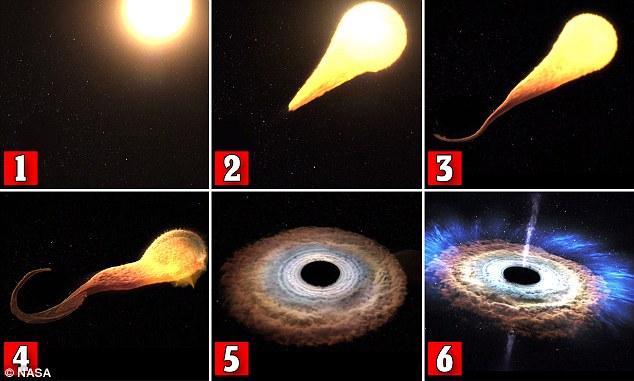
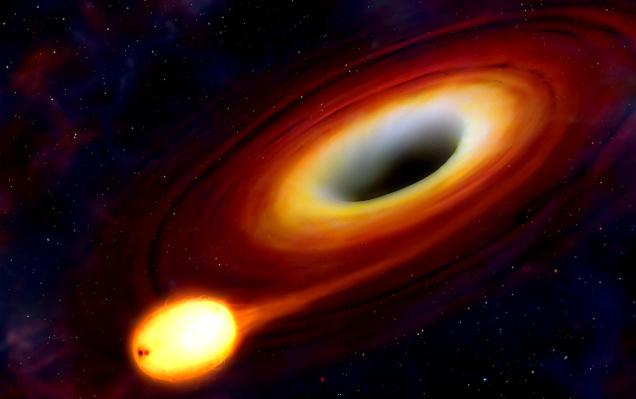
This is how a star is swallowed by a black hole! A stunning step by step picture!

Black holes are called black holes for a reason. These celestial members are those dense areas of space that have gravitational pulls to such extreme degrees that neither light nor any matter can pass through them. This is the reason why it is always difficult to study these. They just keep hiding there in the vastness as huge voids.

star-4

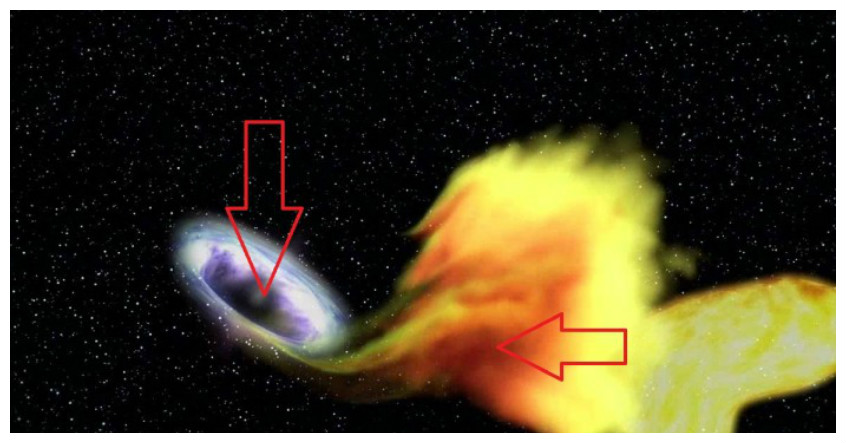
Recently an international team of researchers has observed one such black hole swallowing up a star and this has been observed for the very first time. This event took place over several months; hence over a period of 12 months the research team got a chance to study this amazing event in order to test the theory that when a large volume of gas is pulled in by such an object, a fast moving jet of plasma travelling at close to the speed of light escapes from near the black hole rim.

The black hole that the team studied was a massive one with a mass one million times that of our sun and located at a distance of 300 million light years. It was in December 2014 that the event was first spotted at the Ohio State University by astronomers who were using an optical telescope in Hawaii. After this, a team from UK’s University of Oxford turned their telescopes in the direction of the object and caught the event in the nick of time.

Due to this combined effort, it became possible to gather radio, optical and X-ray data which in turn contributed to provide a supreme quality, detailed and valuable record of the event. Based on all the data received, the researchers were able to prove with the multi-wavelength portrait that the increased light emission was the result of a newly trapped star. This in turn proved the existing theories regarding such events.

star-1

John Hopkins University’s Sjoert van Velzen said: “The destruction of a star by a black hole is beautifully complicated, and far from understood. From our observations, we learn the streams of stellar debris can organize and make a jet rather quickly, which is valuable input for constructing a complete theory of these events.”

As a technology lover you may like our daily important technology news series. It’s a playlist and you can retrieve the total day-wise videos. Please consider subscribing our YouTube channel:

Author: Technology and Beyond

Tagged : /
Verified by ExactMetrics