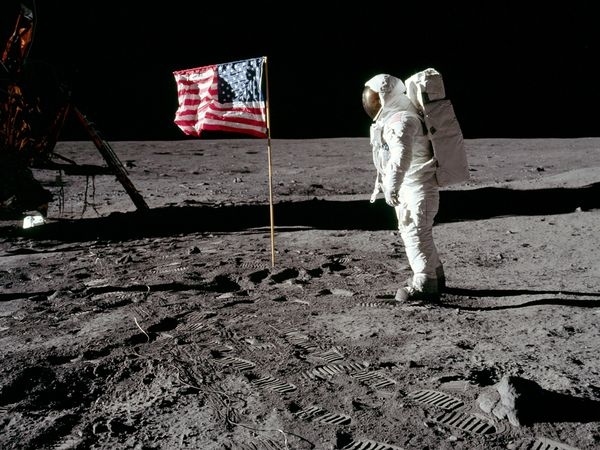
Neil Armstrong’s first step on the moon was undoubtedly one of the biggest things in the 20th Century. NASA knew that it was one such event that was going to linger in the minds of people for years to come so they planned for a live broadcast and as expected it came out to be the biggest television event of the 20th century. In July 1969, the space technology wasn’t as refined as today’s. So broadcasting the historic event of landing of Apollo 11 on the Moon had required a lot of hard work, innovation and amazing engineering.

Hello… Hello… Deep Space!
In any space mission, exchange of information or communication is the key. It is imperative that a communication system exists where there is an easy and continuous exchange of information between a spacecraft and supporting ground crews. For the Apollo mission it was even more necessary as Apollo, unlike the Mercury and Gemini programmes (where included flying missions in earth’s orbit) was to go beyond the Earth’s orbit.
The Mercury and Gemini programmes had used separate radio systems. Using Ultra High Frequency (UHF) and Very High Frequency (VHF); two-way voice communication, uplinked data and down-linked telemetry were done while tracking was achieved with a C-band beacon on the spacecraft interrogated by ground-based radar. Since this was a system for simpler missions, it wouldn’t have worked for Apollo which was going to the Moon with three men working in two spacecraft that would be operating simultaneously and sending down live television images, NASA needed a new way to uplink and downlink more data.
The NASA team came out with a solution for this and this was called Unified S-Band or USB. It was different as it combined tracking, ranging, command, and voice and television data into a single antenna. Voice and biomedical data were transmitted on a 1.25 MHz FM subcarrier, telemetry was done on a 1.024 MHz bi-phase modulated subcarrier, and the two spacecraft — the command and lunar modules — would use a pseudo-random ranging code using a common phase-modulated S-band downlink frequency of 2287.5 MHz for the CSM and 2282.5 MHz for the LM. All this meant that every base was covered as far as the information exchange between the ground and Moon-bound spacecraft was concerned.
The only thing that was still occupying the team’s mind was the television broadcast. So, in order to free up space for a television downlink from the lunar module, NASA removed the ranging code and changed the modulation from phase to frequency. This freed up 700 kHz of bandwidth for a television downlink on the USB signal. But this too posed a problem as 700 kHz was not enough bandwidth for the standard video camera of the day that transmitted 525 scan lines of data at 30 frames per second at 5 MHz.
Considering all this, what NASA needed was a slow-scan camera needed optimized for a smaller format, 320 scan lines of data at 10 frames per second and all this could be transmitted at 500 kHz. Once the specifications and guidelines of the camera were decided upon, NASA awarded a contract to RCA for the command module camera and another to Westinghouse Electric’s Aerospace Division for the lunar module camera.
[adinserter block=”7″]
Next page For More
