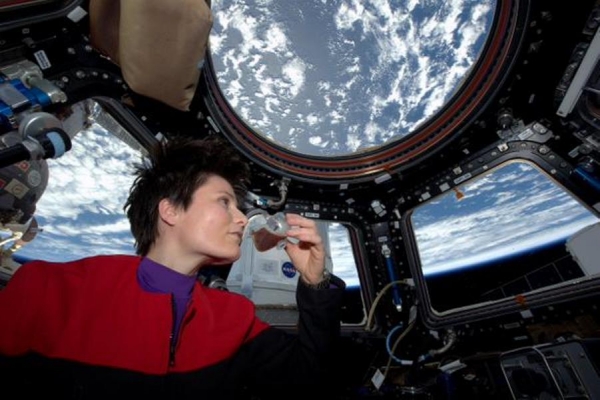
Sadly, one of the many things astronauts miss out, or rather have experience differently in space, thanks to the effects of zero gravity, is sipping liquids from a cup. The fact that they have to draw coffee via straws speaks for itself. This diminished coffee experience may change for the astronauts thanks to a new 3D-printed cup designed to help NASA study the behavior of fluids in microgravity.
 Italian European Space Agency astronaut Samantha Cristoforetti received an espresso machine and that is when the desire to study capillary flow, liquid containment, and low-gravity fluid dynamics came alive. A team of researchers were hired by NASA who designed six different transparent polymer cups- five of which were 150 ml and the sixth, made exclusively for holding espresso in it, is 60 ml.
Now what was special about these cups? Well, first of all, these cups have a crease in them to hold the liquid in place even if the cup is tossed or turned. Hazardous situations in space can thus be overlooked with this precautionary feature. Next, the cup is open unlike the current models astronaut have had to suffer until now.

For this, the crease again comes to use as it has a dual purpose: It also allows the liquid to move out of the glass via surface tension when the astronauts want to drink. “Wetting conditions and the cup’s special geometry create a capillary pressure gradient that drives the liquid forward toward the face of the drinker,” said mechanical engineering professor Mark Weislogel of Portland State University. “An astronaut can drain the cup in sips or one long gulp in much the same manner as on Earth.”

The NASA-lead team presented the initial results of this capillary flow experiment during this week’s annual meeting of the American Physical Society’s Division of Fluid Dynamics in Boston. These cups are being actively tested by Japanese astronaut Kimiya Yui and NASA astronauts Scott Kelly and Kjell Lindgren for different beverages and their overall responses including “Hey, you can smell the coffee, and “This is eerily like drinking on Earth.” are pleasant.
[adinserter block=”7″]
Author: Technology Blog