
CubeSats are simple, cheap satellites that can offer space access of students, and countries lacking their own space programmes to perform space explorations in the future. Paulo Lozano at the Massachusetts Institute of Technology, and his team say that they “want to offer space access to people who don’t have it.”
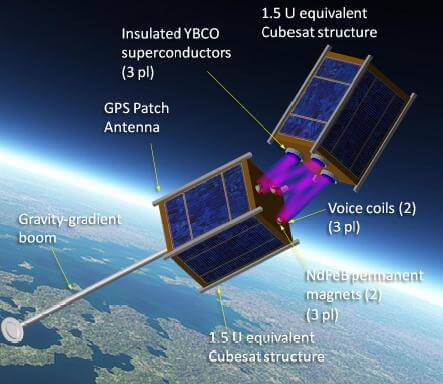
About ten such 1 kg satellites have been constructed till date, and they can perform tasks such as climate modelling experiments to exoplanet hunting. But, these tiny space-gadgets are only good till they are set on the orbit, and that is where they contain to remain for the rest of their working lives. This would contribute to serious issue of growing space junk. “If little satellites had the capability to move, we could do a lot of things that currently we cannot,” Lozano says.
The fuel used in this satellite is an ionic liquid composed solely of positively and negatively charged ions. Because the material is liquid at room temperature, it is safer and simpler to take into space than a plasma or gas. Applying an electric field can send these ions streaming away from the satellite at high speeds, producing a force in the opposite direction.
Lozrano though voices a few questions about the applicability of this fuel method. He worries that not only might the ions left behind corrode the spacecraft, but positive ions left behind might end up pulling the negative ions back in, resulting in cancellation of the thrust.
Lozrano and his team performed tests of this satellite back in August in a vacuum chamber, and the body was magnetically levitated. Thrusters placed on the either side kept it going in a circle, while another kept the satellite electrically neutral. After 20 minutes of continuous firing, the CubeSat spun at about 2 rotations per minute. Lozano says this would be enough to take a CubeSat from an altitude of 400 kilometers up to 800 kilometers, or to de-orbit it at the end of its life.

Next, the team fired the thrusters continuously for 140 hours, using up all the fuel without corroding the spacecraft. “This is one of the other showstoppers we had at the beginning: will we be able to deplete all the ions from this ionic liquid?” Lozano says. “But we were able to get every single ion out. The tank was completely dry. This is the most exciting test we have run so far.”
[adinserter block=”7″]
Author: Technology Blog


