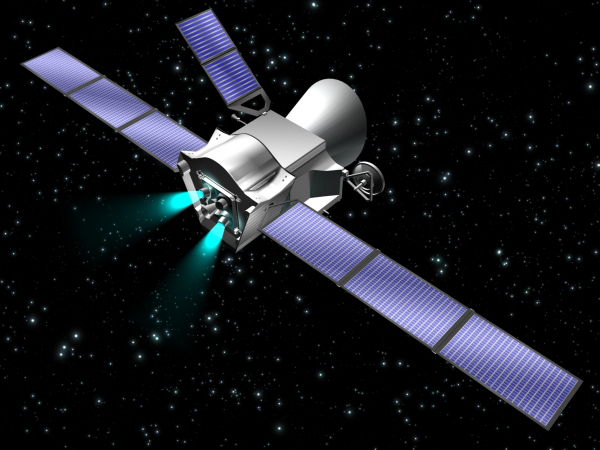
Do you know what ion-engines are and how they work? These engines are basically low-thrust propulsion systems with a long run time and because of this long runtime these are the best engines for spacecraft flight. These engines generate thrust by ionizing a propellant gas and then accelerating that gas through the engine using an electrostatic or electromagnetic field. There are a variety of ion engines that use different ionizing materials and different propulsion systems.

Now a researcher from University of Sydney Dr. Patrick Neumann, claims to have created the world’s most efficient ion engine. Up until now, it was NASA’s HiPEP engine that held the record for ion drive performance. Dr. Neumann created the engine as part of his PhD thesis and is using the invention to form the basis of his new company Neumann Space. The Neumann drive uses a solid propellant and an electrical arc to vaporize the propellant into a cloud of ions, electrons and neutral vapor. This mixture is accelerated through an anode ring and then focused using a magnetic field. This combination pushes the gas mixture out in a contiguous pattern of short and light bursts.
Neumann drive is also advantageous in some respects when compared to other drives. It is simple in design hence easy to operate and repair. It can be powered by several different commonly found metallic substrates like Magnesium. This multi-fuel capability is in contrast to the NASA’s drive that uses Xenon gas to run. When it comes to thrust, NASA’s HiPEP certainly leads with 30 to 40 µN/W as opposed to Neumann’s 20 µN/W. But when it comes to specific impulse, the Hall thruster provides 9,600 (+/- 200) seconds of specific impulse while the Neumann drive is calculated at 14,690 (+/- 2000) seconds. This means Neumann’s drive uses fuel more efficiently and thus can fly longer than its NASA counterpart. This implies a possibility to reach Mars and then return on a single tank of fuel.
Neumann’s new company Neumannn Space has been granted a provisional patent for this technology and Neumann plans to improve this technology further. He will also be representing his research during the 15th Australian Space Research Conference, which will be held on 30th September at the Australian Defence Force Academey.
[adinserter block=”7″]
Author: Technology Blog