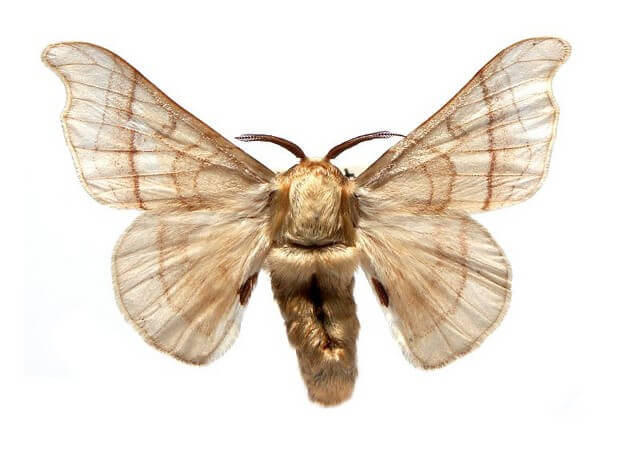
Moths Determine the Course of their Flight via Selective Turbulences

According to a new paper in Current Biology, the European silver Y moth can sense changes in the turbulence while migrating from northern Europe to the Mediterranean and back again. They use these cues in changes in air pattern to safely find their way.
Autographa gamma moth_Shutterstock_web

Moths are nocturnal creatures, so like most other insects they can’t rely of the sunlight to provide a landmark.

“Imagine you’re in a hot air balloon, drifting with the wind at night, and you closed your eyes. And someone said, ‘Which way is the wind blowing?’ You would have no idea,” co-author Jason Chapman — who studies how animals move at England’s Rothamsted Research — told Inside Science. “You’re moving in the fluid, the air, and you’re in a sensory vacuum.”

According to the laws of fluid dynamics governing turbulence, less disturbances are found when you’re flying downwind. Hence, if the moths could sense stronger turbulences, and in which direction these were directing the course of the moth, they could know the direction of the wind flow.

The team referred to 15 years worth of radar tracked bird movement, especially during migration, and found the working of the Ekman spiral. Ekman spiral in Physics, states that  air currents flow counterclockwise in the Northern hemisphere and clockwise in the Southern hemisphere (as Earth is on constant rotation on its axis), but those same currents in the Northern hemisphere shift to clockwise rotation at higher and higher altitudes.

The radar data showed that the moths would mis-align ever so slightly to the right when flying downwind in the Northern hemisphere, and vice versa in the Southern hemisphere, supporting the Ekman spiral.

1413330692891492781

Now that the mystery of what the moths use as a compass has been solved, the question of how they achieve this feat still remains unsolved. Scientists believe they use magnetic fields, an ability that flies, beetles, ants, bees, and termites are known to possess.

[adinserter block=”7″]

Author: Technology Blog

Space Glass for Sipping Space Whisky

One common complaint by International Space Station (ISS) crews is the lack of anything Earthlike in their environment. Balentine, a Scottish distillery has commissioned an Open Space Agency team led by James Parr, to develop Balentine’s Space Glass whisky for astronauts in space. This sophisticated piece of culinary gives the astronauts a more home like feel compared to sipping juice through straws from a plastic baggy.

space-glass-4@2x

First things first, Balentine has managed to look way into the future and has used 3D plastic to make this glass, thus ensuring, that astronauts might be able to produce these in space.

Through the course of a year, the team studied the behaviour of intoxicating liquids like whisky under zero gravity. A series of prototypes were built involving sides festooned with tiny straws as well as rotating disks and spinning bases like little centrifuges. The video and the contents of glasses was studied after they were dropped from the ZARM Drop Tower in Bremen to stimulate weightlessness.

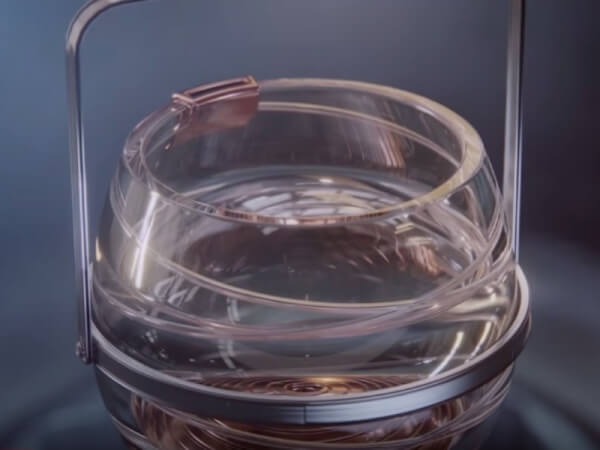
Balentine’s Space Glass is a globe with a sealed top and a screwable base. This glass can be used both on space and Earth. On Earth a weighted rose-gold plated spiral convex base plate is installed to give it a decent heft. And in space, the “weight” comes from a 10 kg (22 lb.) pull magnet that gives its a bit of inertia and anchors it to the table in zero gravity.

The motion of the whisky from thee glass to the mouth of the sipper is explained by James Par, the designer in the project “We are using inertia and the notion that the whisky will stay at rest while the bottle and the glass is moved around the resting liquid. Motion one pulls the whisky into the base of the glass, then motion two is to roll the whisky in your hand and let the heat transfer through the metal base into the liquid itself. Step three involves then moving the glass down prior to moving your nose into the space where the vapors are resting. The final motion is to move the glass upwards to capture the liquid in the base plate and let it enter your mouth.”

Limited Edition, Special Batch Ballantine’s Space Whisky comes with a stronger flavour than whiskeys on earth. This is to combat the nasty flavour of bringing from plastic, not to mention microgravity suppresses taste.

ballantine-s-space-glass

“In space, you do not experience the sense of smell and taste with the same intensity as you do on Earth,” says Sandy Hyslop, Ballantine’s Master Blender. “This meant I had to make the Ballantine’s Space Whisky more heightened in flavor and robust whilst maintaining the Ballantine’s signature style. Astronauts miss the taste of home so crafting a fruitier, stronger, more floral blend is a way they can keep the taste of home with them.”

[adinserter block=”7″]

Author: Technology Blog

Why country kids have better immune system than urban dwellers?

Ever heard of ‘hygiene hypothesis’? This is actually a concept which believes that a lack of exposure to dirt and microbes is the reason why there is a marked increase in childhood allergies and asthma. This is the reason why as compared to urban kids, kids who grow up on farms are less likely to develop allergies and asthma. The basic reason or mechanism responsible for this difference is a bacterial protein called endotoxin. It is found on the surface of many species of common bacteria like Escherichia coli which are more abundant in farm environments, especially dairy farms. Endotoxin is important for damping down overactive immune systems. But there is one more thing that one needs to benefit from this bacterial protein, and that is, a person’s genetic make-up.

Lead-Spectacular-Immunity-i

A new experiment which was conducted on mice suggests that one of our own enzymes, A20, is also essential for protecting against allergies. Those who lack this enzyme don’t benefit from endotoxin exposure. The enzyme A20 is activated in newborn babies when they come in contact with benign bacteria in the birth canal and this is the same enzyme that teaches a baby’s body to not to overreact to harmless microbes. That is the reason why, children who have genetic mutations disrupt the functioning of A20 and hence are more susceptible to having asthma and allergies.

In order to test this fact, Bart Lambrecht of Ghent University in Belgium and his team, with the help of an experiment, tested the sensitivity of two groups of mice to house dust mites (which is a common source of allergies in both humans and mice). While one group of mice was normal other was genetically engineered to lack the enzyme A20. They found that normal mice had no allergic responses to the mites, although normal mice from a control group that were not exposed to endotoxin did have allergies. However, endotoxin exposure did not stop mice lacking the A20 enzyme from becoming allergic to mites. This experiment threw light on the fact that both the bacterial protein and the enzyme are needed to ensure the immune system did not overreact. When the same team continued their study with human lung cells, they found that A20 was also less active is adults suffering from asthma.

Based on this study, Erika von Mutius of the Ludwig Maximilian University in Munich, Germany, a leading proponent of the hygiene hypothesis said about the study: “It’s important because it shows that endotoxin can’t work on its own.” But William Parker at Duke University Medical Centre in Durham, North Carolina doesn’t extend his support to this theory. Instead he opines: “The virtually complete loss of contact with organisms such as intestinal worms that don’t produce endotoxin is known to be an important contributor to the over-inflammatory state of Western immune systems.”

140423170905_1_900x600

But one thing is for sure, getting too paranoiac about hygiene isn’t a good thing for your immune system.

[adinserter block=”7″]

Author: Technology Blog
Verified by ExactMetrics