Superconductors are an important innovation and are used in variety of things in today’s age. For ex. they are utilised in important technologies like MRI scanners and nuclear fusion reactors. But the greatest limitation associated with superconductors is that most of the superconductors work at temperatures below -234º C (-389º F). With their zero electrical resistance and remarkable magnetic and thermal conductive properties, superconductors have the potential to change the face of numerous technologies if only we could find a way to make them work at room temperature.
Aiming for this, researchers from the Max Planck Institute for Chemistry and the Johannes Gutenberg University Mainz have developed a new record-high-temperature superconductor which starts superconducting at a temperature of -70 º C and at a pressure of 1.5 megabars. Though this is not anywhere near to the room temperature, it still is an achievement, as until now, the best available have been copper oxide ceramics or cuprates that superconduct at -140º C (-220º F) at normal pressure and -109º C (-164º F) at high pressures.
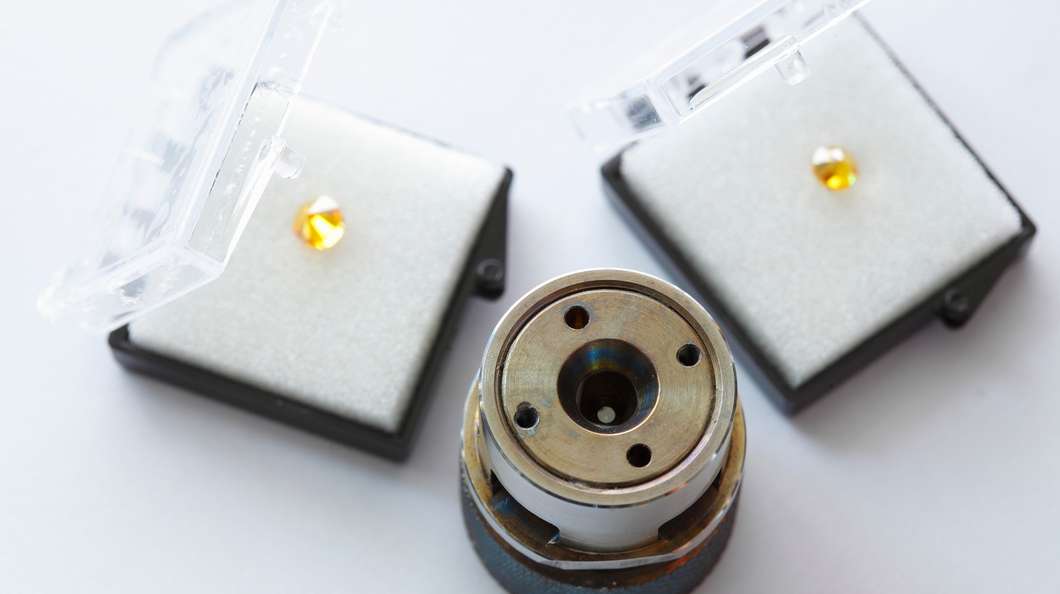
The new conductor developed by the team is hydrogen sulfide (H₂S) – yes the gas with the characteristic smell of rotten eggs. The researchers caused the compound to superconduct by cooling it and subjecting it to high pressures using a diamond anvil (which is a super high-pressure chamber made of two flat-faced diamonds). Super-cooled liquid hydrogen sulfide was placed in a one-cubic centimeter cryogenic cell between the diamonds and pressure was applied. As the diamonds squeezed together, the mixture was subjected to a pressure of 1.5 megabars (which is half the pressure found at the Earth’s core) at which point it started to superconduct at a record new high temperature of -70º C (-94º F). The cryogenic cell was equipped with electrodes to measure electrical resistance.
Another chamber was equipped with magnetic sensors. With the gradually increasing pressure and gradually decreasing temperatures, the two chambers were able to accurately measure the exact point where the changes in magnetism and conductivity showed the transition to superconductivity.
After this success, the team is now trying to better its own record by developing superconductors that can work at even higher temperatures and for that they will need to use some other compound other than hydrogen sulphide, probably hydrogen using twice the pressure used in the case of hydrogen sulphide. Mikhael Eremets, head of the working group said: “There is theoretically no limit for the transition temperature of conventional superconductors, and our experiments give reason to hope that superconductivity can even occur at room temperature.”
[adinserter block=”7″]
Author: Technology Blog