
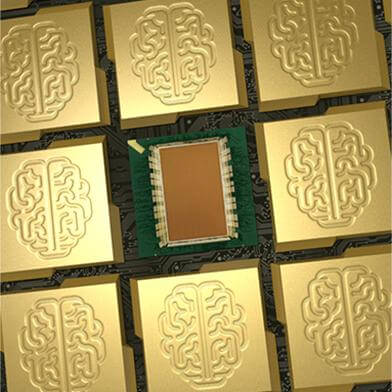
In August 2014, IBM had introduced a chip designed to operate something like the neurons and synapses of the brain. Now the company has moved forward and started developing a next-gen brain-inspired chip that could make mobile devices better and smarter. John Kelly, a senior vice president at IBM who oversees IBM Research and several business units informed: “We’re working on a next generation of the chip, but what’s most important now is commercial partners.
Companies could incorporate this in all sorts of mobile devices, machinery, automotive, you name it.”According to Kelly, if these kinds of chips are added to smartphones, then it would add to the ability of the phone to recognize anything that their owners say and tracking what is going on around them.
The chip as it is called, BM’s TrueNorth chip architecture, was developed through a DARPA-funded program intended to make it possible for mobile computers to run advanced machine intelligence software such as image or speech recognition without having to tap into cloud computing infrastructure, and using very little power. IBM wants A true North Chip to be added to device designs as a “co-processor” that works alongside the conventional processor and never powers down. The chip that was unveiled last August s roughly the size of a postage stamp and has one million silicon “neurons” with 256 million connections between them that are analogous to the synapses that link real neurons. The chip consumes over 1,000 times less power than a conventional processor of a similar size. IBM has demonstrated how its network of neurons can be programmed to perform tasks such as recognizing different vehicles in video footage in real time.
One thing to be noted though is that the TrueNorth chip architecture is very different from those in existing computers, so it requires new approaches to writing software. Also its fake neurons work differently than the software-based artificial neural networks that companies such as Google, Facebook, and Microsoft have recently used to make breakthroughs in speech and image processing using a method known as deep learning. Neurons in IBM’s TrueNorth architecture encode data using electrical on-off “spikes,” whereas the simulated neurons in deep learning don’t. This is the reason why Yann LeCun, who leads Facebook’s AI research lab and helped pioneer deep learning, has expressed skepticism about the practicality of the TrueNorth chip. But Dharmendra Modha, who leads development of IBM’s brain-inspired chips says that his team has begun o create tools that will make it possible to transfer trained-up deep learning neural networks onto a TrueNorth chip. According to Modha, “This chip was envisioned as a substrate onto which a large variety of neural networks can be mapped for real-time, ultra-low energy, ultra-low volume applications.”

Though this unveiling comes as a progressive surprise for smartphone users, IBM is sure going to face stiff competition because Google is already working on ways to crunch down artificial neural networks to run on existing mobile devices and several companies, including leading mobile processor designer Qualcomm, are also working on chip designs that would run existing deep learning software on mobile computers such as phones or in cars. Whatever may be the result of this competition for these companies, one thing is for sure that the users are going to benefit a lot.
[adinserter block=”7″]
Author: Technology Blog

