Astonishing Common Link Found Between Black Holes and Young Stars

Shares

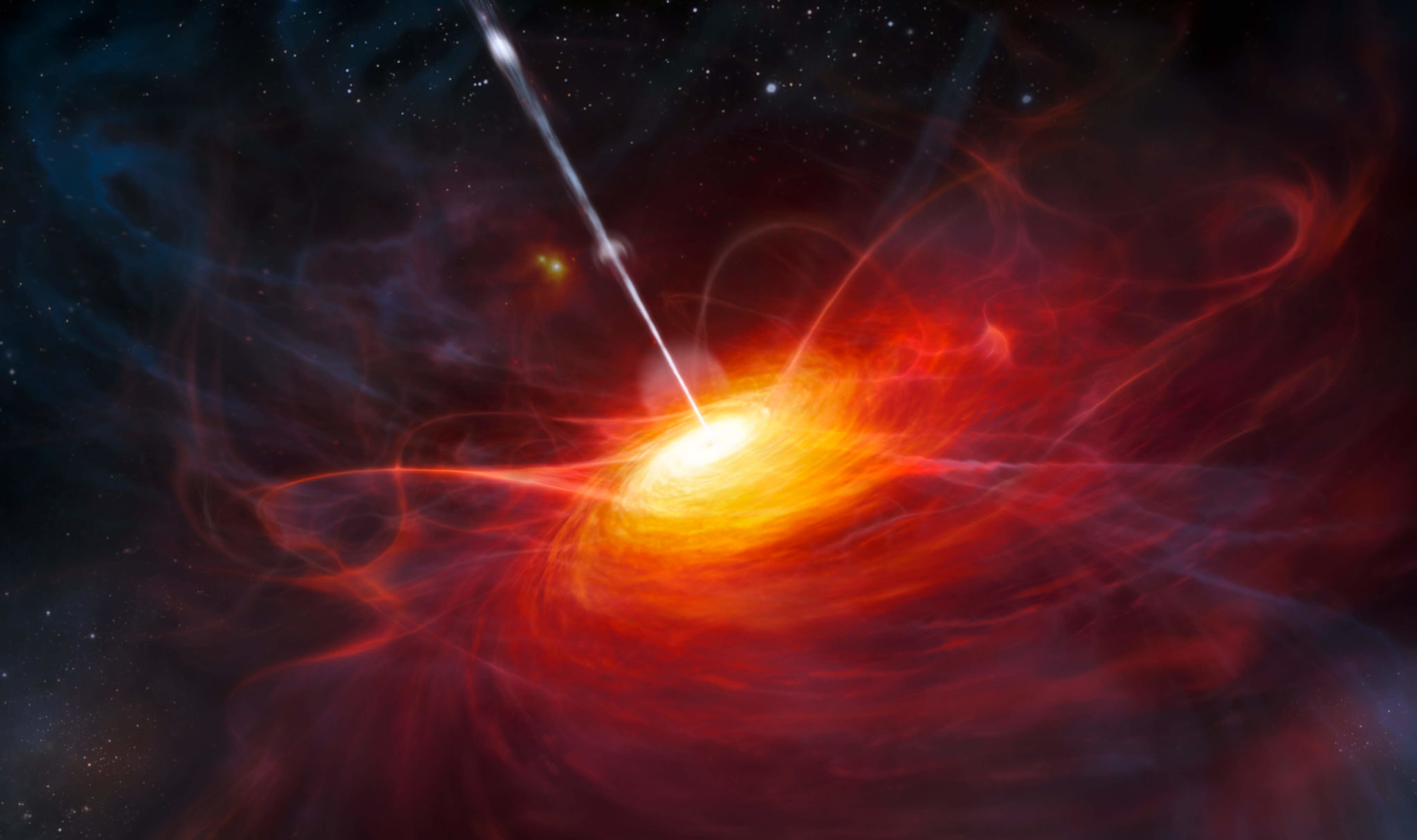
Comparing data from young stars in the latter stages of formation against that from black holes and white dwarfs, the team, which was led by Dr Simon Vaughan from the University of Leicester’s Department of Physics and Astronomy, made an unexpected discovery when it identified similarities in the readings from the discs surrounding black holes and young stars, even though the objects have wildly different properties.
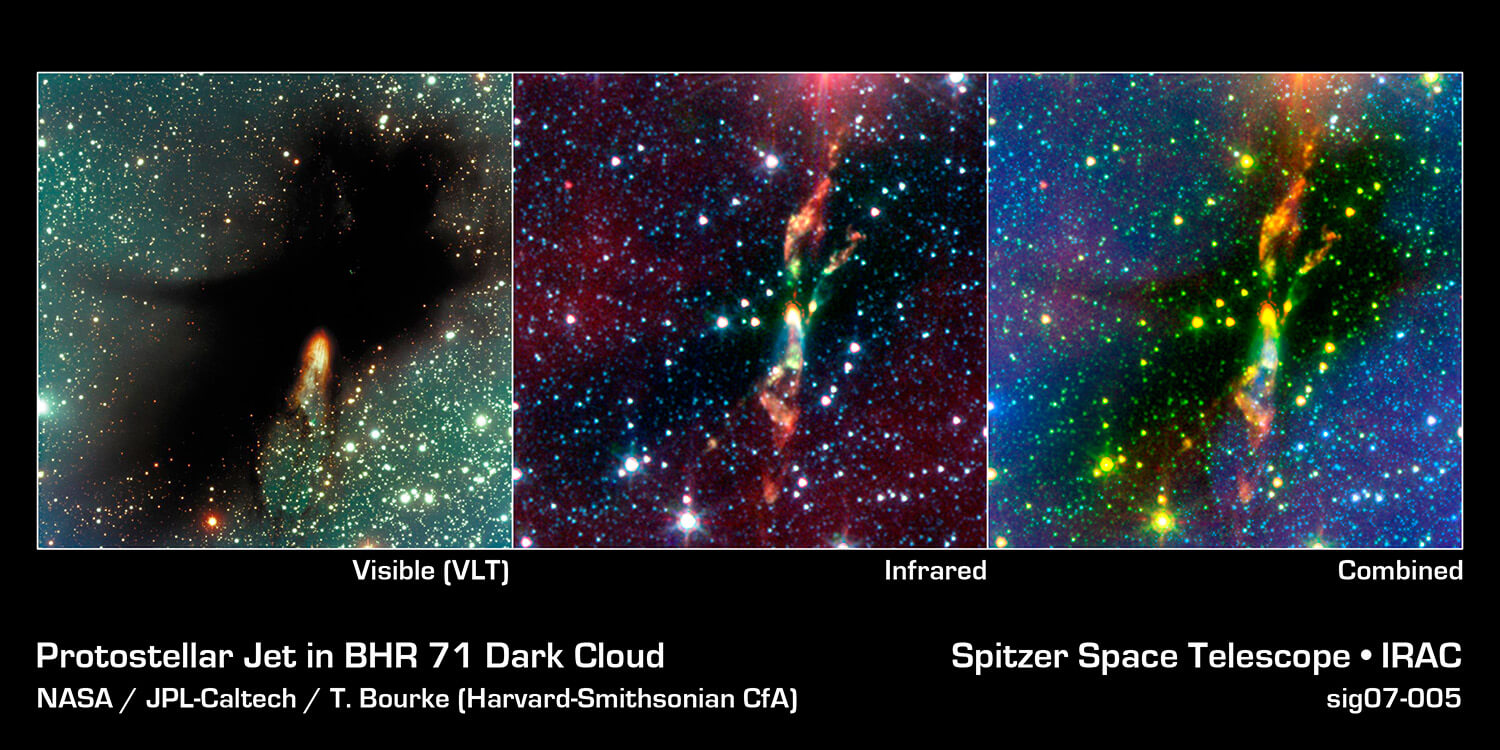
Two rambunctious young stars are destroying their natal dust cloud with powerful jets of radiation, in an infrared image from NASA's Spitzer Space Telescope. The stars are located approximately 600 light-years away in a cosmic cloud called BHR 71. 

In visible light (see below, left), BHR 71 is just a large black structure. The burst of yellow light toward the bottom of the cloud is the only indication that stars might be forming inside. 

In infrared light (see below, right), the baby stars are shown as the bright yellow smudges toward the center. Both of these yellow spots have wisps of green shooting out of them. The green wisps reveal the beginning of a jet. Like a rainbow, the jet begins as green, then transitions to orange, and red toward the end. 

The combined visible-light and infrared composite (above) shows that a young star's powerful jet is responsible for the rupture at the bottom of the dense cloud in the visible-light image. Astronomers know this because burst of light in the visible-light image overlaps exactly with a jet spouting-out of the left star, in the infrared image. 

The jets' changing colors reveals a cooling effect, and may suggest that the young stars are spouting out radiation in regular bursts. The green tints at the beginning of the jet reveal really hot hydrogen gas, the orange shows warm gas, and the reddish wisps at the end represent the coolest gas. 

The fact that gas toward the beginning of the jet is hotter than gas near the middle suggests that the stars must give off regular bursts of energy -- and the material closest to the star is being heated by shockwaves from a recent stellar outburst. Meanwhile, the tints of orange reveal gas that is currently being heated by shockwaves from a previous stellar outburst. By the time these shockwaves reach the end of the jet, they have slowed down so significantly that the gas is only heated a little, and looks red. 


Two rambunctious young stars are destroying their natal dust cloud with powerful jets of radiation.

“The seemingly random fluctuations we see from the black holes and white dwarfs look remarkably similar to those from the young stellar objects,” said Dr Vaughan. “It is only the tempo that changes.”

To explain, the team targeted accretion discs as their object of study as it produced brightness variations around astronomical objects and provided a common ground of study. The instruments put to use were NASA’s Kepler/K2 and ULTRACAM– a superfast camera taking 500 pictures per second in three colours. ESO’s Very Large Telescope and the William Herschel Telescope were also involved in the process.

Thus, the team was able to conclude that the size of the object at the center of the disc, was influencing the speed of flickering in the observed brightness. This proves that the physics of accretion was sound and universally across all planetary bodies.
Black Hole-3

Findings of this have been published in Science Advances and have been funded in part by the Science and Technology Facilities Council with contribution from the Universities of Leicester, Southampton, Warwick and Sheffield to the study.

[adinserter block=”7″]

Author: Technology Blog

Shares
Verified by ExactMetrics