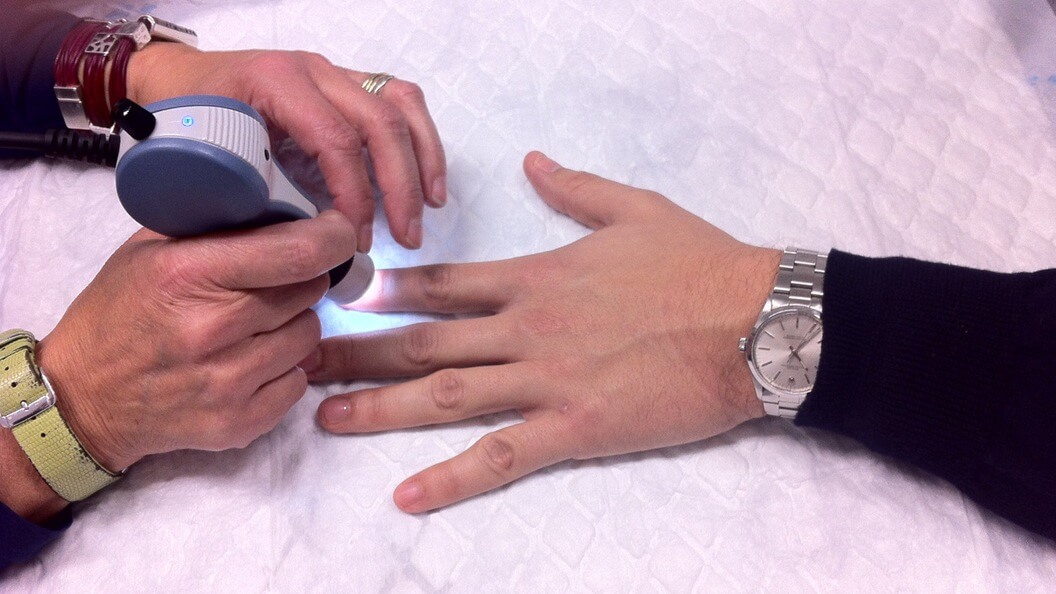
White blood cells are extremely important for the overall immunity of our body. And these become even more important when chemotherapy receiving patients are under question. The chemotherapy can lead to suppression of the immune system, a decline in white blood cells and hence giving rise to the possibility of infections and other complications. As a prevalent method, the patients undergo regular blood tests so that the doctors can keep an eye on things. But blood tests are unpleasant tasks when conducted at short intervals.

In order to make this test less invasive, Carlos Castro, biomedical engineer at MIT and his team, which includes researchers from Boston University, the Universidad Politécnica de Madrid and the Spanish National Cancer Research Centre (CNIO), have developed a prototype for a device called leukometer. This new testing device can simply be stuck onto a fingertip with the ability to tally up white blood cells through the skin in real time.
In real life situations it is really not that easy and realistic to be carrying out blood tests on chemotherapy patients every hour, while it doesn’t always take long for things to take a turn for the worse, so the greatest advantage that this device comes with is its immediacy. If a decrease in white blood cell count can be picked up early on, drugs can be prescribed to return it to safe levels and allow the body to better fight off infection. Additionally, if a patient is recovering from immune-suppression faster than expected, medication could be adjusted accordingly to cut the overall recovery time.
How does a leukometer work? It works like a pulse oximeter. The device projects light and gathers images of capillaries just under the surface using an array of LEDs and a small lens. As light at certain frequencies is absorbed by the blood’s haemoglobin (a protein that carries oxygen around the body), but not by the white cells, they show up as small transparent particles moving through the capillary. The device then uses algorithms to analyze these images and give an estimation of the white blood cell concentration in the blood. The best part is that, all these things can be done by this portable user-friendly device that could help patients monitor their own white blood cells count even at their homes. This can turn to be more advantageous for in rural areas and developing countries.

Carlos Castro opines: “It would also be possible to perform measurements on a continuous basis, opening up treatment options that were previously not possible.” The researchers hope that if they can gather enough funding, a beta product will become available for testing in 2017, with a market ready product to follow in 2019.
[adinserter block=”7″]
Author: Technology Blog

