Slow-motion film and wires
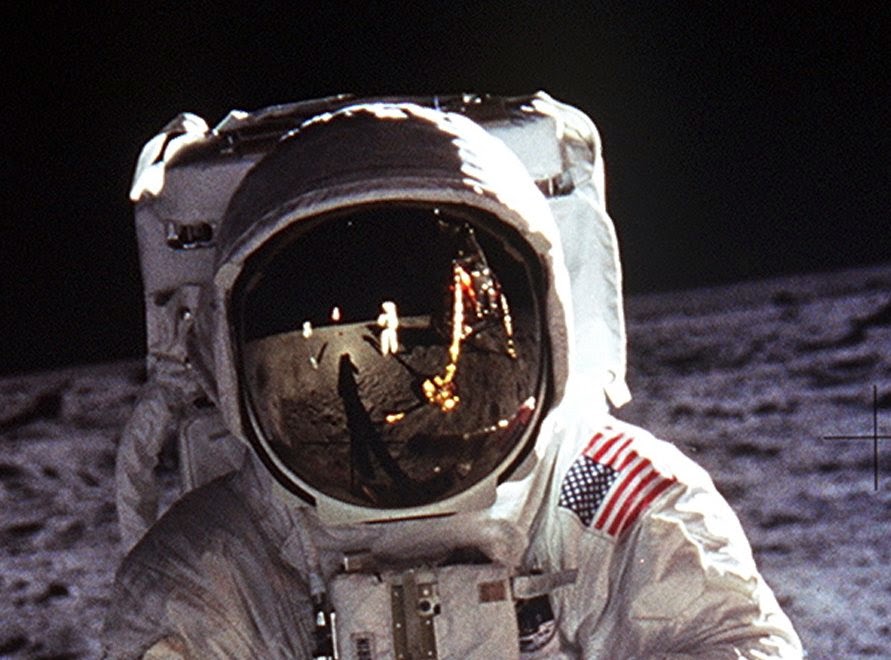
This was the easiest thing to do. Doubters even used wires and pulleys to get elevated jumps and walk. They even filmed them and slowed the video down to give the total video a Moonwalking look. Here, the dust came into NASA’s rescue. The video clearly shows that dusts are kicked up during the walk and that falls right back without forming cloud like it forms on Earth because of the atmosphere. NASA would have had to build an entire studio devoid of air by sucking out all the air. This is a difficult job to do even by today’s standards.
Lack of Impact Crater
There should be a blast crater underneath the lunar module to mark its landing. On any video footage or photograph of the landings, no crater is visible, almost as if the module was gently placed there. Even though the surface of the moon was covered by lunar dust the same was not disturbed much. 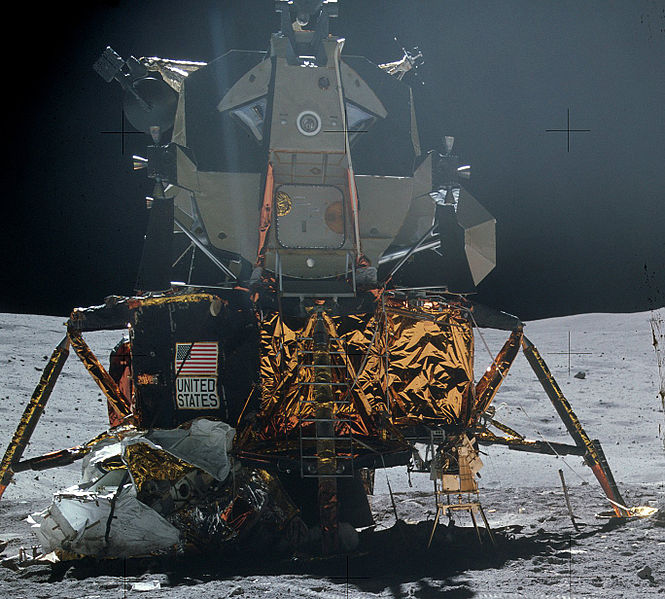 NASA counters that the module required significantly less thrust in the low-gravity conditions than it would have done on Earth. Apart from that the surface of the moon is rocky and hence no blast crater will be there – this is the same reason why an airplane doesn’t leave a crater when it touches down on a concrete airstrip.
The Van Allen Radiation Belt
To land on the moon, astronauts had to pass through the Van Allen radiation belt. The belt is held in place by Earth’s magnetic field and stays perpetually in the same place. Theory says that such huge levels of radiation would have fried the astronauts while going to the moon, despite the layers of aluminum coating the interior and exterior of the spaceship. NASA has countered this argument by emphasizing the short amount of time it took the astronauts to traverse the belt – meaning they received only very small doses of radiation. But one interesting point is that most of the astronauts crossing the Van Allen Belt showed radiation related complications at a later stage.
The Unexplained Object
In the released moon landing photograph a mysterious object is noticed in the reflection of an astronaut’s helmet from the Apollo 12 mission. The object appears to be hanging at the top leading some to speculation that it is an overhead spotlight generally found in film studios. 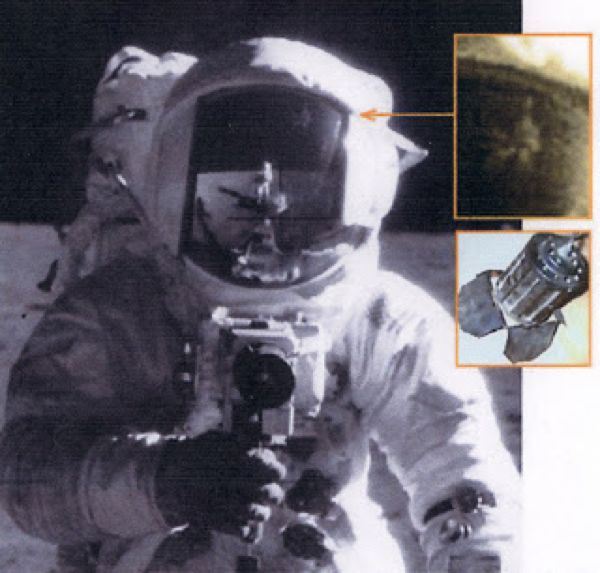 The only explanation received in this regard is to blame the poor quality of the photographs. As on date the presence of this object still remains totally unexplained.
The Layered Cross-hairs
Astronauts used these cross hairs to get aid with scaling and direction. These are imprinted over the top of all photographs. Some of the images, cross-hairs were discovered behind objects, which indicated a doctored image. This has happened in many photographs including the American flag in one picture and the lunar rover in another. While this is not explained properly by NASA it doesn’t serve the purpose of non-believers too. If at all NASA has to doctor the photographs and cross hairs don’t facilitate that why NASA will use the cross-hairs in the first place in a well designed mission/ Fake scenario.  The Duplicate Backdrop
The two photos from the Apollo 15 mission shows the same backdrop despite NASA terming the locations several miles apart. One strangest thing is that lunar module is present in one of this backdrop while it is totally absent from the other. Probably the film director used the same backdrop when filming different scenes of their moon landing videos? 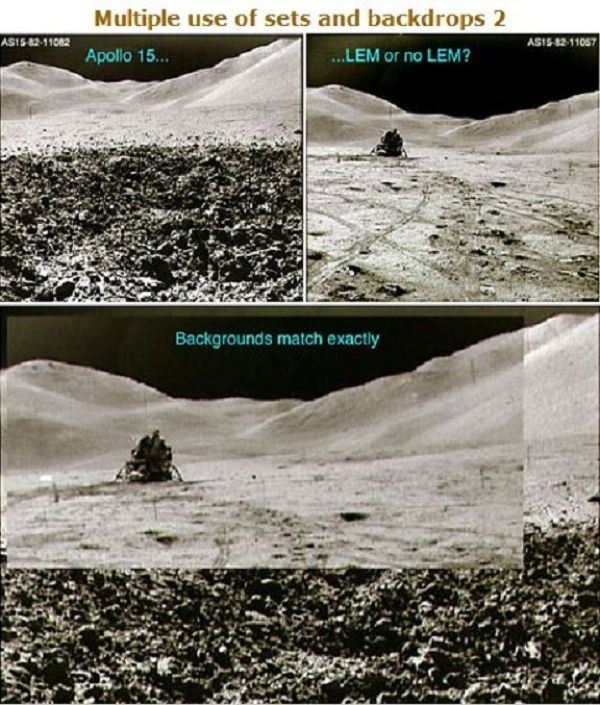 NASA answered that since the moon is much smaller than Earth and so horizons can appear significantly closer to the human eye. Lack of atmosphere further makes it nearer. This doesn’t necessarily explain the full thing.
Moon Landings: Some Independent supporters of NASA:
The Japan Aerospace Exploration Agency (JAXA) launched on September 14, 2007 (JST), orbited the Moon at about 100 kilometers (62 mi) altitude. In May 2008, JAXA reported detecting the “halo” generated by the Apollo 15 Lunar Module engine exhaust from a Terrain Camera image. A three-dimensional reconstructed photo also matched the terrain of an Apollo 15 photo taken from the surface. On September 1, 2009, India‘s lunar mission Chandrayaan-1 took photos of the Apollo 15 landing site and tracks of the lunar rovers. The Indian Space Research Organization launched their unmanned lunar probe on September 8, 2008 (IST), from Satish Dhawan Space Centre. The photos were taken by a hyperspectral camera fitted as part of the mission’s image payload. China‘s second lunar probe, Chang’e 2, which was launched in 2010, can photograph the lunar surface with a resolution of up to 1.3 meters (4.3 ft). It also spotted traces of the Apollo landings Disclaimer: This article is generated from various documents available in the public domain. This article is not specifically to support or discard Lunar landing incident. Rather, this article is generated to ignite the scientific mind inside you so that you independently evaluate the scientific theories behind all this and form your own hypothesis. In the meanwhile, we celebrate the so-called biggest achievement of the humankind!
Author: Technology and Beyond
[adinserter block=”7″]

