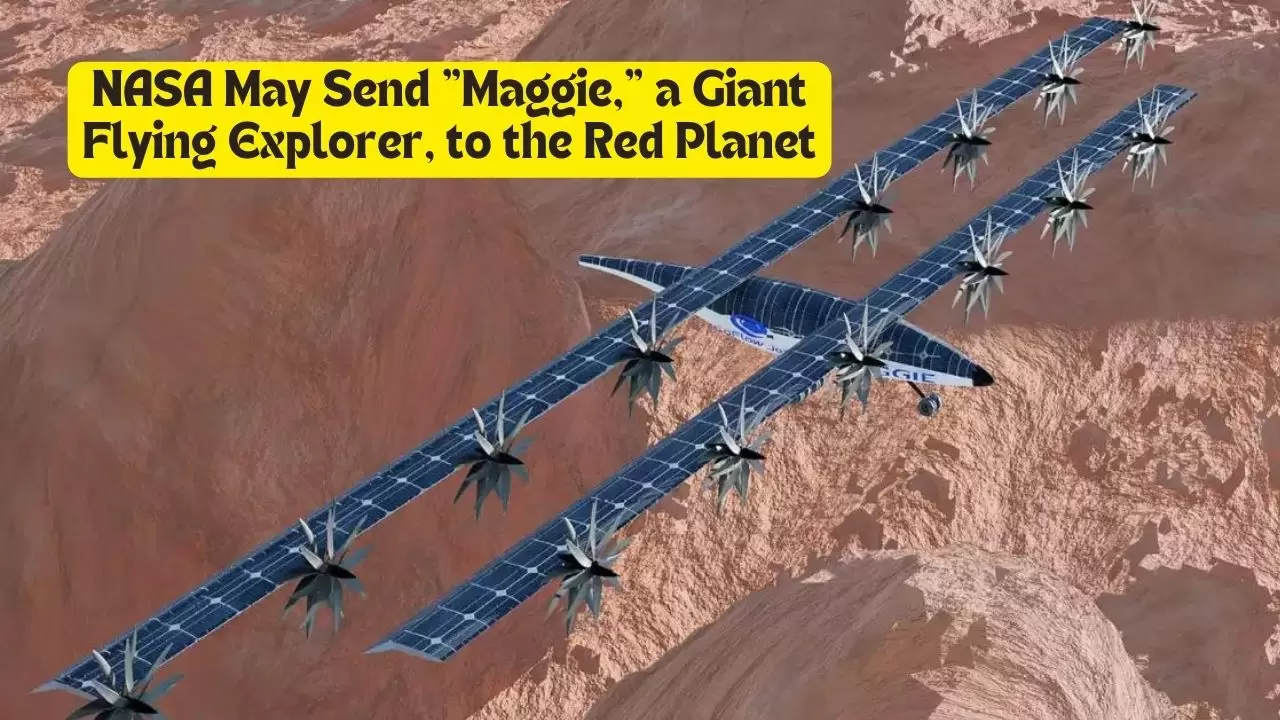
Mars Gets Wings: NASA Considers Sending “Maggie,” a Giant Flying Explorer, to the Red Planet
Hot on the heels of Ingenuity’s historic helicopter flights on Mars, NASA is eyeing the skies with its next ambitious Martian mission: the Mars Aerial and Ground Intelligent Explorer (Maggie). This proposed behemoth wouldn’t be another nimble chopper, but a colossal fixed-wing plane, dwarfing its predecessor in both size and scope.
Dubbed “Maggie” for short, this solar-powered aircraft wouldn’t just soar through the thin Martian air; it would be designed to revolutionize our understanding of the Red Planet. Its impressive wingspan, stretching potentially 32 meters, would allow it to traverse vast distances, covering up to 179 kilometers on a single charge. And Maggie isn’t built for fleeting expeditions; its extended-range fuel cells could keep it cruising for over 16,000 kilometers throughout a Martian year, roughly two Earth years.
But what would Maggie be exploring in its cosmic voyages? Unlike its helicopter cousin, focused on short, targeted flights, Maggie aims to paint a panoramic picture of Mars. Its mission will revolve around three key objectives:
1. Unveiling the Secrets of Martian Water: Water, the elixir of life, is one of Mars’ biggest mysteries. Maggie will carry sophisticated instruments to detect evidence of past and present water, searching for hidden deposits in polar ice caps and subterranean reservoirs.
2. Decoding the Martian Magnetic Field: Mars’ weak magnetic field leaves it exposed to harmful solar radiation, a major hurdle for future human missions. Maggie will map the Martian magnetic field in unprecedented detail, helping us understand how it works and its impact on the planet’s environment.
3. Chasing the Methane Puzzle: Methane, a potential indicator of biological activity, has been detected on Mars, sparking excitement about possible life forms. Maggie will meticulously measure methane concentrations across the planet, providing crucial clues to this tantalizing mystery.
Sending a giant plane to Mars presents unprecedented challenges. The thin atmosphere requires innovative designs for efficient lift and propulsion. Maggie’s landing system will need to be robust enough to handle the Martian terrain, and its solar panels must withstand the harsh dust storms that rage across the red landscape.
But if these hurdles are overcome, Maggie could change the game for Martian exploration. Its ability to cover vast distances, map large areas, and carry sophisticated instruments makes it a powerful tool for understanding the Red Planet like never before. The tiny chopper Ingenuity proved that flight is possible on Mars; Maggie could show us just how far we can soar.
While still in the conceptual stage, Maggie represents a bold step forward in our quest to unlock the secrets of Mars. As NASA engineers refine the design and technology, one thing is clear: the Martian skies might soon welcome a new kind of explorer, one with wings as wide as our ambitions.

