Electromagnetic suspension:
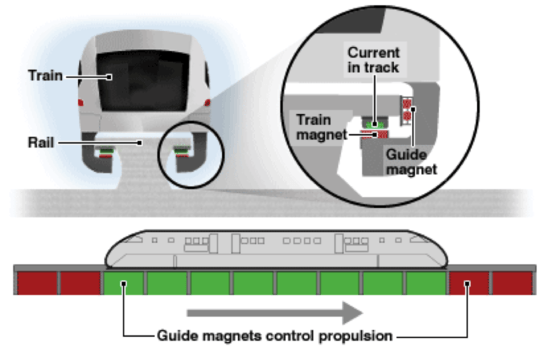
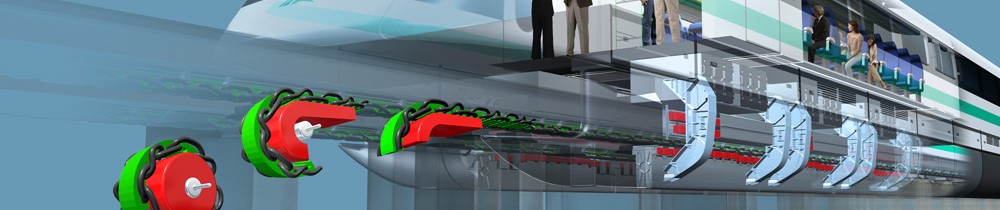
It is the typical Magnetic property that opposite poles attract each other and similar poles repel each other. This forms the basics of electromagnetic propulsion. Electromagnets, property wise, are similar to other magnets but unlike natural magnets they acquire magnetic property by application of electrical power. They attract metal object but, the magnetic pull remains temporary and over the duration of applied electrical power. It works by simple rule. An electromagnet can be created by connecting a copper wire to the positive and negative ends of an AA, C or D-cell battery which creates a small magnetic field. If one disconnects either end of the wire from the battery, the magnetic field is taken away. The magnetic field created this way forms the idea of a maglev train rail system. There are three components to this system : a electrical power source, metal coils lining on a guideway or track and large magnets attached to the underside of the train. 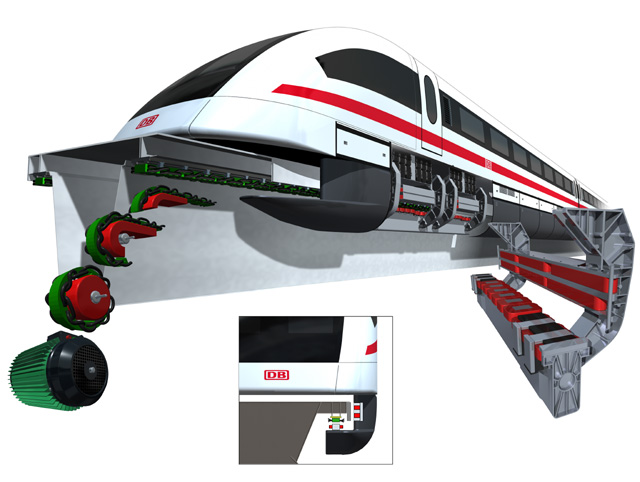 The big difference between a maglev train and a conventional train is that maglev trains do not have an engine. It does not use fossil fuel to power itself . Rather, it runs because of magnetic field. The magnetized coil running along the track is called a ‘guideway’ and is responsible to repel the large magnets on the train’s under carriage. This allows the train to levitate between 0.39 to 0.93 inches ( 1 to 10 cm) above the guideway. Once the train gets levitate, power is supplied to the coils within the guideway walls to create a special regime of magnetic fields. This helps to create requisite pull and push to glide the train along the guideway. The electric current supplied to the coils of the guideway wall is altered continuously to change the polarity of the magnetized coil. This change in polarity results to pull the vehicle forward. The magnetic field behind the train is kept at high level to provide more forward thrust.
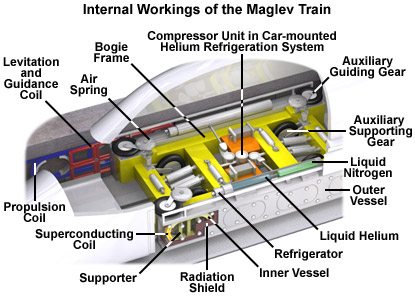 Maglev train eliminate friction as it floats on the air. This lack of friction and aerodynamic design of these trains allow them to reach up to the speed of 310 mph or 500 kph. Developers say that maglev trains will eventually connect cities that are 1,000 miles apart. With 310 mph speed. With this High Speed Train one can reach in two hours from Paris to Rome.